Chris Watson

birdwatching

Review: Birds of New Guinea (2nd Edition)

ReviewChris Watson

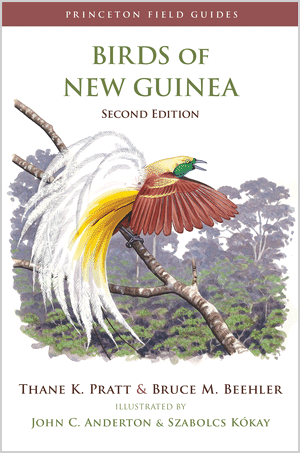
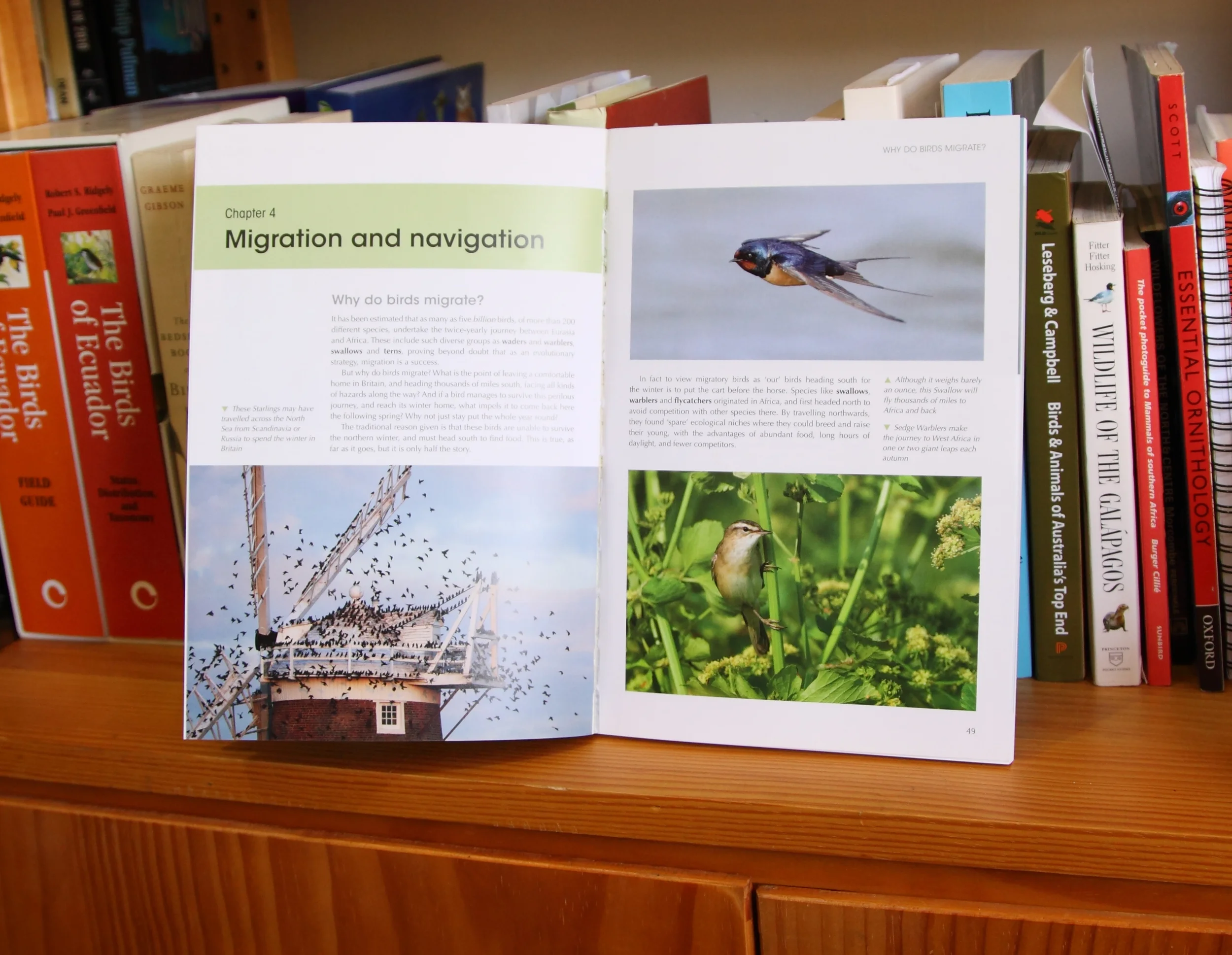
Birds of New Guinea 2nd Edition by Thane K. Pratt and Bruce M. Beehler.

“New Guinea is central to this story: the island is not so much a neighbour of Australia as a core part of it, biologically speaking. To include Tasmania but not New Guinea is to let nationalism distort ecological thinking. Whenever sea levels have fallen New Guinea has joined the mainland for longer than Tasmania has, because the water that separates it is shallower. The line between northern Australian savanna and rainforest is more limiting to birds than is the Torres Strait. New Guinea’s birds are part of the Australian bird fauna.” Tim Low in Where Song Began: Australia's birds and how they changed the world, Chapter 4 - New Guinea: Australia's Northern Province.

New Guinea is weird - so close but so distant.

A perfunctory scan through a list of its fauna reveals tree kangaroos and hare-wallabies, dasyurids and monotremes: all the sorts of animals that are most obviously associated with Australia. The little Rakali Hydromys chrysogaster, can be found from Tasmania right up through Australia's mainland and through all but the highest parts of New Guinea. Even New Guinea’s most iconic animals, the birds-of-paradise, are also represented in Australia by four species: three riflebirds and the Trumpet Manucode.

As birders, we’re used to drawing arbitrary lines on maps for the purposes of delineating our lists but, at least from a biological perspective, none of these lines is more arbitrary than the separation of New Guinea’s fauna from Australia’s. This is perhaps one of the major themes of Tim Low’s sweeping assessment of song bird evolution in Where Song Began.

Like many birders, New Guinea is high on my list of places I yearn to visit. Also, I suspect, like many Australian birders, I barely gave New Guinea a moment’s thought before reading Low’s book. Despite being so close to Australia – I’ve flown over it countless times on my way to near-antipodal destinations – New Guinea is, by most accounts, still a challenging place to visit.

Gradually though, this reputation is changing and books like this 2nd edition of Birds of New Guinea are an important part of the process. Papua New Guinea, and even parts of Indonesian-occupied West Papua, is now a fixture on the itineraries of most of the major wildlife touring outfits. There is a string of reputable wildlife lodges across some of the more important habitat areas. As well as infrastructure and services though, the availability of accurate field guides is an important step in making wildlife tourism more attractive. And, as we’ve seen in many other developing parts of the world, when tourism revenue is tied to biodiversity it can result in benefits for research, conservation, local economies and, ultimately, greatly improve our understanding of the birds of that region.

For an area with such a famously diverse avifauna, New Guinea has been served by a limited, though quite high-quality, range of books on the topic. Before the release of this 2nd edition, the 1st edition of Birds of New Guinea was thirty years old and Birds of New Guinea and the Bismarck Archipelago by Coates and Peckover, while an impressive achievement as a photograph record of such a diverse and often secretive bird fauna, was a long way short of comprehensive (it covers 444 species).

Birds of New Guinea 2nd edition covers all 780 bird species for the first time and includes full-colour plates for all (some plates in the 1st edition were black and white). For a book treating such a number of species the layout is smart. The plates fill the first 260 pages and are accompanied by brief species accounts and range maps on the facing page. Maps were critically lacking in the 1st edition. The remaining half of the book is taken up with more detailed family and species accounts including range, habitat and appearance notes as well as quite detailed commentary on the vocalisations including, for selected species, stylised spectrograms giving a visual aid to the cadence and pitch variation of the bird’s song.

The plates are a bit of a mixed bag. They range from superb to serviceable but are competently executed throughout. They’ve been supplied by four different artists so there is bound to be some variation and, unsurprisingly, the plates depicting the birds-of-paradise are probably the finest in the book.

Considering the close affinities between Australian and New Guinean birds, Birds of New Guinea 2nd edition is a useful reference for Australian birders to have available. For northern Australian birders ever-hopeful for vagrant birds visiting from our northern neighbour, it’ll be indispensable.  For the introductory sections alone, describing the natural history and geography of the island, it is worth the asking price; there is so much to learn here.

We can hope that it won’t be so long before another revision, but with this edition being so expertly finished, Birds of New Guinea 2nd edition looks capable of seeing us through another 30 years if necessary.

CBW

Buy it from Andrew Isles.

If you enjoy reading The Grip, click HERE or look for the button in the right sidebar to become a supporter.

The Night Parrot: A bird in the hand but how many left in the bush?

Opinion, Citizen Science, ResearchChris Watson

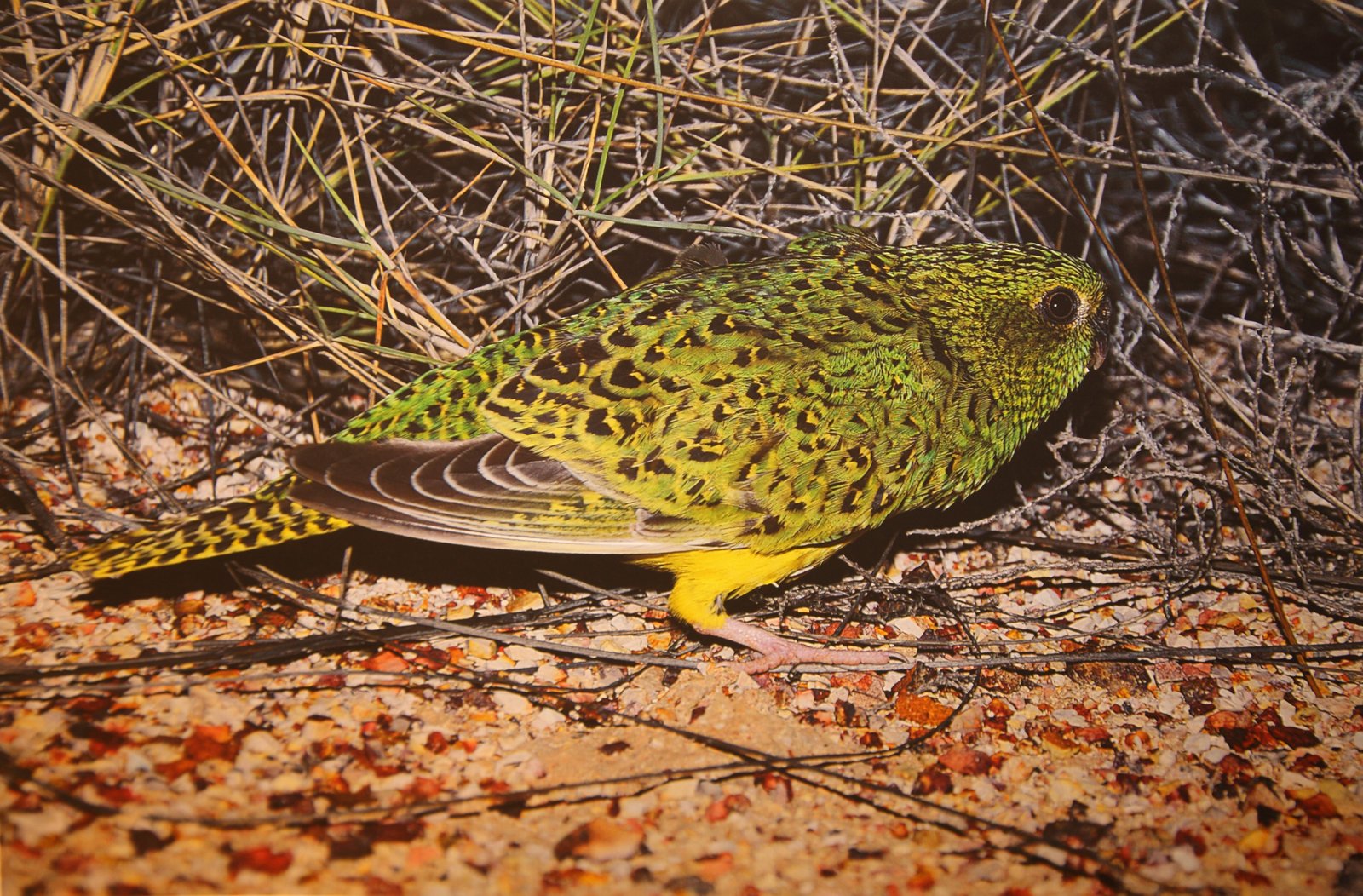
Night Parrot Pezoporus occidentalis. by kind permission John Young

In 2005 the Cornell Laboratory of Ornithology published its report of the rediscovery of the iconic Ivory-billed Woodpecker Campephilus principalis, rightful claimant to the title of Grail Bird in US ornithology, and presumed extinct since the 1940s. Exhaustive searches of the Cache and White River systems ultimately produced no further evidence and the "rediscovery" is now widely discredited. The similarly elusive Pink-headed Duck Rhodonessa caryophyllacea, may have been sighted in 1988 on the banks of the Brahmaputra (north-eastern India), by Rory Nugent and Shankar Barua - but we can't be sure. The only known photographs of this species alive are from 1925, and the last specimen was shot in India, in 1935. That much of its habitat lies in remote and poorly surveyed parts of Myanmar is a cause for some optimism and its official classification is Critically Endangered, rather than Extinct. But despite a few reports in the last decade, no evidence of its continued existence has ever been produced. In Australia there still remains one living species that, despite being seen and identified by a few determined birders in its difficult north Queensland home in most years, no photographs of a live specimen have ever been produced* - the Buff-breasted Button-quail Turnix olivii.


The world of birds offers many tantalising mysteries to the intrepid adventurer, but pre-eminent among these has always been the Night Parrot Pezoporus occidentalis - a bird tailor-made for controversy and a species which eluded some of the best field ornithologists in the land for a century. A fair dinkum enigma.


The Night Parrot has laboured under many unfortunate monikers; The Loch Ness Monster of birds, The Tasmanian Tiger of birds, The Holy Grail of Birding, The Fat Budgie, or simply, The Ex-Parrot. If you have been following this story however, you will understand that none of these epithets is fitting, if indeed they ever were. While it will almost certainly remain the Holy Grail for some birdos, some of the mystery surrounding the species was banished forever on Big Wednesday. On the 3rd of July 2013, Australian naturalist John Young revealed at an exclusive, invitation only, private function at the Queensland Museum, irrefutable evidence of the species' continued existence at an undisclosed site in the southwest of the state. Marking the culmination of many years of fieldwork and study including 17000 hours at the one site, John Young, with his mate John Stewart holding the torch, managed to capture high quality digital photographs and 17 seconds of video footage of the species, very much alive, in its native habitat of thick spinifex. Only a few photographs were displayed at the strict no-cameras and no-recorders event, and only 6 seconds of the video footage, but the images have been studied around the world and there is no doubt that they're the real deal. John’s stunning images graced the cover of our national bird magazine, Australian Birdlife, and one of them now graces my wall.


A more demure and heavily-watermarked image appeared on the front page of The Weekend Australian accompanying an article by Tony Koch on June 29th 2013. The online edition of that story can be found here.


Since this first appearance in the media, John’s story has done the rounds and an online search will take you to any number of articles that have summarised the find with wildly varying degrees of accuracy. Among the coverage that has been less burdened by truth, rectitude, and research, I got a particular chuckle out of the following that claims the species can be "commonly found" while still being one of the "world's most mysterious birds" in the same sentence. It also credits the discovery to a "Mr John King", (there's been a second discovery?) and accompanies the news with a stolen picture of a Ground Parrot Pezoporus wallicus, here.


Suffice to say that the coverage in the media has been patchy at best, and is a nice reflection of a conversation that is gaining momentum across the country about the loss of good science journalists. Other reports unnecessarily perpetuated some old myths and even started up a few new ones. Chief among these is the fallacy that the species was presumed extinct. Very few, if any, people with any interest in the subject thought that the species had already gone extinct. This would be a difficult assumption to maintain in the face of much evidence to the contrary. Although the last specimen was actively acquired in 1912, two dead specimens were found more recently within 200 kilometres of each other in western Queensland; one in 1990 and the second in 2006. Dead birds have to come from living populations. 


Other news reports claimed this to be the first time the bird was seen alive in over 100 years. This is another clear exaggeration - the excitement in the ornithological community was over the first photographs of a live specimen, ever. It would be unusual for more than a few years to pass without one or two reports emanating from the outback of observations of the species. While many of these reports have common and questionable characteristics (they occur in poor light, observers had fleeting glimpses, observers were not bird experts or even practised bird-watchers) and are rightly treated with some skepticism, not all of them are likely to be apocryphal or mistaken. Some observations have been by highly respected, experienced field ornithologists, and some have been well-documented and ratified by peer review as recently as 2005 in Western Australia.  Add to this the fact that anyone seeking or claiming to have seen the Night Parrot has often been treated to raised eyebrows and some level of derision with labels like "Yowie Hunter" sometimes thrown around. In such an atmosphere it's easy to understand that there are probably other sightings that have gone unreported due to the fear of ridicule or the loss of professional credibility. Furthermore, if we look at other examples of species whose former range covered much of the continent inside the 280 millimetre isohyet, Greater Bilby Macrotis lagotis, say, it's possible that there remain remnant populations at widely separated locations - it's unlikely that John discovered the last of the Night Parrots. He just happened to be the only one with the talent and the grit, and let’s be fair perhaps a bit of good luck, to find them. At the time of writing he remains the only living person to have found a population of Night Parrots.

John’s photographs are spectacular, and provide satisfying evidence of the bird's continuing existence, but they don't really provide any advantage to other people looking for the species; we already know what the bird looks like and we have 24 museum specimens to study at close quarters.


Make no mistake - it is a recording of the Night Parrot's call that professional ecologists have been really excited about. This will provide an immeasurable advantage in any attempts to locate populations of this bird elsewhere. As, by John's own accounts, the bird is so difficult to observe, knowing what it sounds like will be the crucial tool for professional scientists hoping to identify remnant populations in other locations, and prevent the destruction or disturbance of their habitat. For professional ecologists working on the site of a development, the key to halting or modifying the extent of habitat disturbance or destruction comes down to proving the presence of listed species. So seen through the eyes of an ecologist conducting pre-clearance surveys in remote areas with undisturbed tracts of potential Night Parrot habitat about to be flattened, the importance of this recording is difficult to overstate. As it stands, field ecologists have Buckley's chance of actually observing a bird, and even less chance of being able to authenticate the sighting unless they also manage to photograph the bird. However, if they know what to listen for, or better yet, have an automated recording device allowing them to screen both audibly and visually for the bird's vocalisation after several weeks or months of constant recording, the chance of verifying the species' presence, and stopping land clearing, heads into the realms of practicality.


Withholding such a crucial tool for establishing the species’ presence hampers attempts to locate the birds in other locations. John kept his recordings of the bird’s call to himself in the weeks and months following his announcement and I was too hasty to be critical of him for this at the time. I’ve since got to know John quite well and have come to understand the immense pressure that he must have been under at the time. He had a lot of different interests competing for his attention and his response, and in hindsight perhaps the best thing he could have done, was to keep the welfare of the bird in the front of his mind and keep the recordings under wraps. Once the dust had settled he had the unenviable task of trying to work out what to do next and the rest, to coin a phrase, is history.

I know nothing of the supposed acrimony surrounding John’s parting of company with the current research team at Pullen Pullen Reserve so there is no point engaging in baseless speculation. But the availability of acoustic data remains a pertinent and pressing question three years on. Why can’t it be released? Bush Heritage, or people operating on their property, are in possession of an unprecedented library of calls. Just a few call recordings is all it would take for ecologists operating in potential Night Parrot habitat elsewhere to positively confirm the species’ presence. The species range once took in most of inland Australia so they might not necessarily occur in habitat identical to that at Pullen Pullen Reserve; we should be looking and listening far and wide. Just a few individuals and organisations have been in possession of this critical piece of knowledge for some years now, while potential Night Parrot habitat has been going under the dozer blade for developments of all types across the outback. Bush Heritage and the team they have researching the Night Parrot at Pullen Pullen deserve full credit for the work that they are doing. It will be a landmark publication when the findings of their study finally see the light of day but we have no way of knowing how far off that publication will be. Their lack of engagement has some in the conservation community pessimistic that the call will ever be released.
Courtesy: social media commentators


A common cry from supporters of the current status quo, in rebuttal to those requesting the release of call recordings has been, "go and record it yourself". Apart from being the sort of argument I'd expect from a petulant eight year old, this demonstrates a particular backwardness and a deep misapprehension of the process of scientific investigation. I'm not going to be so naive as to suggest that the scientific community is free from spats, rifts, and schisms - there are even a few famous examples of what might be termed long-running feuds. By and large though, these are intellectually driven and rarely internecine. Scientific competition and rivalries drive opposing teams to greater rigour in their experimentation and investigation to disprove the counter position - thereby driving the process of understanding. We all benefit from the hard graft of our predecessors, hence the much-quoted saying attributed to Sir Isaac Newton of those who achieve greatness doing so only by, "standing on the shoulders of giants".

The time has well and truly come, for those in possession of Night Parrot call recordings and findings about the species’ ecology to put their cards on the table, hoist any critics to their shoulders and let them see what else they can see. 


At the time of John Young’s initial rediscovery of the Pullen Pullen population, the one thing that there was little disagreement on, across the board, was that it would probably be best if the location of the population remained tightly controlled. There was sound reasoning for allowing a small team of researchers in to commence a detailed study. Beyond that though, even hardcore twitchers, rabid birders, and fanatical photographers were in rare, if slightly grudging agreement - the site should remain protected for as long as possible. This, despite the fact that it's arguable the site was adequately protected already. If it was anywhere within any sensible interpretation of John's description of "southwest Queensland" then it had the benefit of being remote, probably not accessible on sealed roads, and probably difficult to get to from any major centre with anything less than a fairly costly field expedition. In an area as remote as that, any such expedition could be fairly sure of attracting attention before they'd got within a stone's throw of the site. 


Once again though, the long-standing fallacy of the "twitching hordes" was wheeled out for another tired lap around the forums and social media sites. It’s a myth; albeit a persistent one. Of all the numerous threats facing Night Parrots, the occasional unethical happy-snapper is the least of them. The slightest acquaintance with other cases where the binocular-wielding bogeymen of the twitching hordes have been invoked, shows it to be pure fantasy.

Courtesy: social media commentators

The excitement of Princess Parrots Polytelis alexandrae, present west of Alice Springs in 2010, attracted fewer than 150 people to travel out to see them. Of these, more than half were the families and friends of locals connected to authorities charged with the protection of the site - mostly not birders, just curious locals going for a gawk because they could. Sure there were a few car-loads of interstate twitchers, and a few knobs who did the wrong thing by going out there without permission too, but what are we talking about? 5 people? Maybe 10? Remember there were hundreds of Princess Parrots, probably with the Night Parrot, the most sought-after species on the Australian List. Admittedly, there was one confirmed report of sinister activity from a prominent aviculturist during this event (let's just call him "Ladder Boy"), but twitching hordes? Hardly. 


Then Princess Parrots turned up again in 2012. This time they were on publicly accessible land, just a short drive from Alice Springs at the Australian Wildlife Conservancy's (AWC) Newhaven Sanctuary. You could leave Alice Springs after breakfast and be on-site by lunchtime. This has a well-serviced and beautifully set up campsite too - hot showers even. AWC had volunteer wardens guiding people to see the birds every morning and afternoon. Again, there were flocks of over a hundred birds, super reliable every day for close to a month! How many of the horde, twitching or otherwise, came to see them? Fewer than a hundred is my information from AWC's managers. Again, a good portion of these were locals. I went out there twice; the first time the only other visitors were a few members of the Alice Springs Field Naturalists Club, and four people from the nearby community of Nyirripi who didn't even have binoculars! On my second visit I shared the campground with only two other people.

Courtesy: social media commentators


What about a situation perfect for the terrorisation of a bird by unethical birders and photographers? A first for the Australian mainland list in a suburban garden. When a Forest Wagtail Dendronanthus indicus, appeared in Alice Springs in April 2013, many prognosticated the end of the town as we knew it. The hordes were saddling up and galloping to the Red Centre to swamp us; supermarkets were emptied of baked beans and cockroach spray and locals hunkered down in their panic rooms. Sure enough though, a few birders came for a dekko, but again, the greatest visitation was by locals. The total number of people who have this bird on their list eventually, and in a very polite and convivial atmosphere, crept north of 100 during the bird’s almost three month occupancy of the Cormacks’ back lawn. In a garden. With chairs, and shady trees, and cups of tea, scones, toilets. Around the corner there are cafes, and shops, and fuel stations, and hotels. If this twitch was too arduous for the twitching hordes, what’s the likelihood of them going after a bird that foxed one of the greatest bushmen in the country for 5 years? In a fly-blown, spinifex-covered gravel-pit in western Queensland?


No, the whole myth of the twitching hordes, while it might be a concern in similar situations in the UK, is just a red herring in an Australian setting. More than alerting us to the dangers of over-zealous birdwatchers it raises the valid question of why those who perpetuate the myth, continue to do so.

Bulldozers: an actual threat to bird conservation

In contrast, I have stood in broad daylight with not a twitcher in sight, in very remote parts of Queensland, the Northern Territory, and Western Australia and watched people, fully sanctioned by Australian law, driving 49 tonne bulldozers through hundreds of kilometres of pristine, potential Night Parrot habitat. I often feel like the reality of this land clearance is elusive to the majority of Australians with little experience of the outback, but land clearing has been identified by numerous bodies as one of the greatest threats to Australian ecosystems and the primary cause of species extinctions on the mainland. The outback can seem so big and indomitable that a few cuts of a dozer blade might seem inconsequential in the vast scale of things. If you’re at all uncertain of what a serious threat this is to our environment, just do a Google search for “reflection seismology” and have a read of what you find. This is a common practice in mineral exploration in Australia and it is cutting lines right across the outback every single day. At present, the only thing likely to stop this is professional ecologists confirming presence of Night Parrot (or other listed species) on exploration tenements. Again, this brings us back to the urgency for a survey methodology informed by acoustic data.


The protection of the location of Bush Heritage’s Pullen Pullen Reserve, while condoned by most in the Australian conservation community, is certainly less critical than the search for other populations in potential Night Parrot habitat under imminent threat of such clearing. Considering the number of journalists that Bush Heritage have been flying in and out of the site, how long can the site remain a secret anyway?  


In fact, it turns out, the site is now all but common knowledge. In The Weekend Australian published yesterday, Greg Roberts reveals that the cattle property John Young found the birds on is Brighton Downs Station, from whom Bush Heritage recently negotiated the purchase of the 56,000ha Pullen Pullen Reserve. With Google Earth and SatNav, even Blind Freddy can find Pullen Pullen Reserve now. Not that it really matters though. This still makes not a jot of difference to the likelihood of the site receiving any unwanted visitors, be they birdwatchers, egg-collectors, Jehovah’s Witnesses or otherwise. The site is under 24-hour surveillance, with intensive coverage of camera traps and listening devices and… it’s still a bloody long way from anywhere.

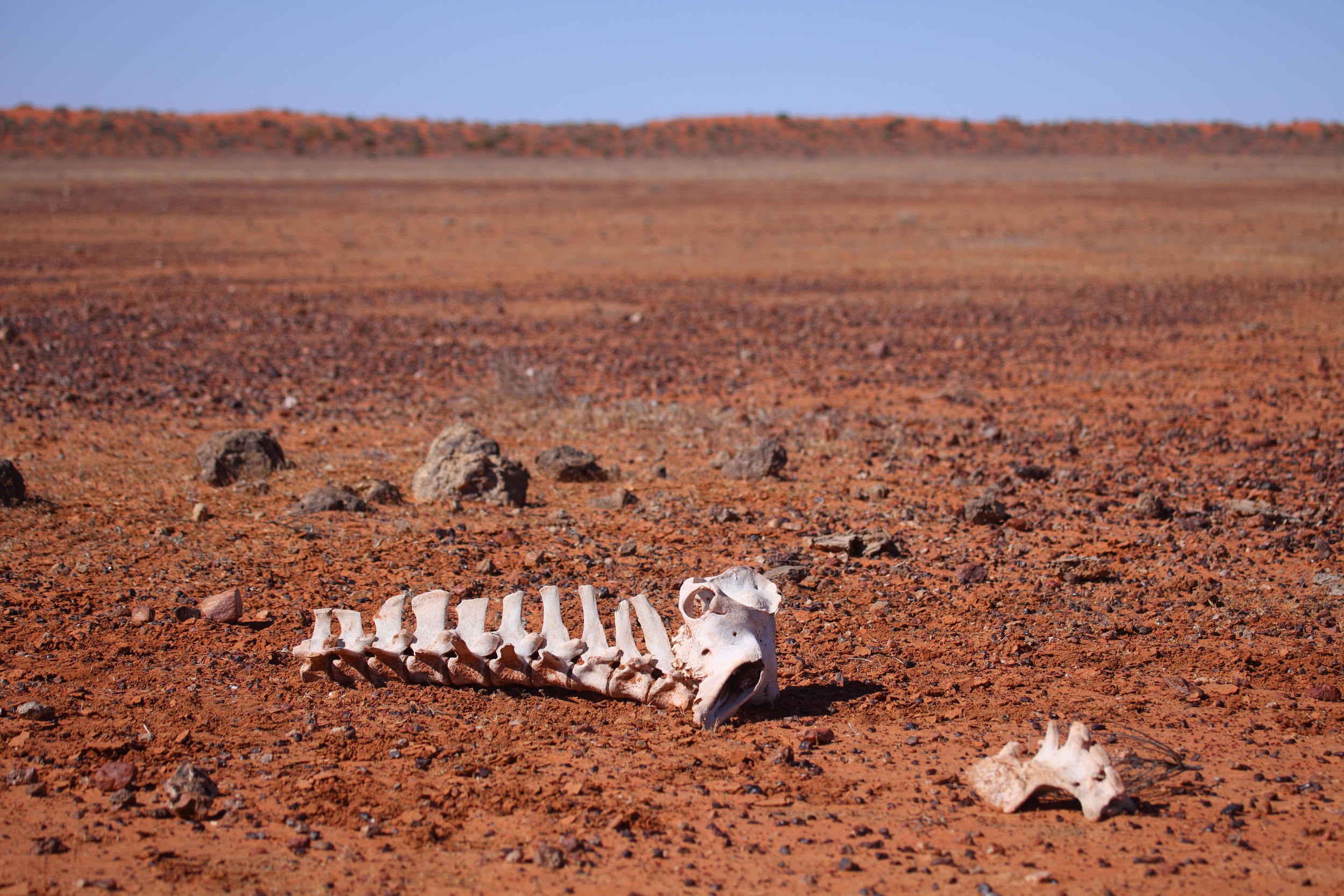
The Outback: if you think it's going to be an easy twitch.... you're wrong

In the mess that this story has now become, birdwatchers are still being touted as among the top threats to the well-being of the Night Parrot and Bush Heritage’s efforts to protect it. This is so far beyond ludicrous that I’m genuinely surprised at the readiness with which the birding community has been prepared to sit back and wear it. By far the biggest threats to the conservation of the species now are the mishandling of public interest and goodwill, the clearing of potential Night Parrot habitat elsewhere, feral cats and foxes, uncontrolled fires and the continued and inexplicable hoarding of acoustic data that should be informing pricked ears and automated recorders right across the outback rather than just taking up space on a hard drive somewhere.

Courtesy: social media commentators

In the three years since John Young’s historic find, the site, to the best of our knowledge, has received no unwanted visitors. Nil. It’s time to dispense with the twitching hordes bullshit. It just doesn’t add up and any further attempts to perpetuate it should be seen as a deliberate attempt to deflect attention and a pointless attack on a group who continue to make a valuable contribution to conservation and our understanding of birds in this country.

It’s also an interesting measure of the mishandling of both the media attention and the overwhelming goodwill of the birding community toward this project that, in the wake of Greg Roberts’ revelatory article, the internet was comparatively silent on the matter.

People have finally got Night Parrot fatigue, something I wouldn’t have thought possible. A bird that once set the birdwatching forums, blogs and chat rooms alight with spirited conversation and debate barely rated a few short threads on Facebook and a few fairly pedestrian posts on Birding-Aus. Bush Heritage may well be protecting the Night Parrot to the best of their ability but their media team seem to have killed the bulk of the public interest in it stone dead. The scientifically incompatible use of secrecy as a marketing tool and the drip-feed of same-old same-old titbits masquerading as news updates, clearly isn’t working.

As it stands, there are probably a few individuals out there who have become infinitely more knowledgeable about the ways of the Night Parrot than anyone else in history. This is some consolation. Publication is a slow process at the best of times and anyone can understand the need for researchers to guard their work until after publication. We can assume they’ll share this knowledge one day, but time is getting on. There are almost certainly populations of Night Parrot elsewhere in the outback that don’t enjoy the same level of habitat protection afforded to the birds at Pullen Pullen Reserve. As long as we don’t have a widely available acoustic survey methodology, every other population of Night Parrot is in imminent danger of being bulldozed into oblivion even before we know where they are.

Another source of great consolation is that John Young now has the full backing of AWC and is back out bush where he belongs. AWC, working with Queensland National Parks and Wildlife (QPWS), have committed to building one of the largest feral predator-proof enclosures in the country at the Diamantina and Astrebla Downs properties in western Queensland. This is in the middle of prime Night Parrot and Greater Bilby country and it’s not revealing any secret at all to state that these properties are right next door to Brighton Downs. So with the only man with a proven track record for finding Night Parrots spearheading their operation, you’d have to say that it’s a pretty safe bet that, in due course, AWC will be sitting on Night Parrots too and that can only be a good thing.

And besides, it’s fitting that John Young continues to be the Night Parrot man. That’s a title he never asked for and actively shuns. At every public occasion he has stated repeatedly that he wants the story to be about the bird and not about him. But you can’t always get what you want. The name of John Young is now irretrievably linked with the Night Parrot whether he likes it or not. If it weren’t for John Young I wouldn’t be writing this, we wouldn’t be having this conversation, and the internet would be even more silent (on this topic anyway) than it has been in recent days.

For this, we all owe John our thanks.

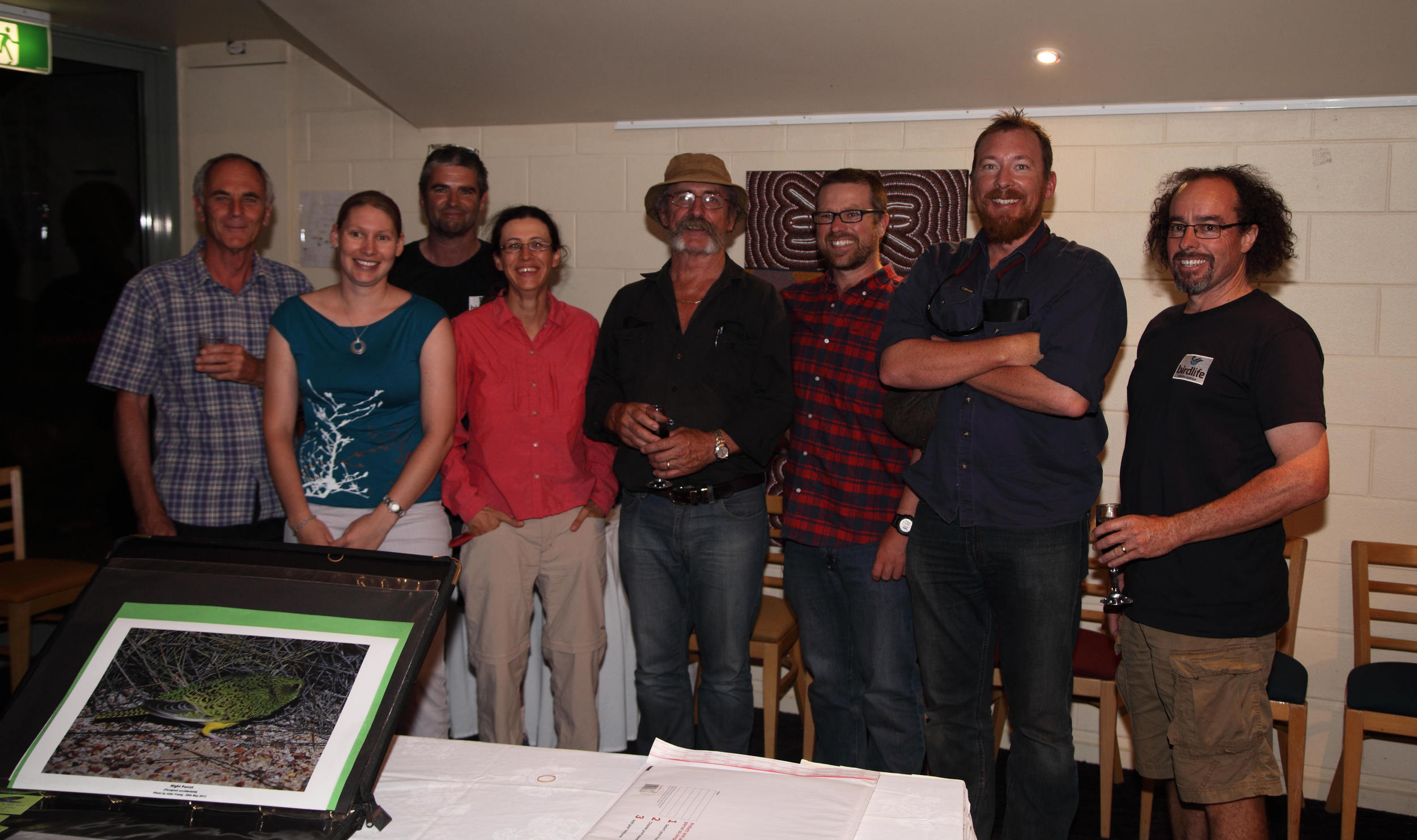
Good times in The Alice with John Young (centre) and the committee of Birdlife Central Australia

Postscript

This is an instructive conversation to be having at any time but perhaps particularly so in the lead-up to another federal election. We’ve watched science and conservation funding whittled away by successive governments and officially sanctioned environmental vandalism and negligence on an unprecedented scale in recent years. With the fair dinkum work of conservation increasingly being left to private organisations like Australian Wildlife Conservancy, Birdlife Australia and Bush Heritage, such groups need all the support they can get.

If it seems like I’m unfairly or overly critical of any organisations or individuals it is only because I care about the iconic landscapes and animals in Australia’s outback which I often suspect of being consistently overlooked by those who make the decisions about what is worth preserving and what research is worth funding. I can only write with the information that I am privy to, but if there are any errors of any kind, feel free to get in touch and I’ll straighten them out.

NB: *There have been persistent rumours in recent weeks that we should expect some big news regarding this last holy grail in Australian ornithology. We can only wait for more information.

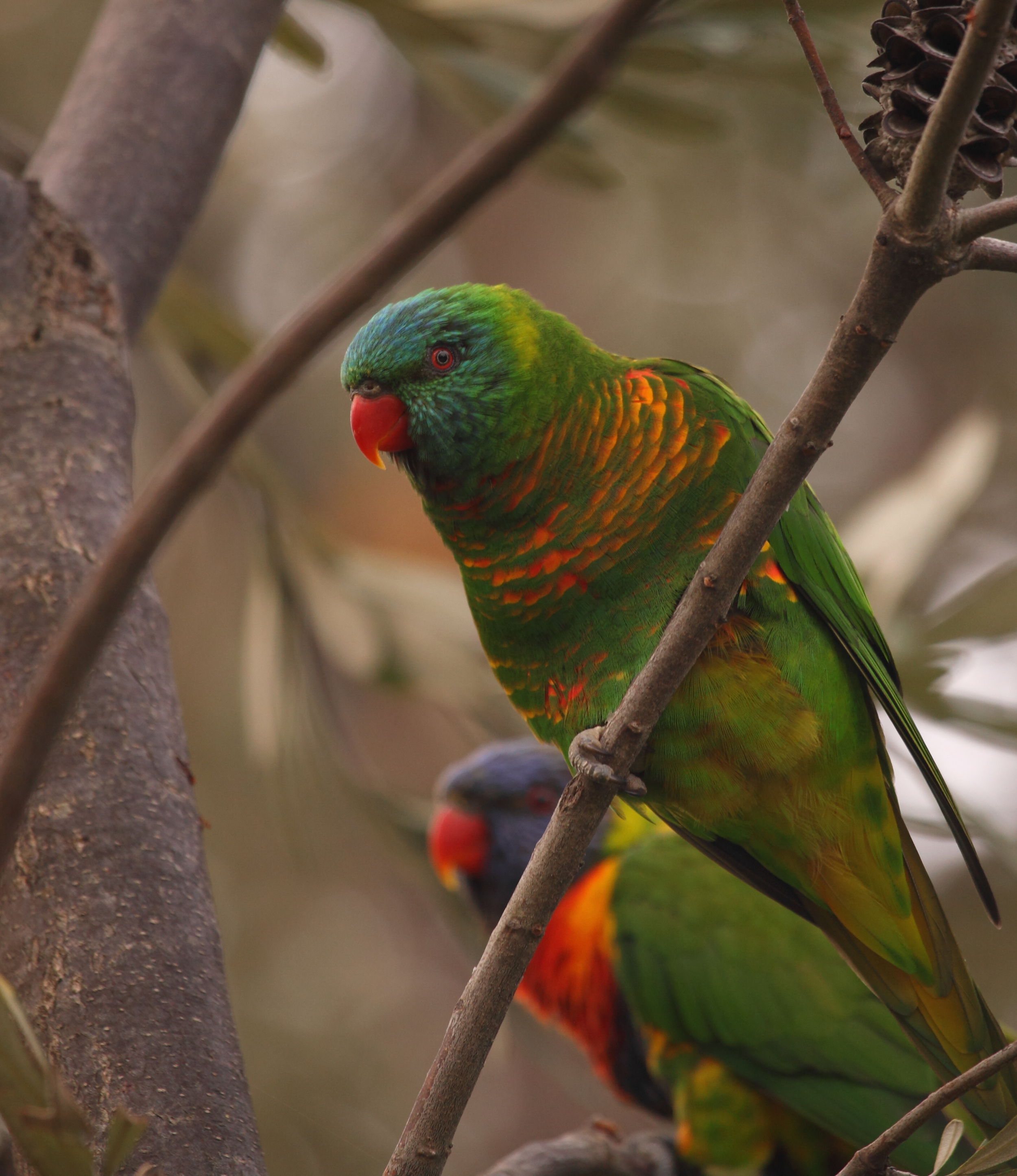
Scaly-breasted Lorikeet: a wild hybrid

birdingChris Watson

A hybrid Scaly-breasted Lorikeet with its mate, a Rainbow Lorikeet in the background.

My encounters with wild hybrids have been few. Back in Alice Springs a local friend put me onto a tree hollow that was used for a year by a Long-billed Corella holed-up with a Galah but I never saw the outcome of that pairing. Then there are the more usual hybrid Pacific Black Ducks that are pretty common here and there.

Flashback to Alice Springs: a Long-billed Corella and a Galah as unconventional homemakers.

But I've never before seen wild lorikeet hybridisation. It's not uncommon to hear about it and it's rampant in aviculture. Scaly-breasted Lorikeet is not a species that I've seen around Melbourne before but I'm aware that they're about. They have a patchy distribution and are only present in small numbers but a quick search on eBird reveals the areas where they are most regularly spotted.

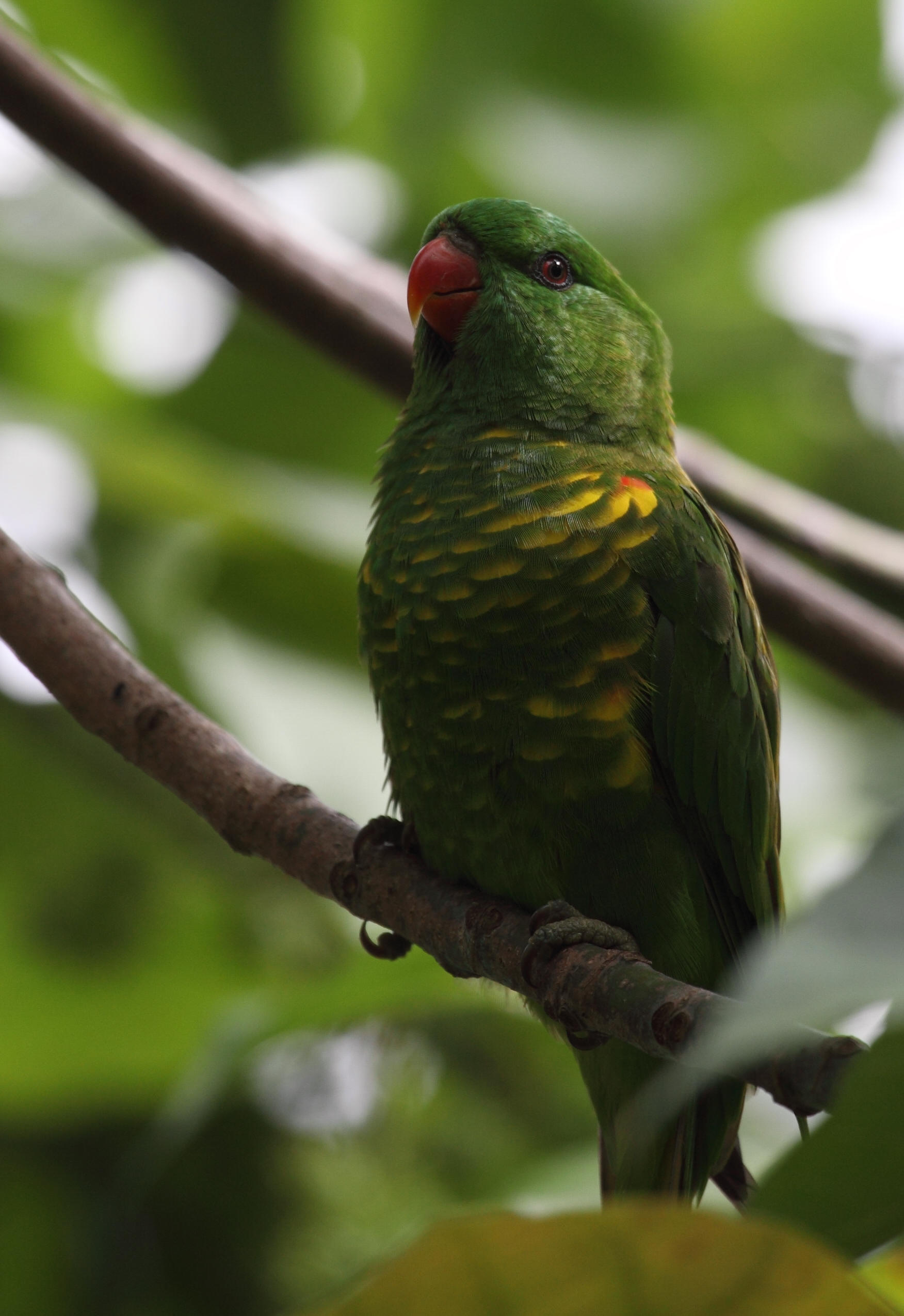
The more usual presentation of Scaly-breasted Lorikeet - this is a bird in Brisbane. The head colour conforms to the green of the rest of the plumage and the yellow scaling across the breast is a more uniform bright yellow when compared with the hybrid bird.

Ricketts Point in Beaumaris is one of these places. Scaly-breasted Lorikeets are recorded pretty regularly and have been observed (and photographed) pairing with Rainbow Lorikeets here in the past. Large flowering Banksias (Banksia integrifolia) provide abundant nectar as well as numerous breeding hollows. The regular pedestrian traffic means birds are accustomed to human incursion so this presents a good opportunity for observation. 

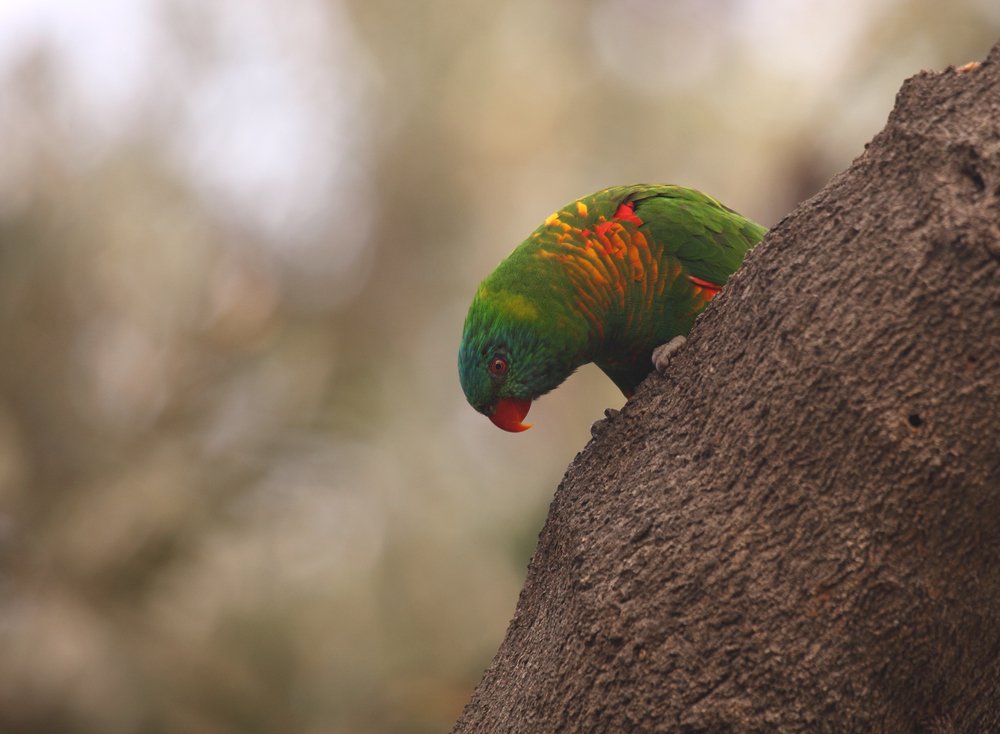
Fellow Manky Shearwater Sean Dooley had spied some Cattle Egret (an uncommon visitor) earlier in the day so I'd popped down to see if they were still lurking; no luck on that count. Seeing the scaly breast flash past and land on a tree trunk beside my head was what first singled the bird out as different to the dozens of Rainbow Lorikeets. In stalking the bird for a better look it quickly became obvious that it didn't look quite right for a pure Scaly-breasted Lorikeet. The head had a a definite streaky bluish tint and the scaly breast was a deeper golden orange rather than a bright yellow. All doubt left me when it perched beside a Rainbow Lorikeet and a lot of mutual preening and noisy chatter ensued. 

The Ricketts Point bird immediately caught my eye as being out-of-the-ordinary.

So it would appear to be a pretty clear-cut case of natural hybridisation between Rainbow and Scaly-breasted Lorikeet. There was nothing else unusual around the reserve but it was still a beautiful day, plenty of Australian Pelicans, Pacific and Silver Gulls about and this unusual bird was a pleasant surprise.

On The Island Of Borneo

birding, TourismChris Watson

In May 2015, the Sabah Tourist Board invited me to visit the island of Borneo. Their purpose was to expose me to all of the best wildlife lodges in Sabah, including some new lodges that have only recently started operating, and to meet and work with local guides and operators to develop itineraries for birders and photographers that will offer the best possible wildlife experiences.

Somewhere in the canopy of a Bornean rainforest - birding paradise.

Borneo is one of those place names that comes packed with a panoply of images and emotions. The name wafts connotations of deep remoteness, isolation, impenetrable dark jungle, bizarre and little-known creatures, and intrepid explorers the likes of Alfred Russel-Wallace and Redmond O’Hanlon.

When O’Hanlon and poet James Fenton first set foot on Borneo in 1983 they were intent on travelling to the centre of the island in search of the Sumatran Rhinoceros, Dicerorhinus sumatrensis. By the time I first visited the island in May 2015, they had recently been declared extirpated from the province of Sabah and classified as Critically Endangered with as few as 80 remaining worldwide. But despite Borneo’s vanishing rhino population, not to mention orangutans and Sun Bears that are faring only slightly better, it has retained a magnetic pull for travellers seeking a glimpse of its unique fauna. Birding ecotourism in particular, has supported the development of a string of wildlife lodges and guiding enterprises across Sabah, and interest in the region’s diverse avifauna and other wildlife has never been more intense.

The geography of the place remains elusive to many. Ask people to identify it on a map and most will stab a finger vaguely between the Indonesian Archipelago and Southeast Asia. For such a large landmass, it seems to slip through the cracks of our collective imagination. It exists, almost literally, in parentheses dwarfed by the charisma of neighbouring Indonesia and Malaysia who, since the uneasy resolution of the Indonesian-Malaysian Confrontation 1963-1966, share custodianship of most of the island. The southern three quarters comprise the five provinces of The Republic of Indonesia, collectively known as Kalimantan (in fact the name Kalimantan in Indonesian refers to the entire island of Borneo). The northern quarter is split roughly in half between the two Malaysian states of Sabah in the east and Sarawak in the west, which surrounds the tiny sovereign state of Brunei, which constitutes just 1% of the island’s total land area.

Adding to our murky perception of the place, for many Australians, Borneo may also be prominent in the memory for its role in the Pacific Theatre during World War 2. The name Sandakan, located on the eastern coast of Sabah, is irretrievably infused with infamy as the site of the eponymous death marches. Lest we forget, of the 2,345 allied prisoners forced to march that route from Sandakan to Ranau, only six survived, all Australians, and only because they were the only ones who escaped. This is the first among numerous military associations with the place.

At one point during my visit, a local, realising I was Australian, enquired whether I knew about the Australian who had been killed by an elephant on the island. At this I had to dip my lid. This was a piece of Australian military trivia that I was certain was known only to myself, a few nerdier graduates of RMC Duntroon, and David Horner, author of SAS, Phantoms of the Jungle: A history of the Australian Special Air Service.

“Lance Corporal Paul Denehey”, I said immediately.

“No… Australian girl….” came the puzzled response.

Paul Denehey was charged by a bull elephant during a patrol along the Selimulan River (modern day Kalimantan) on the 2nd of June 1965 while conducting “Claret” operations during Konfrontasi. He died before he could be evacuated, giving him the dubious distinction of being the first Australian SAS fatality on active service. Unknown to me he was not the last Australian killed by an elephant on the island of Borneo. In December 2011, Jenna O’Grady Donley, a 26 year old veterinarian from Sydney, was charged and killed by an elephant on the Tabin Wildlife Reserve of Sabah, in Malaysian Borneo.

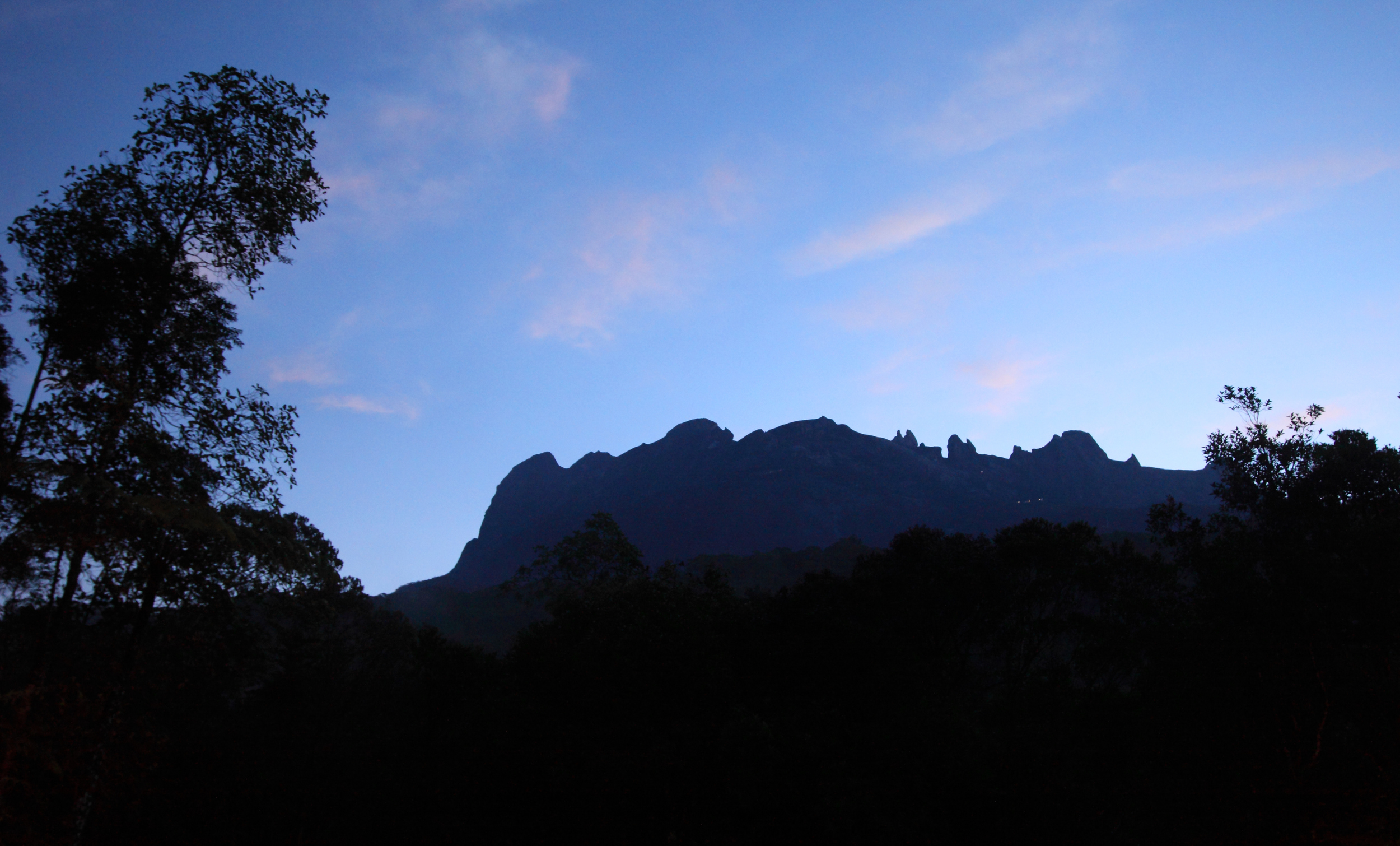
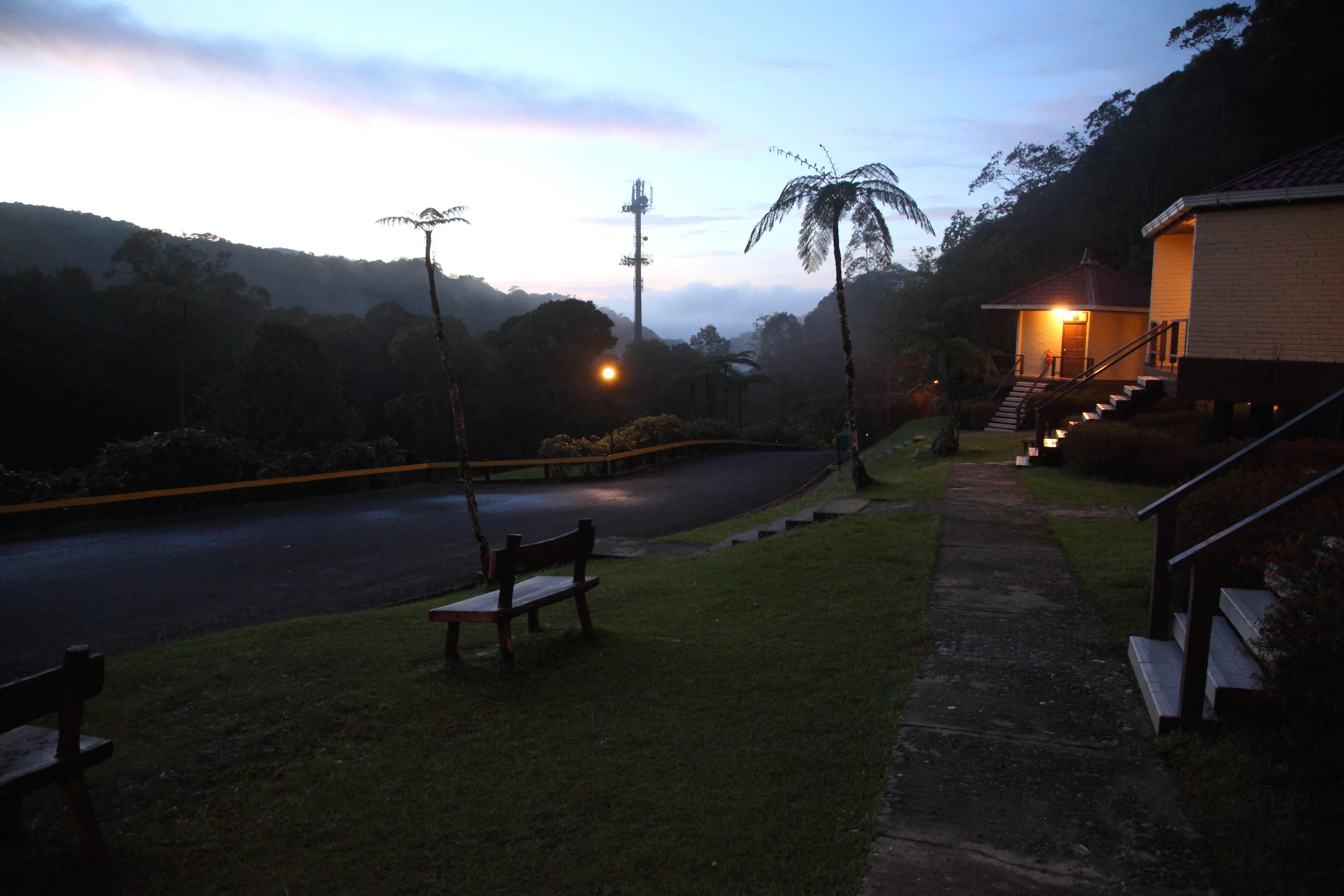
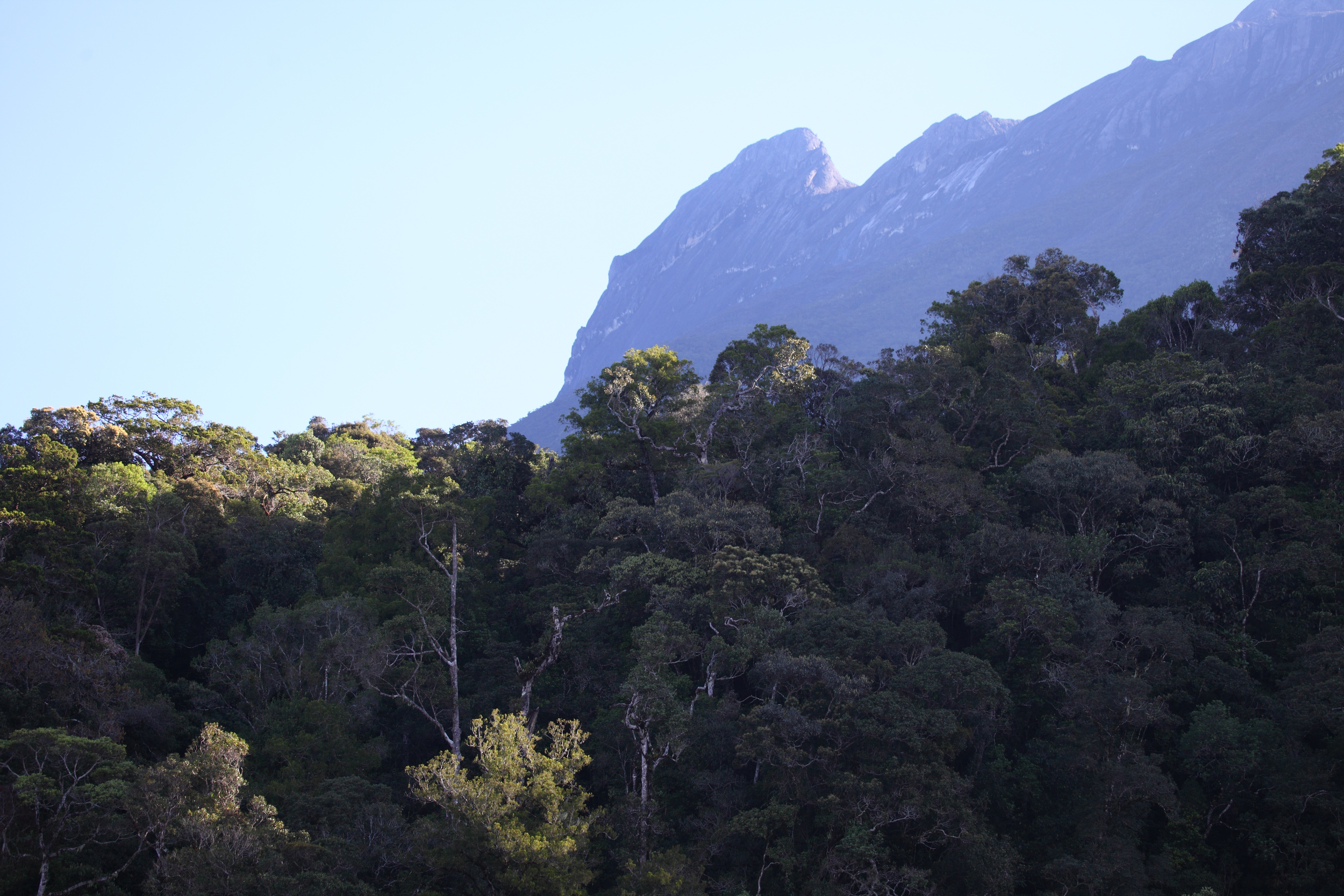
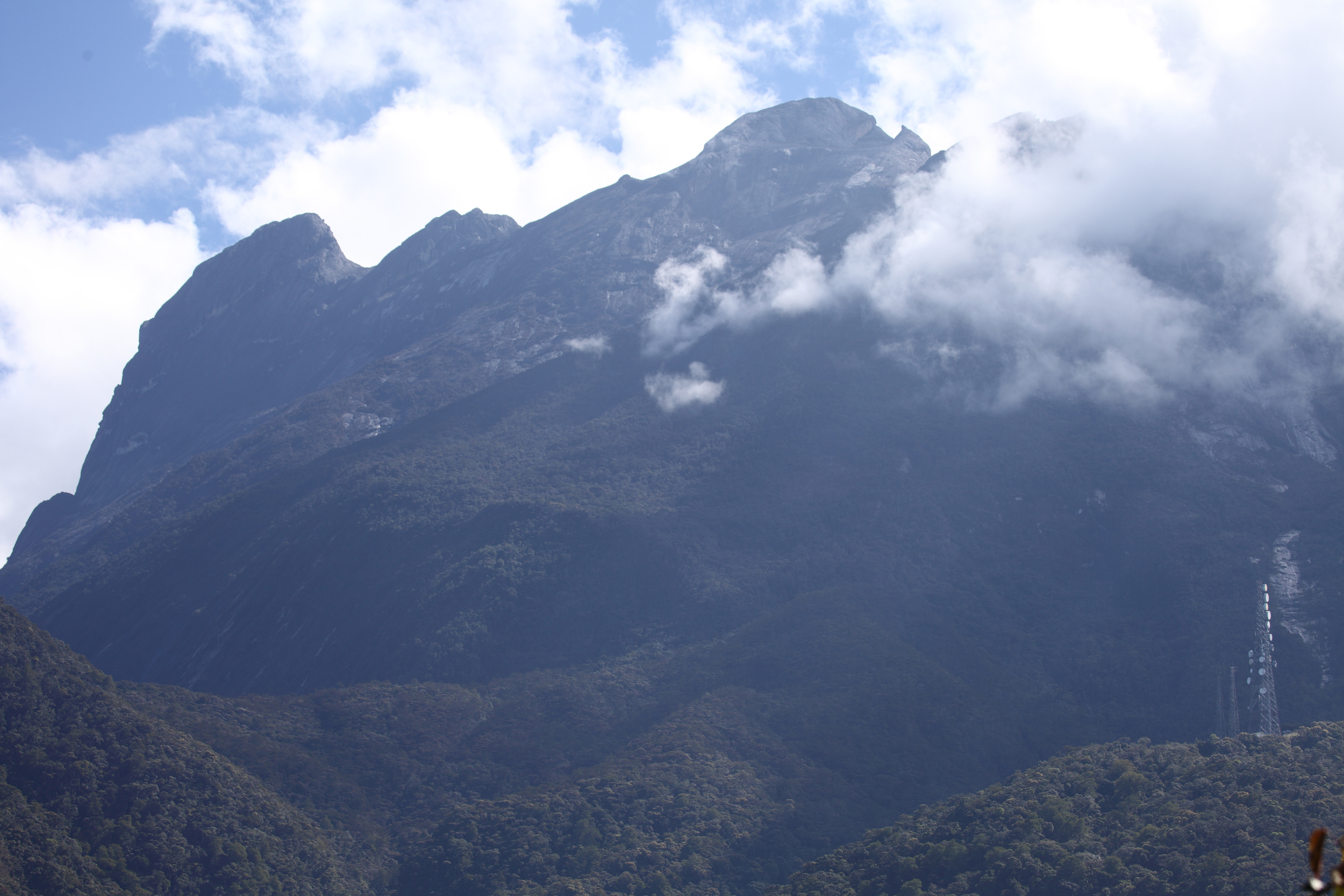
My first visit to Borneo was of only 11 days and I spent all of that in the Malaysian province of Sabah. Often referred to as The Land Below the Winds, an old maritime reference to the fact that the region lies below the typhoon belt, this state takes up the northern end of the island. Flying into the capital city Kota Kinabalu (KK), you get the feeling of a small (pop. ~450,000) but bustling Asian city perched on the edge of a vast forested interior. The Crocker Range rises a short distance inland culminating in the World Heritage-listed Kinabalu Park including Mount Kinabalu at 4,096m above sea level, the highest peak in the Malay Archipelago.  

In order to experience as much of the region’s staggering biodiversity as possible, the folks at the Sabah Tourism Board had arranged a busy itinerary. The route would take me across to the east coast to explore the lowland dipterocarp forest, swamps, rivers, oxbow lakes and coastal regions before travelling overland to Kinabalu Park for some higher altitude birding among the misty montane forests on Mount Kinabalu’s slopes.

TABIN

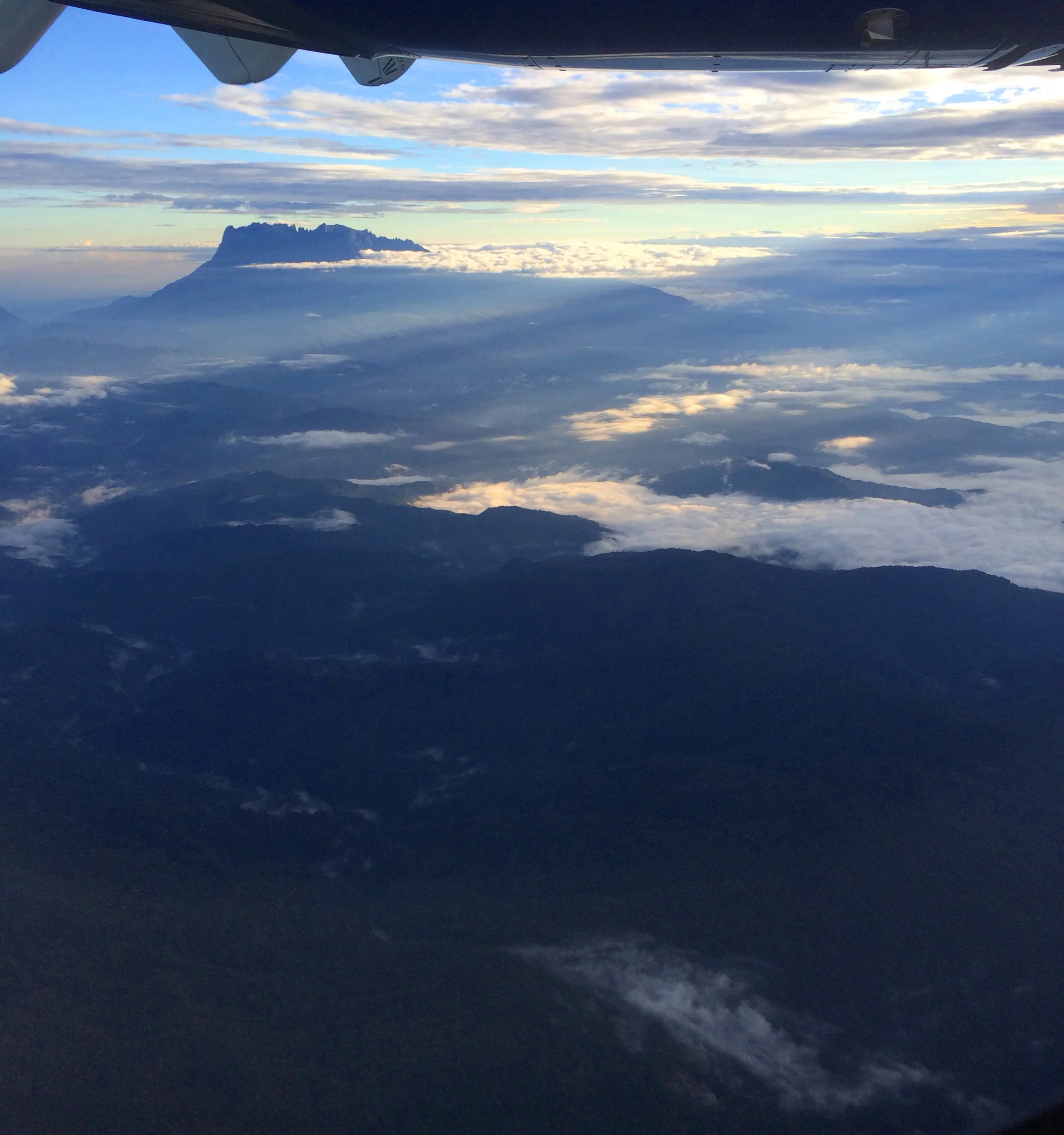
Following an overnight stop in KK, the fun began with a pre-dawn flight across the top of the island to get to Lahad Datu (pop. ~200,000), a port town shipping palm oil, cocoa and rainforest timber. Flying into the sunrise as its first rays hit the misty crags of Mount Kinabalu was as impressive a spectacle as anyone could imagine.

Touching down in Lahad Datu there were the usual airstrip birds along with a few Zebra Doves Geopelia striata, interesting for me as a split with Australia’s Peaceful Dove G. placida, a few years back – the first lifer for the trip.

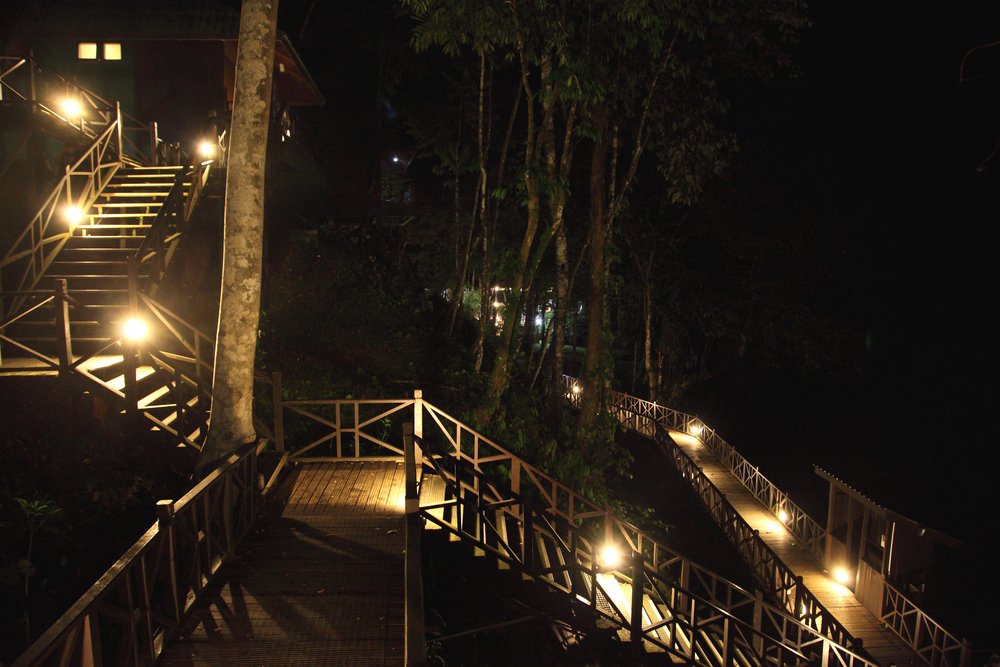
Tabin Wildlife Resort was to be my first stop just 45 kilometres northeast of Lahad Datu. Moppers had stayed here with a friend of hers en route to Birdfair 2014 and had been enthusing about it ever since. The resort is a tourist facility within the massive Tabin Wildlife Reserve, which covers 122,539 ha of lowland dipterocarp forest. It’s probably best known as the last place to have had wild Sumatran Rhinoceros in Sabah. They now have a small captive breeding program but the species is gone from the wild in Sabah. The reserve also has a small population of Bornean Elephant Elephas maximus borneensis, often referred to as Bornean Pygmy Elephant despite the subspecies being no different in size to populations of Asian Elephant on Peninsular Malaysia. Seven of Borneo’s eight primates can be found here and it has a bird list somewhere in excess of 260 species.

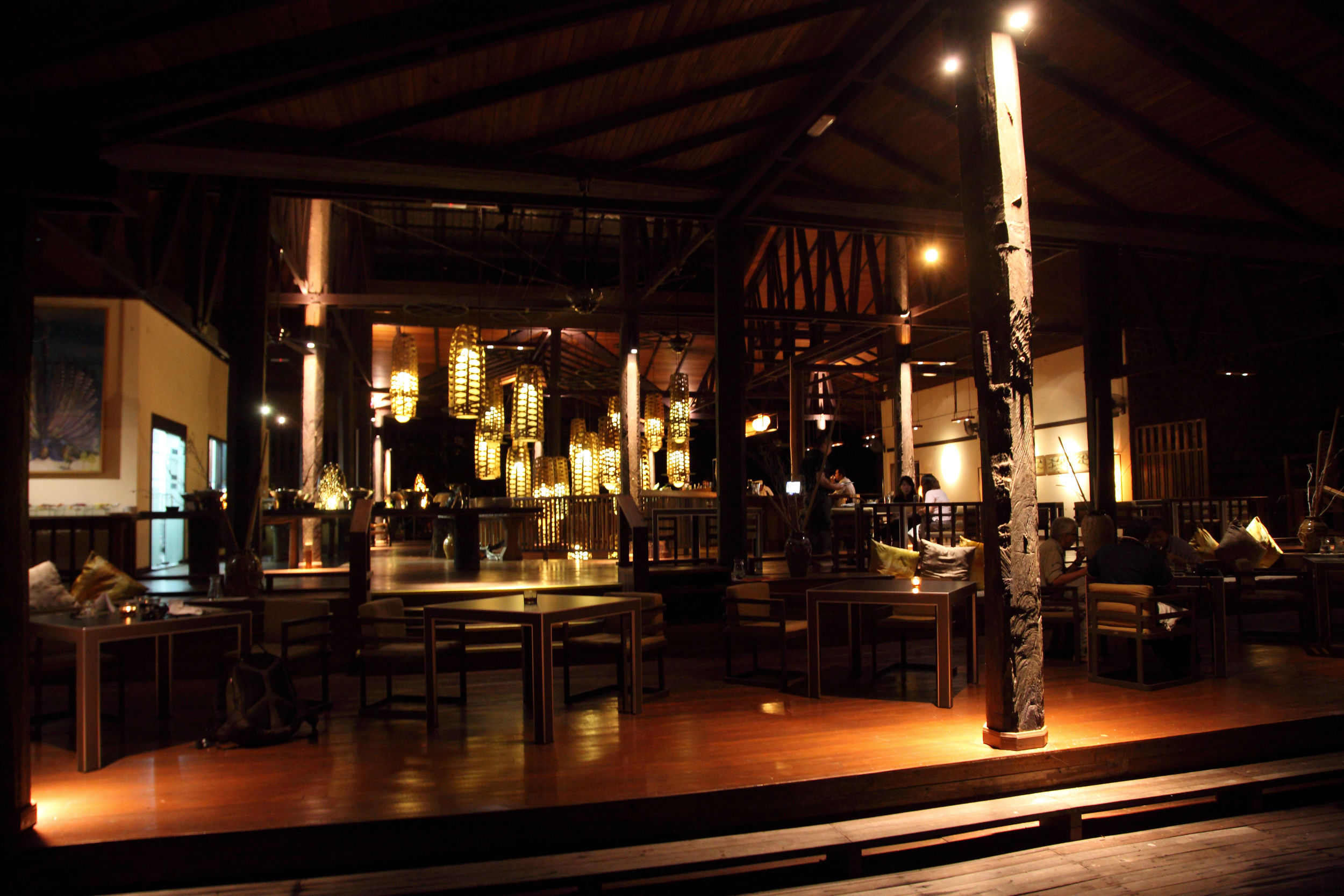
Tabin after dark - an extraordinary Escher-like tangle of stairs through the jungle. Like living in an Ewok village.

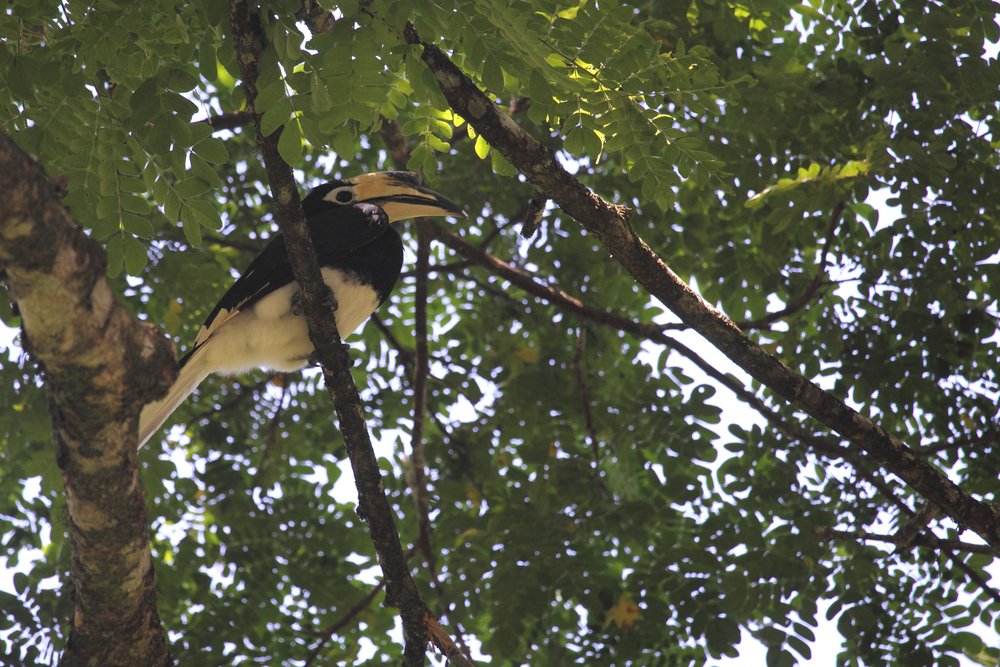
As an introduction to a Bornean wildlife lodge, you couldn’t be given a better first impression. A pair of White-crowned Hornbills were foraging at eye level in the reception garden and perching on the railings of nearby accommodation while a family of Bornean Gibbons swung directly overhead ululating rapturously. In the feeding table garden beside the dining room, Eastern Crimson Sunbirds and Orange-bellied Flowerpeckers displayed their colours at close range. A troop of Long-tailed Macaques quarrelled atop a nearby roof. Before I could even check in, a Grey-tailed Racer slid past just centimetres from my foot. The hornbills were particularly exciting as they offered the very real prospect of a clean sweep – the chance to see all eight species in the book – a field guide full house. This is a rare feat on any birding trip but apparently quite achievable in Sabah. We’d seen Asian Black Hornbill and Wrinkled Hornbill on the road in so this was hornbill number three. Clearly, this place was going to be fun.

Oriental Pied Hornbill keeping cool below the canopy.

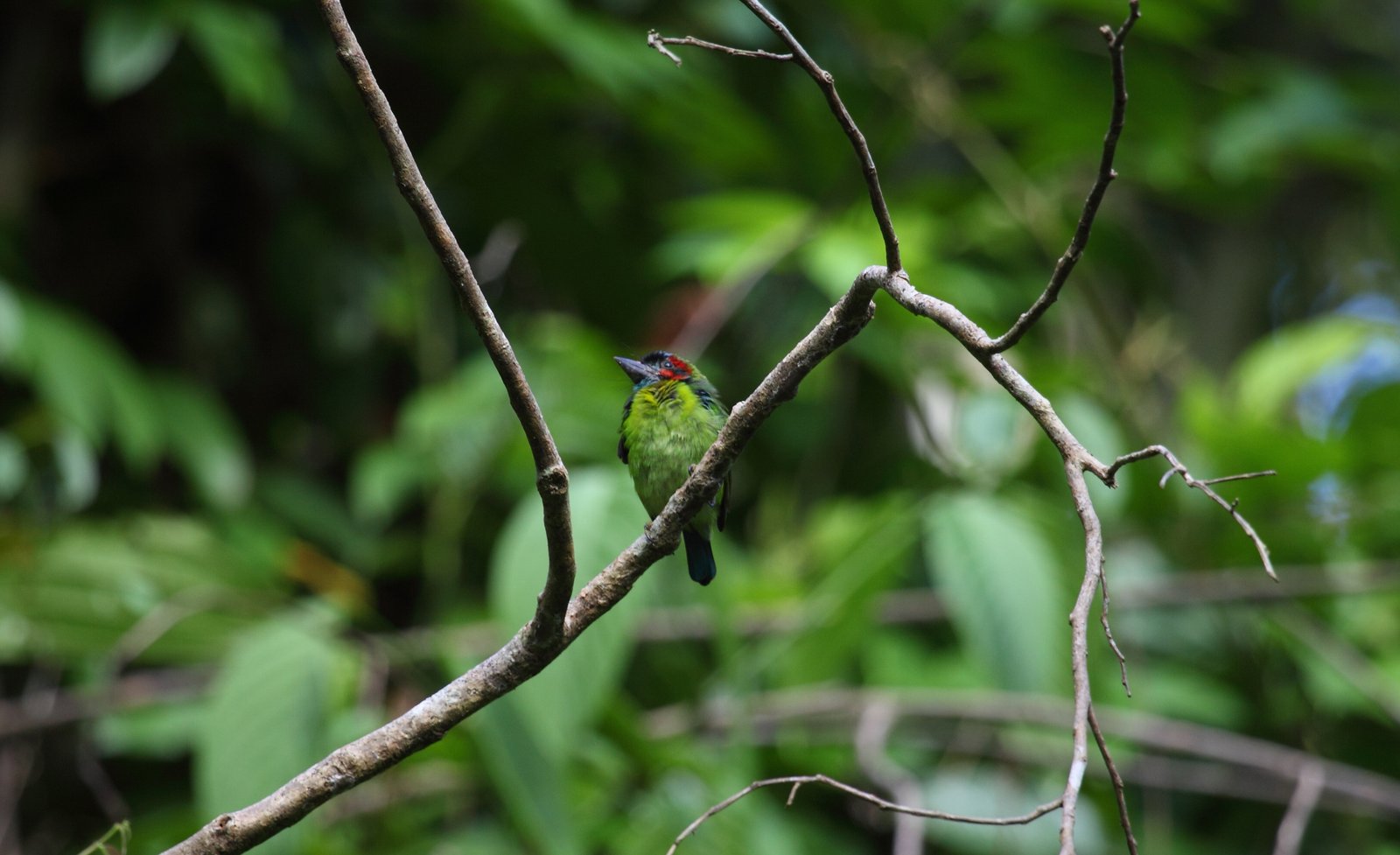
The resort guides have access to extensive jungle trails but perhaps the prize wildlife spotting location in the reserve is the mud volcano. Mineral rich mud bubbles to the surface in this forest clearing, attracting a variety of animals. It’s known as a place to see elephants and we followed in the unmistakeable tracks of one of these beasts on the trail into the clearing although we never clapped eyes on it. A Blue-eared Barbet gave us a good show on the way in but it was the richness of sounds reaching my ears that was most arresting.

Blue-eared Barbet along the trail to the mud volcano.

We stood atop a small mound of coagulated mud and my guide, Raphel, proceeded to breakdown and have what I can only describe as some sort of nervous fit. It began with a craning of the neck and the release of a very loud, staccato, slightly strangled, hoot.

“OOH!!”

My first thought was that somebody had kicked a monkey in the bollocks. He followed this with a half dozen or so more hoots, emitting them at ever decreasing intervals in a slow wind up reminiscent of the call of a Spotted Nightjar. As the frequency of these great hoots became so that they almost overlapped into a single constant tone, he abruptly leaned back and threw out a maniacal cackle something like a bad impression of a Laughing Kookaburra.

“GA-GA-GA-GA-GA-GA-GA-ga-ga-ga-ga-ga!!”

The entire performance, for that’s what this was, took fully ten to twelve seconds to run its course. At its conclusion my guide, a renowned master of Bornean bird calls slumped slightly, quite out of breath. His impromptu seizure had taken me by surprise and I let him regain his composure for a few seconds before I enquired after his health. Before I got the words out though, another local gentleman, apparently at the very top of a distant tree, began suffering similar paroxysms. Raphel beamed a satisfied smile.

“Helmeted Hornbill”.

Hornbill number four.

The largest, rarest, and becoming rarer every day due to the rise in the red ivory trade, of Borneo’s eight hornbill species. Raphel issued his impeccable imitation a couple more times, but the massive bird was not budging from its treetop vantage point. It would be nice to have seen it as close as the White-crowned Hornbills but we could see it well enough through our binoculars. Besides, there was plenty to busy ourselves ogling around the clearing. Long-tailed Parakeets and Blue-crowned Hanging Parrots busied the airspace in typical fast, flat parrot-flight and a Crested Serpent Eagle patrolled high along the edge of the clearing.

The mud beneath our feet too had a lot to reveal. Having spent ten years in Australia’s deserts developing my tracking skills in the fine red sand (surely one of the best tracking substrates it's possible to encounter) I'm confident enough in the mediocrity of my skills to identify only the most obvious and perfect of animal signs. But if fine red sand was a good tracking substrate, moist mud is perfect. It leaves a cast of an animal’s passage. Elephants were obvious – less like an animal print and more like the passage of some industrial machinery. But in and around the pachyderm pads were dense signs of mammal activity. Leopard Cat, Sambar, Lesser Mouse Deer, a few different species of civet, Bearded Pig, and Sunda Clouded Leopard had all visited since the last rain and it rains almost daily there. It’s the sort of large mammal diversity that Australian arid zone ecologists simply are not accustomed to.

An afternoon downpour brought the birding at the mud volcano to a close. After dinner back at the resort, we headed out in an open-topped truck to spotlight along the road dividing the reserve from neighbouring oil palm plantation. Such habitat ‘edges’ often provide the best opportunities to observe wildlife using the clear ground to ease their passage between foraging or hunting patches. Civets were the most commonly seen along with a few large rats of indeterminable species. Slumbering passerines were illuminated in the lower branches of trees along with a large Water Monitor that remained oblivious to our presence. But when spotlighting, we all know what we’re most interested in seeing – owls. For most birders there is something ineffably rewarding about seeing night birds. I find it electrifying. Seeking owls is the pinnacle of birding.

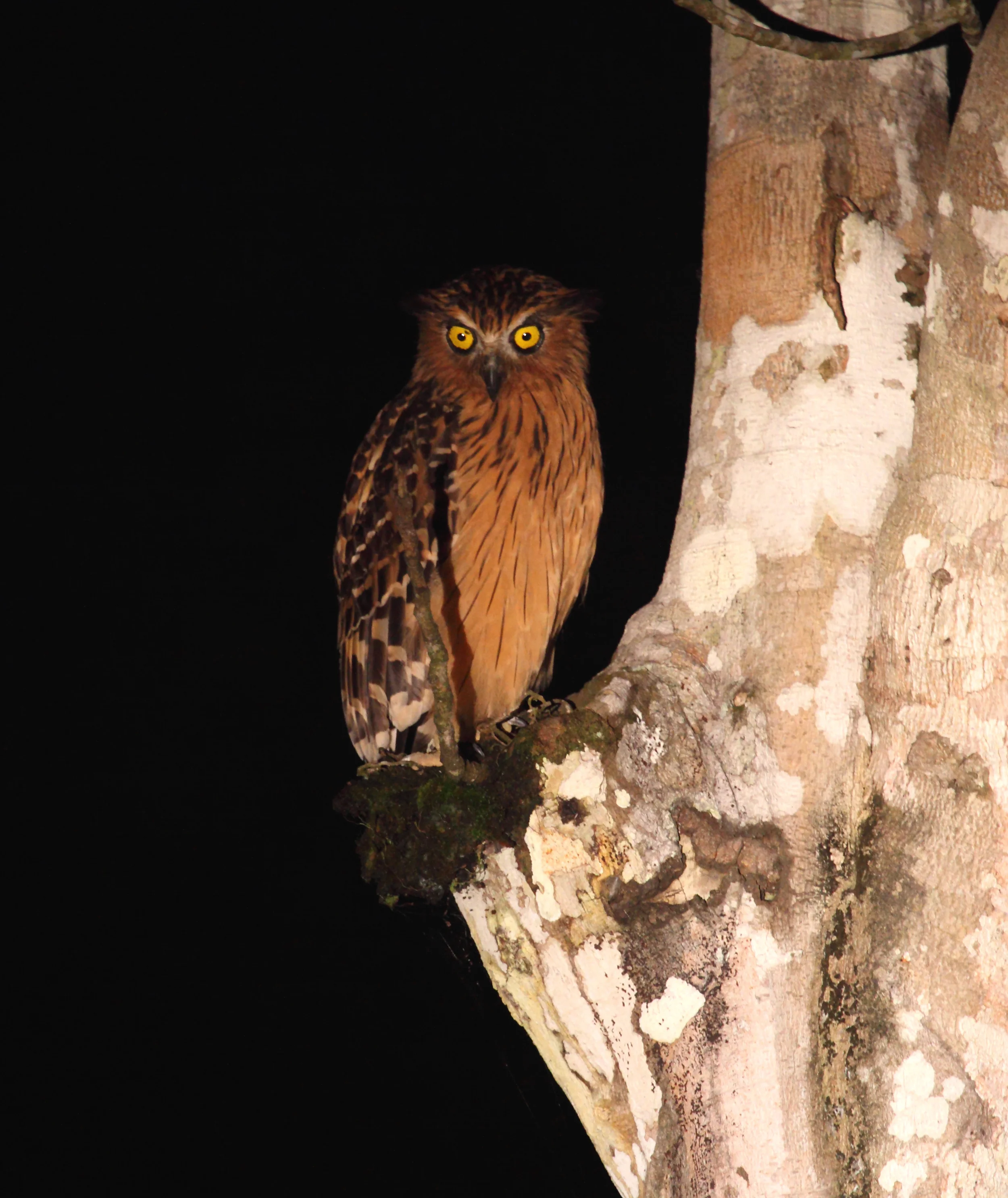
As such, it was a moment of pure magic when the guide swung his beam around to shine on a tree right beside the truck to reveal a Buffy Fish Owl, Bubo ketupu, in the centre of the spot.

Buffy Fish Owl - a captivating animal.

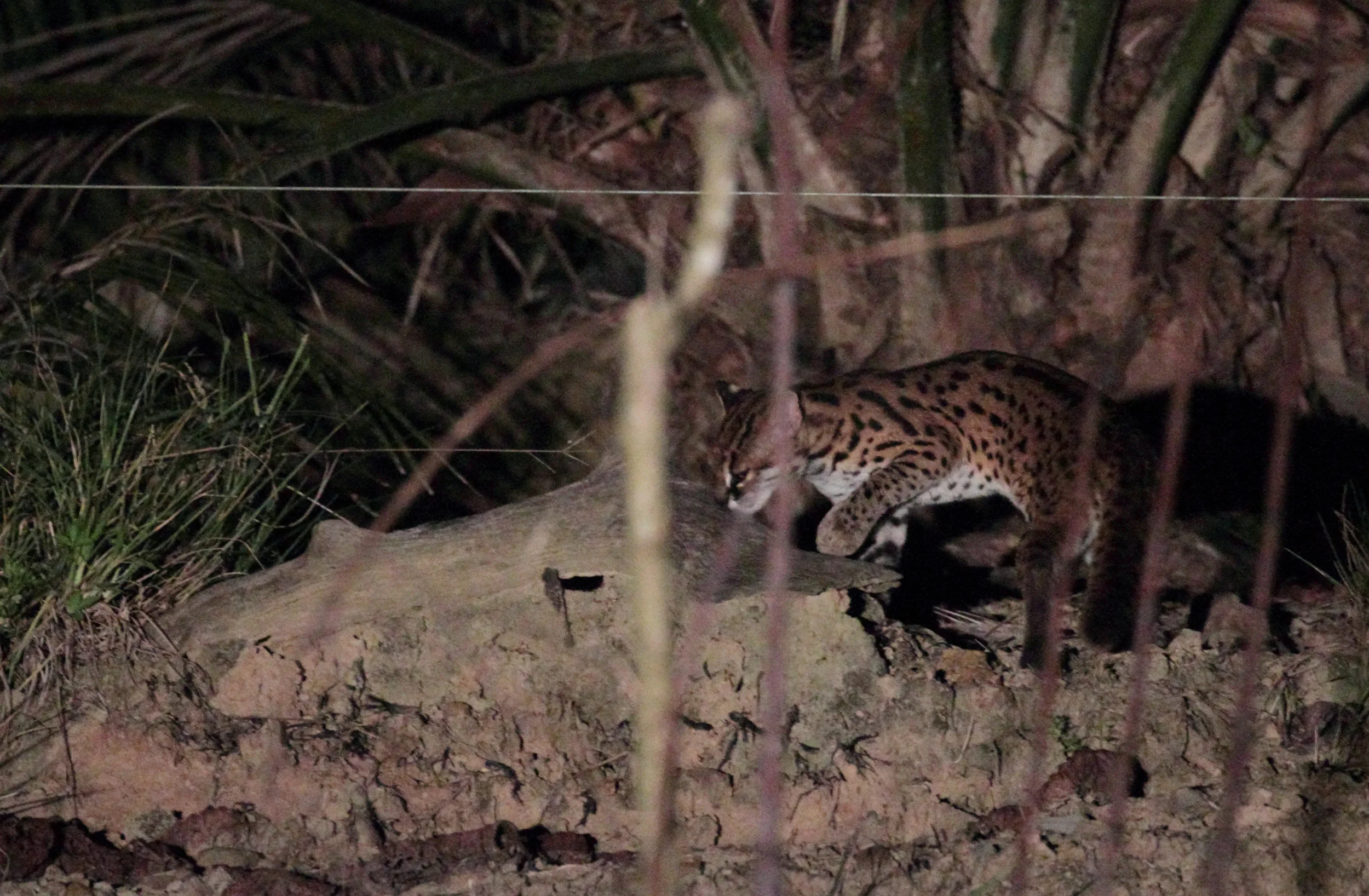
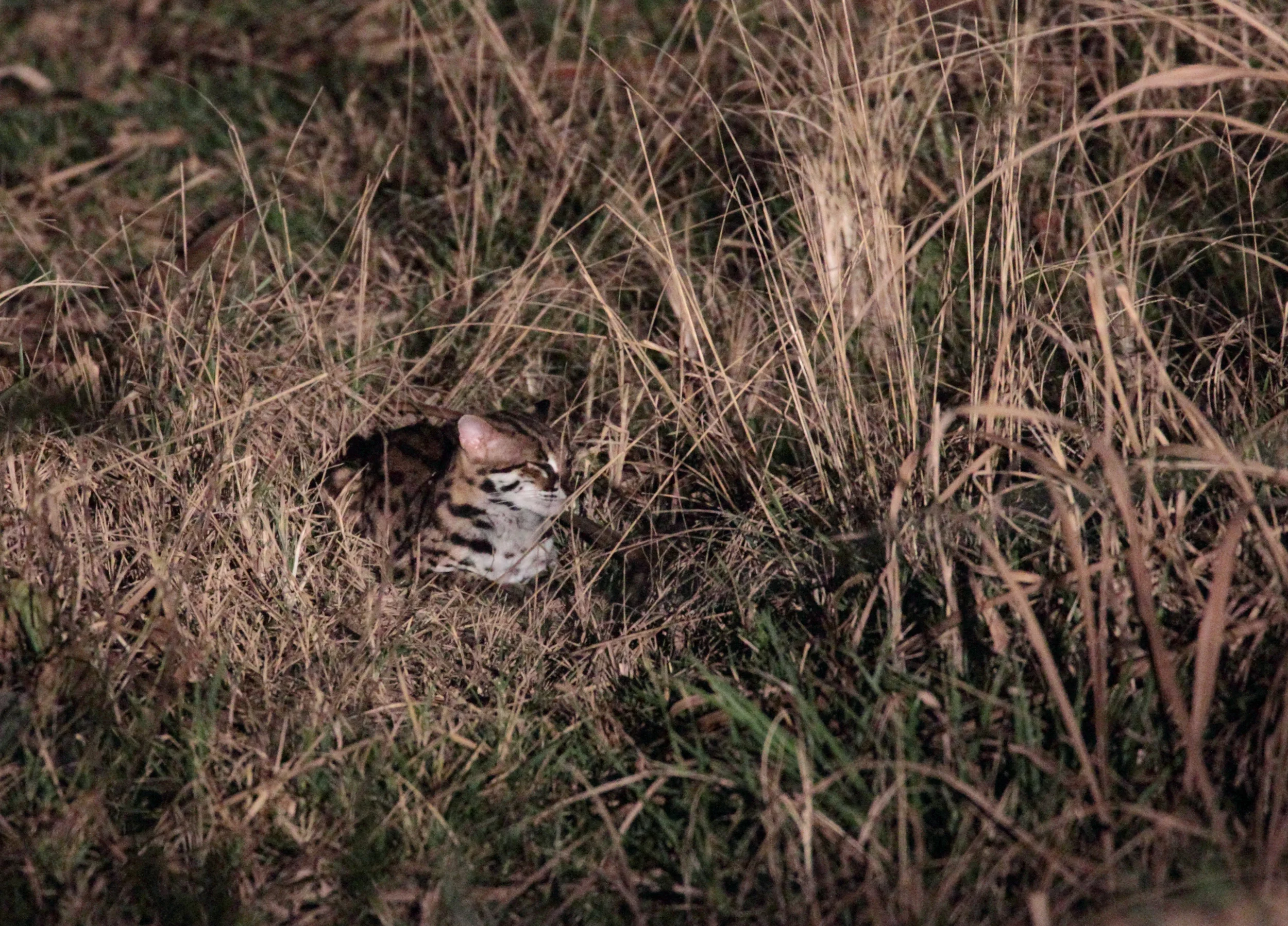
It is the smallest of the four fish owls, but this is a group that contains the world’s largest owl (Blakiston’s Fish Owl) and Buffy Fish Owl is still a very large bird with adults sometimes weighing more than 4.5 kilograms. It had the intensely-focused stare typical of most owls. This bird was so captivating that we almost missed another highlight of the evening as a Leopard Cat Prionailurus bengalensis, slunk across the road just out of the beam of the spotlight. Another sharp-eyed guide saw the movement and trained a light on it in time for us to watch it pause briefly in roadside scrub before vanishing into the forest. This brief encounter was not sufficient to allow any photographs but Moppers was lucky enough to encounter this beautiful cat during her visit as well and has permitted me to use her photographs below.

The following morning there was just time for a foray along one of the forest trails from the resort. We set out in search of one of the pitta species that call the region home. Pitta, of any variety, are never particularly easy to track down and some species are notoriously difficult. This would prove to be the case on this morning as during 2 hours of stalking the forest floor we heard Blue-headed Pitta a few times but never close and certainly never within sight.

DANUM VALLEY

My time at Tabin was over and we had to leave the forest and get back on the road. As the reserve shrank in the rear-view mirror I had to remind myself that I’d only been in-country a day and a half – it already felt like a week.

Next stop – Danum Valley. If Tabin was Sabah’s version of leading with a strong hand then Borneo Rainforest Lodge in Danum Valley was them pulling out all the stops. After transferring back through Lahad Datu it was a further 2 hours of driving through secondary and primary rainforest to get to the lodge. The unsealed road wound through steep gullies and immediately gave me the impression of the green and mountainous Borneo that I had imagined before my visit. It’s a Borneo that is encapsulated for me in another military anecdote from Australian journalist, Tim Bowden. In his 1987 biography of friend and combat photographer Neil Davis, Bowden relates Davis’ telling of a conversation he overheard in Borneo during the Indonesian-Malaysian Confrontation in 1964. A group of Gurkhas, from the famously hardy Nepalese regiments of the British Army, had uncharacteristically rejected a suggestion that they be inserted into combat against Indonesian forces by jumping from planes. They rejected the proposal due to not being trained as paratroopers. Davis’ account continues:

“The Gurkhas usually agreed to anything, but on this particular day they provisionally rejected the plan. But the next day one of their NCOs sought out the British officer who had made the request and said they had discussed it further and would be prepared to jump under certain conditions.
‘What are they?’ the British officer queried.
The Gurkhas told him they would jump if the land was marshy or reasonably soft with no rocky outcrops, because they were inexperienced in falling. The officer considered this and noted that the drop zone would almost certainly be over the jungle. No rocky outcrops there. So, they would be all right. Anything else?
‘Actually, yes,’ answered the Gurkha. They wanted the plane to fly as slowly as possible and no more than a hundred feet high. At that point, the British officer explained that the planes always did fly as slowly as possible when dropping troops, but to jump from 100 feet was just impossible. The parachutes would not open in time from that height.
‘Oh,’ the Gurkha replied, ‘it’s OK then. We’ll jump with parachutes anywhere. You didn’t mention parachutes before.”
[from One Crowded Hour by Tim Bowden]

This is a well-known anecdote in military circles and entirely in keeping with the Gurkha Regiments’ fearsome reputation. This is a unit whose members have been awarded more Victoria Crosses per capita than any other unit in history. Seeing this landscape with my own eyes for the first time almost made the Gurkhas’ willingness to jump from a plane sans parachute understandable. Almost. The slopes were so steep and thickly vegetated that piling out the back of a low-flying plane and doing the old ‘tuck-and-roll’ seems momentarily plausible. If you’re a Gurkha.

The creature comforts of Borneo Rainforest Lodge, a patch of open riverbank, then a vertical wall of green.

The Danum Valley Conservation Area (DVCA) contains 438 square kilometres of lowland dipterocarp rainforest rising to a maximum altitude of 1093 metres above sea level. A little way from Borneo Rainforest Lodge is the Danum Valley Field Centre for scientific research, which also operates as a nursery for the propagation of rainforest trees.

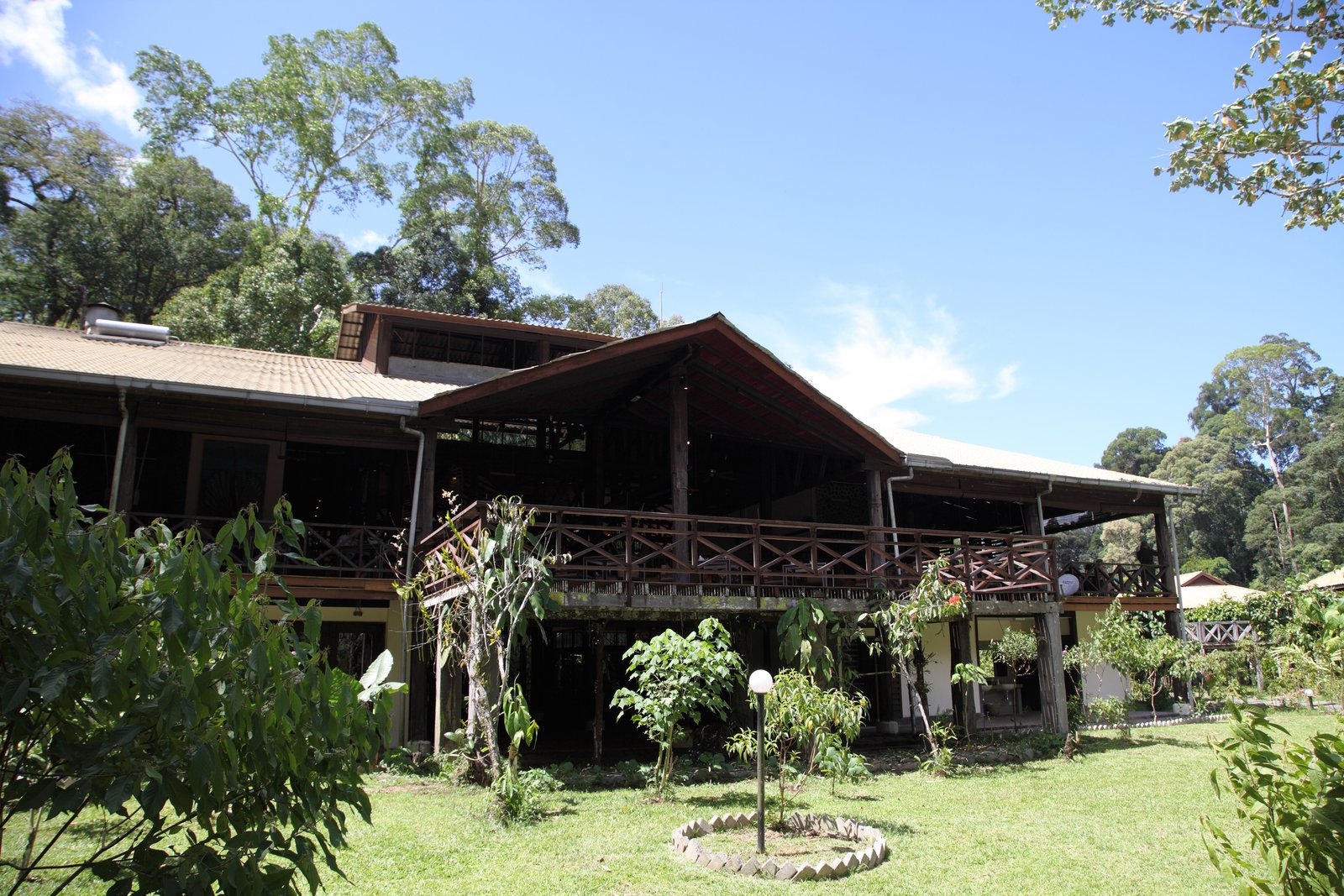
With so much to look at, the drive went quickly and we pulled up at a lodge that has become justly famous for rolling out the red carpet for everyone who visits. The main building of the lodge is set back a few hundred metres from the Danum River to allow for water levels to rise in the wet season. The building itself is beautiful and spacious with numerous boardwalks connecting to the detached accommodation.

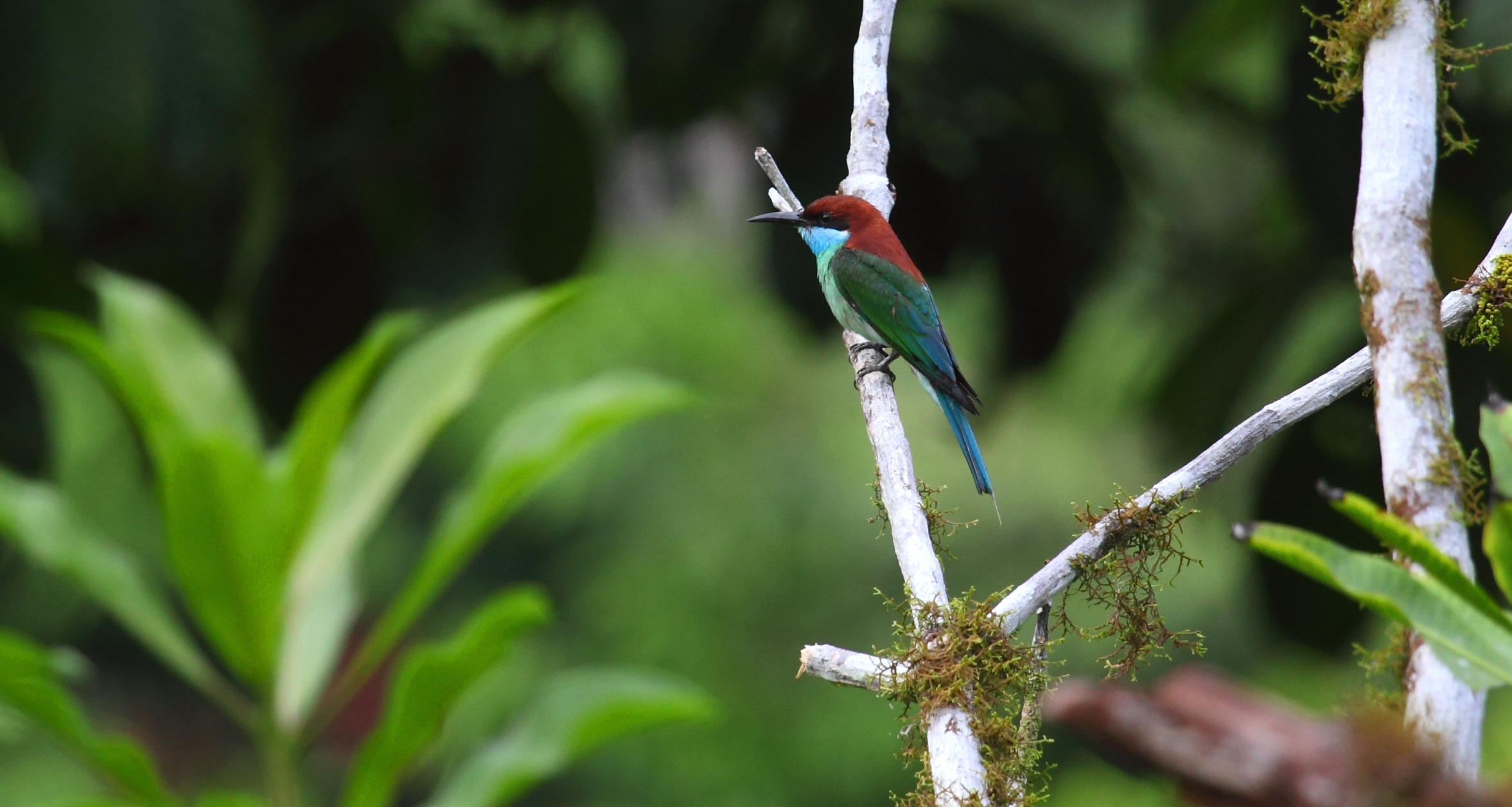
Blue-throated Bee-eater - one of the common residents of the Danum Valley.

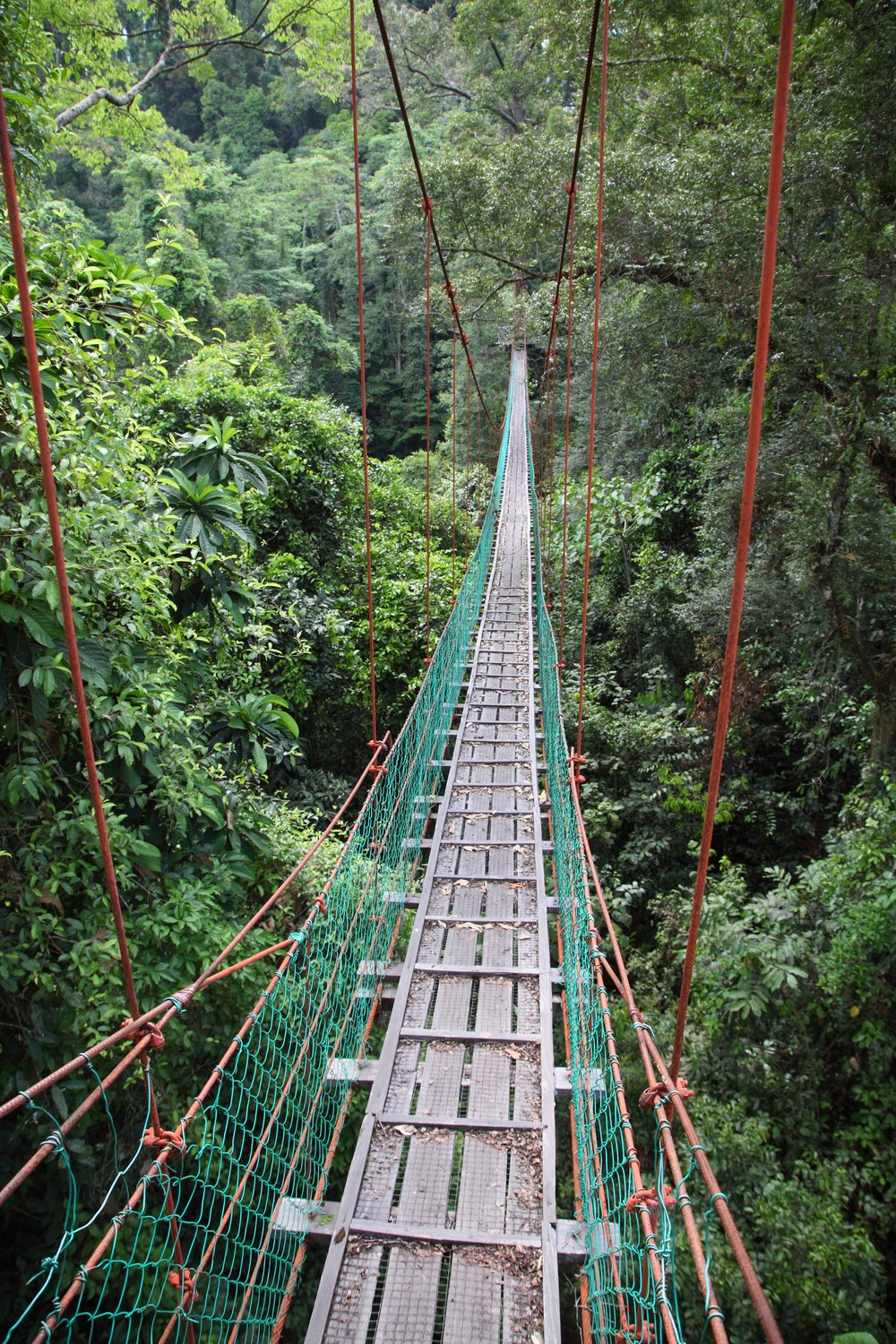
Common though they may be, the species that left the most lasting impression on me from Danum Valley was the Blue-throated Bee-eaters. The lodge has well-tended gardens and dozens of these aerobatic and colourful birds were always present hawking insects over the lawns. Perhaps what Borneo Rainforest Lodge has become most famous for though, is its canopy walkway. This immense structure is a jungle birder’s dream. After trying to identify canopy birds from the dark forest floor the relief of bursting upwards into the light and emerging at eye-level with leafbirds and flowerpeckers is difficult to overstate.

This is the same vantage point from which the mysterious Spectacled Flowerpecker Species novum, was first observed. This is a species illustrated for the first time in the Phillipps’ Field Guide to the Birds of Borneo, and the full story of its discovery at Danum Valley can be read in Birding Asia. The canopy walk traverses through 250 metres of lowland dipterocarp forest at a height varying between 30 and 50 metres above the forest floor. Viewing platforms are fixed to each tree trunk the walkway reaches, to allow for more stable viewing and for those who struggle with the dizzying height to regain their composure.

From this magical lookout, all manner of otherwise difficult birds suddenly became viewable. The minivets were a new group for me and there are 5 species of these colourful passerines present in Borneo. Numerous different flowerpeckers, leafbirds, babblers and bulbuls moved about us and a pair of Wallace’s Hawk-Eagle watched from a nearby perch. The real rock star bird here is the bizarre and ancient-looking Bornean Bristlehead, Pityriasis gymnocephala. This is another elusive canopy bird, which is monotypic and endemic to Borneo. The Danum walkway is known as one of the better places to see this species and we had three birds calling in the canopy high above our heads but only managed the briefest and most distant of glimpses.

Anyone with a smidgeon of equatorial birding experience knows how draining the conditions can be and the heat was getting intense. By mid-morning we headed back down the main road to the lodge for some relaxation before the afternoon session. A brief shower of rain was a welcome relief as we neared the lodge but before we made it all the way back the guide’s radio crackled to life. While the bird life here provides non-stop excitement, the place is so heaving with diverse fauna that there are often interesting non-feathered diversions. Best of all in a place so large, the dozens of guides employed at the lodge all carry radios so when somebody finds something, all groups that are out on the trails can be directed to the new discovery. And wildlife encounters don’t get any more special than one of the three extant great apes.

We diverted down a side road and headed toward the other guide whose group we could now make out standing in the middle of the road in the pouring rain with their heads turned skyward. Before we could reach them a ginger-haired figure shifted its weight in branches just above our heads. This was not the ginger primate we were looking for but welcome just the same. It was a family of Red Leaf Monkeys Presbytis rubicunda. It seems ginger is the favoured colour for primates here.

Red Leaf Monkey: the other ginger primate.

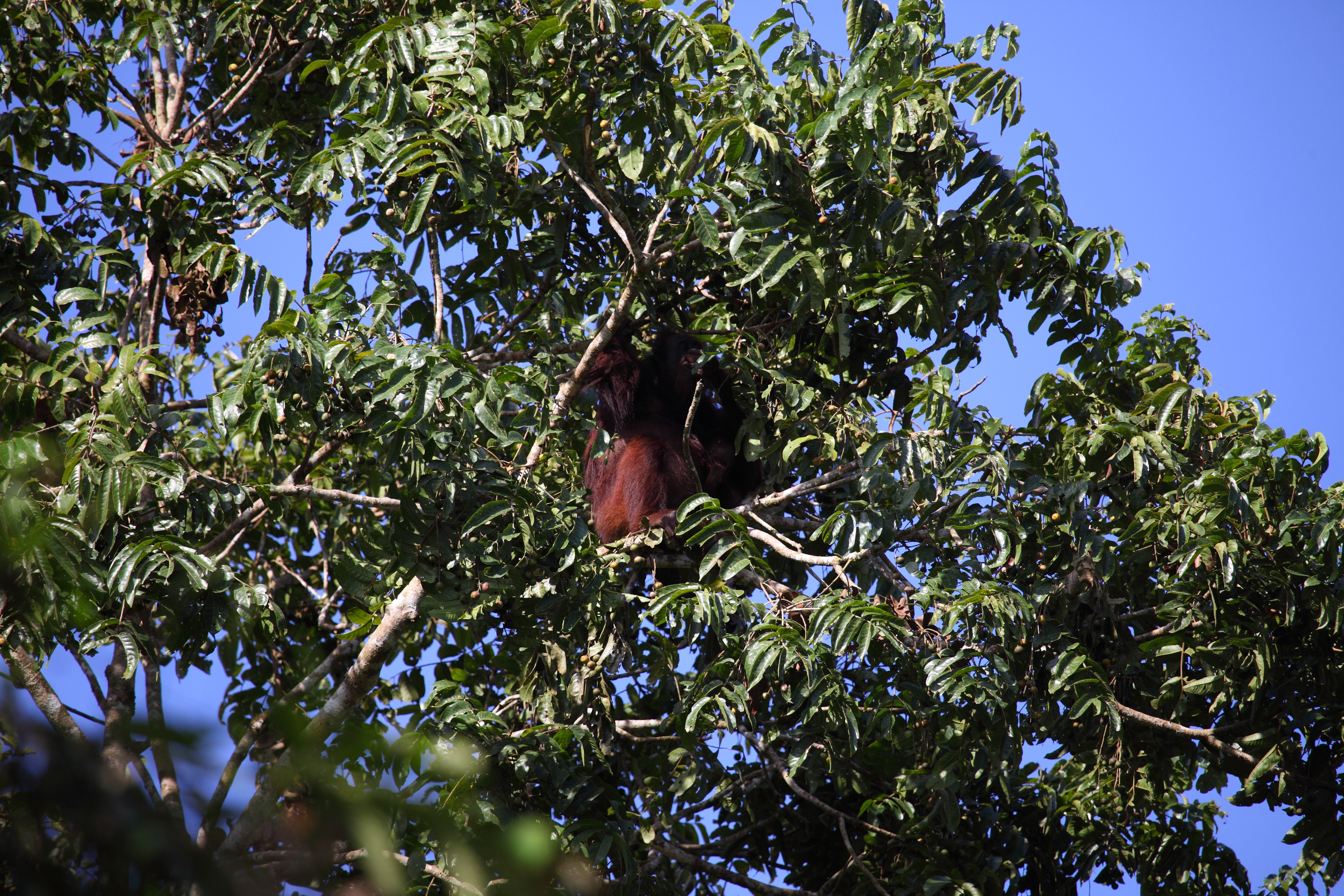
Once we joined the other group it didn’t take long to find what held their attention. Only about 10 metres above our heads was probably the single main reason that most people choose to come to Borneo. Of course it was a Bornean Orangutan, Pongo pygmaeus. This is an animal that is infamously imperiled by the encroachment of palm oil plantations and logging operations that are eating up their habitat at an unsettling pace. Fortunately there are still a few spots, Danum Valley being one of them, where a wild encounter with one of these apes is not too unlikely. There are a number of rehabilitation centres where orphaned or injured animals are nursed back to health for eventual release and tourists can get close to captive animals, but that will never compare with the wild experience.

A lone young adult orang, just loafing peacefully in the understorey trying to stay out of the rain, regarded us indolently. Those with cameras went into a snapping frenzy. After a couple of minutes the orang decided to move off and, with truly impressive speed, made its way through the forest. For a bulky and lethargic looking creature it had a surprisingly languid way of ‘swimming’ through the lower canopy. With grasping hands on the end of all four limbs, it made the best use of even quite thin saplings that seemed incapable of supporting its full weight. It innately understood when it had bent a trunk to its limit and reached out another dextrous limb to grab the next tree and relieve the strain on the last. It wasn’t long before the orang was at the limit of our visibility through the heavy rain and in only a few seconds more it was gone. Even the sound of its passage through the forest was undetectable over the pounding rain.

After a bit of ‘cool-down’ time back at the lodge, we headed out on the trails to try our luck on some of the tricky trogons and pittas of the area. Never easy birds to see, we nonetheless managed to get a some very good views of a Blue-headed Pitta as it dawdled out onto the track in front of us and continued to stroll along in plain view for a few minutes. A short while later the guide picked up the gentle call of Diard’s Trogon. This was an impressive feat as the call very nearly faded into the considerable mid-afternoon background noise of an equatorial rainforest. But eventually I was able to hear it and with some careful triangulation we managed to get the scope on it. Trogons’ habit of sitting quietly in dense foliage means that it is always a thrill to get eyes on one and there are few members of the family that are anything less than dazzlingly colourful.  

As darkness gathered around us on the forest floor, it signalled time to head back to the lodge again. As we made our way along the narrow jungle trail a short distance from the lodge itself, a small group of Bornean Crested Firebacks crossed in front of us. The happy surprises were just never-ending.

Whiskered Treeswift - just a yard bird here.

It was enjoyable sipping a cold drink while watching the bee-eaters and Whiskered Treeswifts hawking in the garden but my mind was already turning to the evening’s pursuits. There was another spotlighting trip pending the easing of the rain, and the frogs were already warming up their vocal chords in the garden. I was eager to get amongst it and see what I could find.

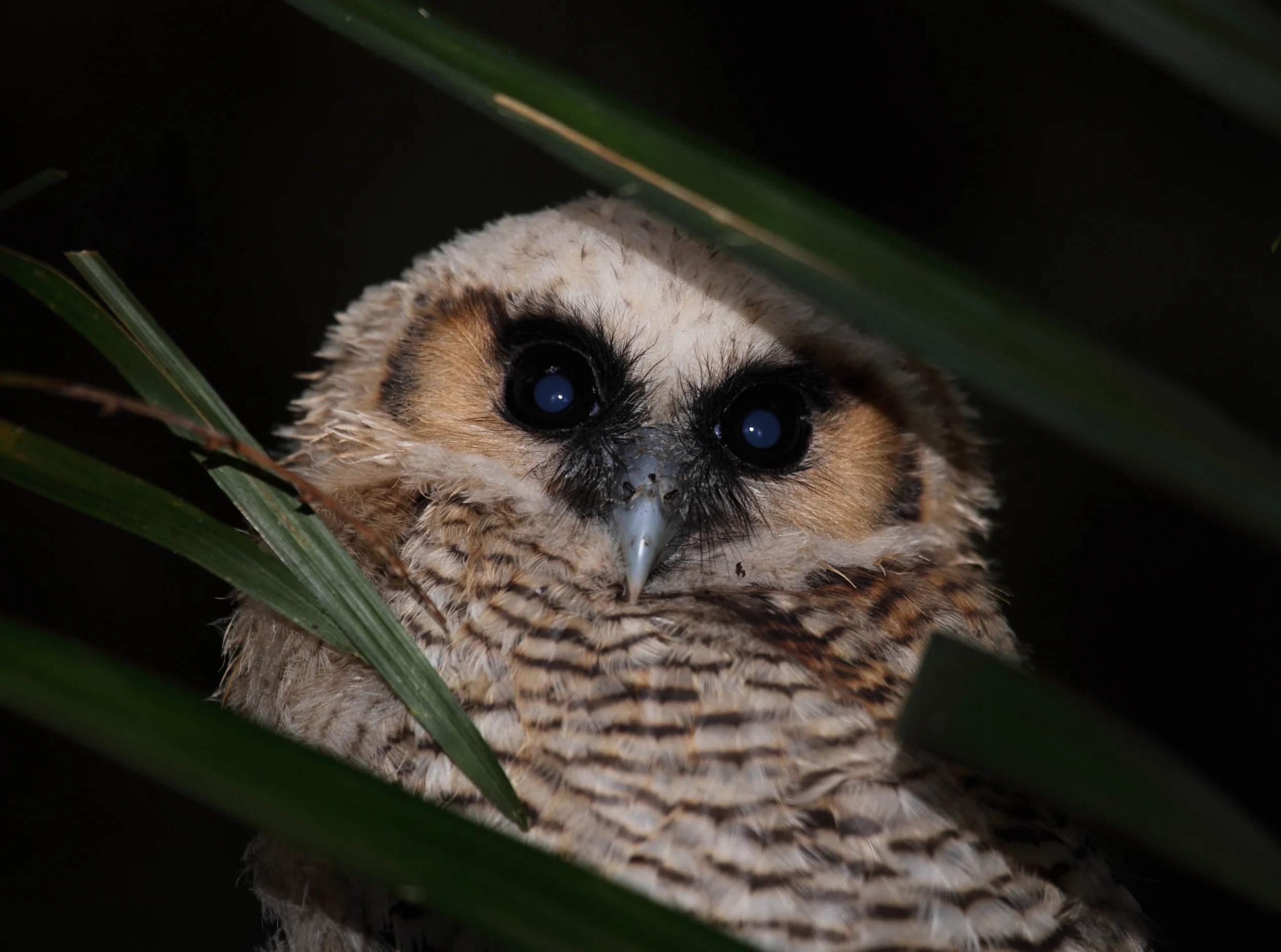
The drive would prove eventful again with captivating views of Red Giant Flying Squirrel gliding, as if driven by invisible guide-wires, between the apparitions of giant Koompassia trunks lit by searchlights. The drive was nearing the end and we had yet to see any birds. As this thought was going through my head, the guide again pulled something out of his sleeve. Just when I thought all hopes of a new owl were dashed, the guide speared the spotlight 50 metres across a clearing to illuminate a pair of preening Brown Wood Owls sitting on a branch about 5 metres above ground level. This was an owl that I had read to be fairly common in the area so it was good to get eyes on it so early in the trip. As the owls sat looking imperious, a Masked Palm Civet ambled purposefully across the open foreground. It stopped to look down its nose at us briefly before continuing on into the forest at the other side of the clearing.

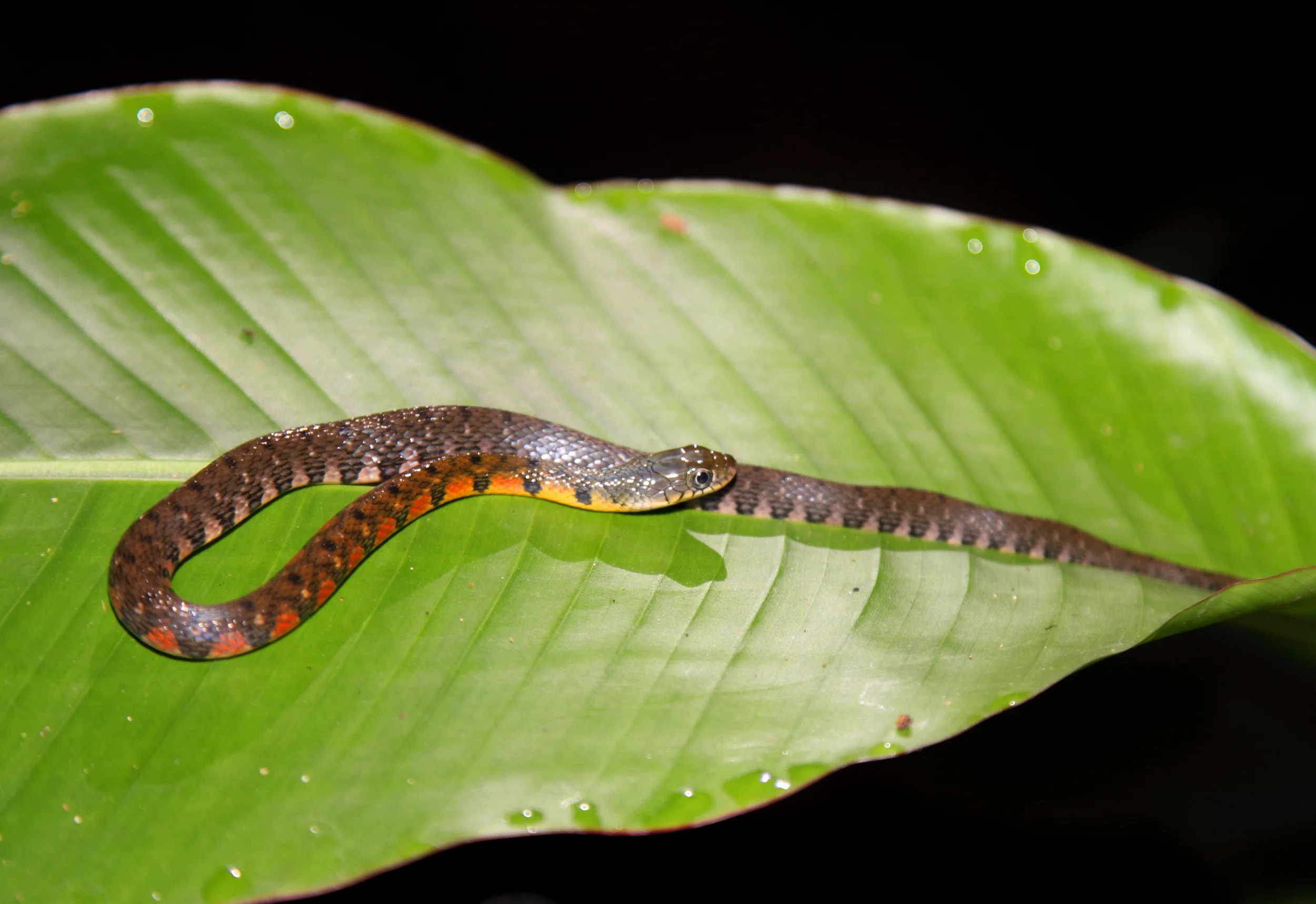
The dozen or so who had joined the evening drive, piled out of the truck and headed back for drinks or an early night but I had other ideas. I split off and headed for the ornamental pond set back from the lodge along one of the nature trails at the forest edge. The sound of calling frogs emanated from every direction but it was still surprisingly difficult to get eyes on one after having my eyes tuned to spotlighting for larger quarry over the last hour or so. But as I adjusted to searching for smaller details, it seemed that frogs were on or under every single leaf I looked at. Best of all, one of the first animals I found wasn’t a frog at all but a frog predator. Sitting in a loose coil on a broad leaf was a strikingly coloured and delicately-built little snake. This one seemed to tolerate my approach impassively and I was able to get some nice photographs. Knowing very few of the snakes of the region I was not confident identifying this species and whether it was venomous enough to warrant being given a wide berth, so I decided to temper my fascination with caution. (Identified later from my photographs as a Triangle Keelback, Xenochrophis trianguligerus, a non-venomous and semi-aquatic species of colubrid snake.) There was much else to attract my interest. In the same small shrub as the snake, I identified at least 3 different species of frog: Nicobar Cricket Frog, Hylarana nicobariensis, Borneo Eared Frog, Polypedates otilophus and one of Borneo’s famous flying frogs, the Harlequin Tree Frog, Rhacophorus pardalis. Around the fringes of the pond and in the garden behind the lodge I found a further two species: Four-lined Tree Frog, Polypedates leucomystax and Rough-sided Frog, Hylarana glandulosa.

Triangle Keelback - a tiny but decorative inhabitant of the frog pond.

Following my second night at Danum Valley, there was just time for a bit of early morning birding before an early departure back up the road to Lahad Datu and out of the forest to head for the next leg of the journey – river birding.

From the balcony, as I ate my breakfast and sipped very adequate coffee, a flock of around eight large, dark birds flew along the river and settled in the gallery of foliage on the far bank. My ‘binoculars-never-out-of-arm’s-reach’ policy served me well and I trained them on a chattering group of Bushy-crested Hornbills making short work of some wild fruit.

Hornbill number five.

KINABATANGAN RIVER

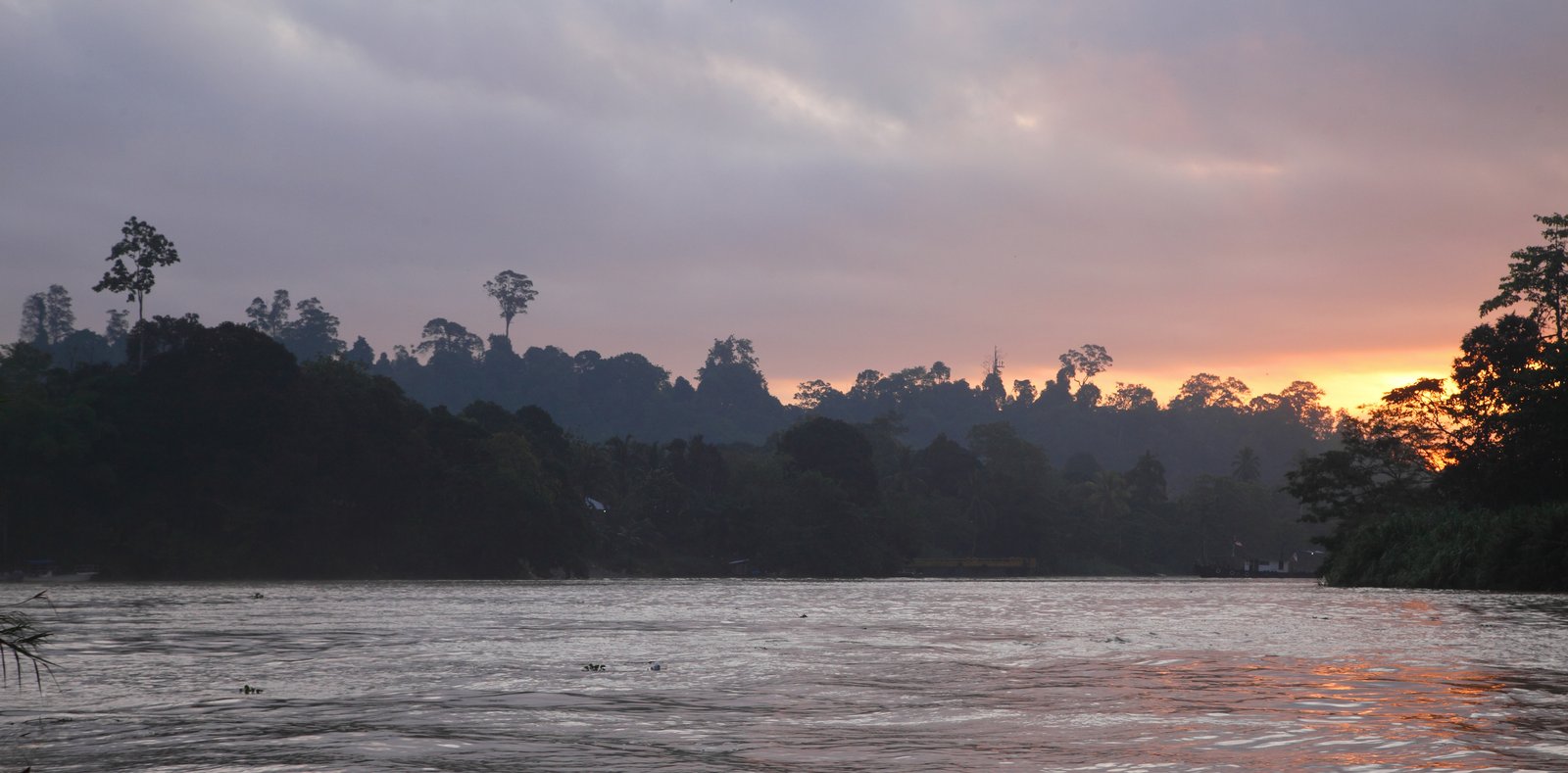
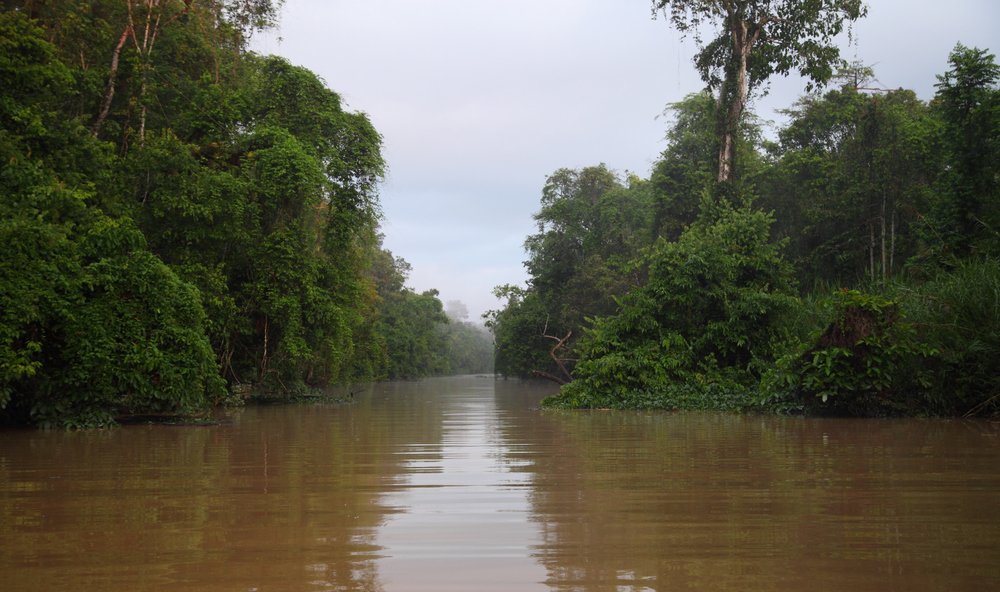
The Kinabatangan near Abai.

After the drive back up out of the forest to Lahad Datu, it was on to the section of the trip that would take me through many extraordinary locations along the Kinabatangan River. This impressive waterway is over 550 kilometres long and empties into the Sulu Sea after draining through an extensive area of periodically flooded lowland forest and mangrove swamps. Having spent a lot of time in Australia’s Top End, I was interested to learn that the Kinabatangan was well-known as a sanctuary for a population of Saltwater Crocodiles. My response to the Top End mantra of being ‘croc-wise’ is reasonably straightforward: complete and total avoidance of all water. (Mick Jerram will attest to my diligent adherence to crocodile safety practices bordering on the hysterical, but that’s a story for another post.) But my own methodical caution is certainly not shared by many Top End residents and I became used to the near-suicidal sangfroid of Darwin folks wading out into coastal waterways to check their crab pots or retrieve their five dollar fishing lure. But if I thought this was taking a far too cavalier attitude towards self-preservation in the presence of an ancient and superior predator, I was about to get a lesson. The fine folks who reside along the Kinabatangan corridor personify an air of casual disregard for the infamous, fearsome, and well-deserved reputation of Salties to take anything and everything on or near the water’s edge.

To be fair, the population of crocodiles along the Kinabatangan is apparently very small and is threatened, as so many other creatures have been, by changes to the ecology of the upper Kinabatangan from logging and land clearing. Sadly, during four straight days on the river I failed to see, or even hear of anyone seeing, a single crocodile.

A minor tributary of the Kinabatangan.

But the Kinabatangan is world-renowned for a huge variety of wildlife besides its crocs. The forests here, are stalked by the spectacular and rare Sunda Clouded Leopard. Although it is rarely seen, for those of us plying the river and its small tributaries hoping to see wildlife, it has an important role to play. Many of the other animals in the forest are so shit-scared of the leopard that from dusk ‘til dawn they head for the trees closest to the water’s edge to spend the night out of reach. So an early start to a cruise along the river can be a very rewarding experience.

Probably the most famous of these animals, and another Borneo endemic, is the bizarre-looking Proboscis Monkey Nasalis larvatus. In the lower reaches of the Kinabatangan, large family groups of these intriguing primates can be seen crowding the foliage overhanging the river. Once the sun is up they go about the social business of preening and vocalising, reinforcing bonds and taking census of the family, before heading into the forest to forage during the daylight hours.

The Proboscis Monkey - easily seen along the Kinabatangan in the early morning.

From our lodge upstream of the small village of Abai, we set out early in small boats up tiny side streams and oxbow lakes and the lifers seemed to be jumping out of every tree. Wild elephants grazed along the river banks. Overhanging branches supported snakes and almost every floating stump sported a kingfisher of some kind. Water Monitors were common, loafing along the banks of the small streams. Our main target down this tributary was the endemic Bornean Ground-Cuckoo. This is a classic skulker. Even the bird guides who work in this part of the country only clap eyes on the bird a few times a year if they are lucky. We were just drifting slowly down the stream listening for the distinctive call. Before we could hear anything though, our attention was drawn to a brightly coloured bird perched in the gallery foliage beside the boat: a Black-And-Red Broadbill. One of the more common broadbill species but still an exciting bird to view so closely.

Mangrove Cat Snake Boiga dendrophila.

Further downstream, our attention was subsequently hijacked by a pale morph Changeable Hawk-Eagle, Scarlet-rumped Trogon, Stork-billed Kingfisher and a confiding Purple Heron. While I was happily being distracted by all this action, the guide had one ear ever-cocked for the ‘whooh’ call of the ground-cuckoo. Eventually he took on that unmistakeable look of someone who has heard something. His eyes narrowed.

“That’s it”, he said quietly.

The day was heating up and the jungle racket of the cooler morning had died down to a more moderate background roar. As I listened it was just possible to make out the ground-cuckoo’s call. The coxswain positioned the boat on the bank and we could hear scratching on the forest floor just a few metres in from the bank but hidden by dense foliage. Eventually a second call came. Two of the trickiest birds to see on the island of Borneo were just metres away but they may as well have been miles away. The vegetation was so thick that we stood no chance of seeing them. The coxswain brought out a paddle and silently manoeuvred us a bit further along the bank to a small break in the green wall. We had a tiny portal through which to survey the dappled light on the forest floor within. After a few minutes the guide leaned over to me, grabbed my shoulder, and pointed very slowly. His steady finger drew a direct line to a dark shape, a bit like a sleek chicken or perhaps a large coucal, scratching among leaf litter about 15 metres away. When it stepped through a patch of light it showed the most enchanting colours of turquoise, green and aqua along the neck and scapulars with the rump and tail vanishing in a deep velvety purple. The headed was hooded almost jet black with green facial parts, and the underbelly was pale with horizontal barring. This was a massive bit of luck to get such a good view of such a rare species and the guide was clearly elated – that’s about the best sign that you’ve just had a crippler. I would have been excited at seeing such a fantastic bird under any circumstances but it adds something to the experience when your guide is visibly exhilarated by the encounter as well.

It was going to be difficult to top this sighting, so we backed off from the ground-cuckoo and tied the boat up in some shade for a coffee break and to let the excitement wash over us for a few minutes. A large male Orangutan bellowed somewhere in the distance. The call resonated through the forest. An Oriental Darter stuck its head up among some lily pads before vanishing back underwater. A Blue-eared Kingfisher alighted on a branch beside the boat. As I sat sweating and sipping coffee a dangerous thought occurred to me – how was I ever going to top this experience?

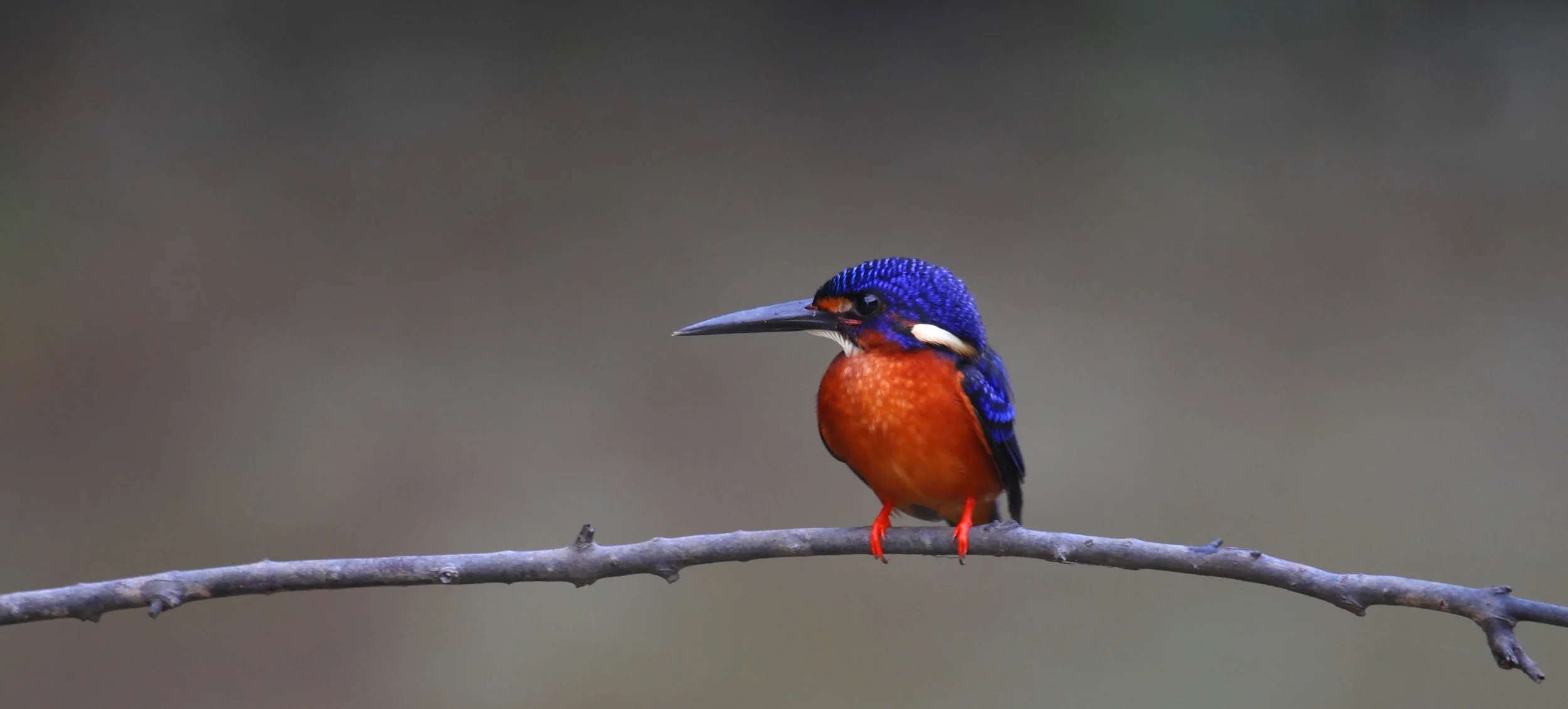
Blue-eared Kingfisher - regularly encountered along the water.

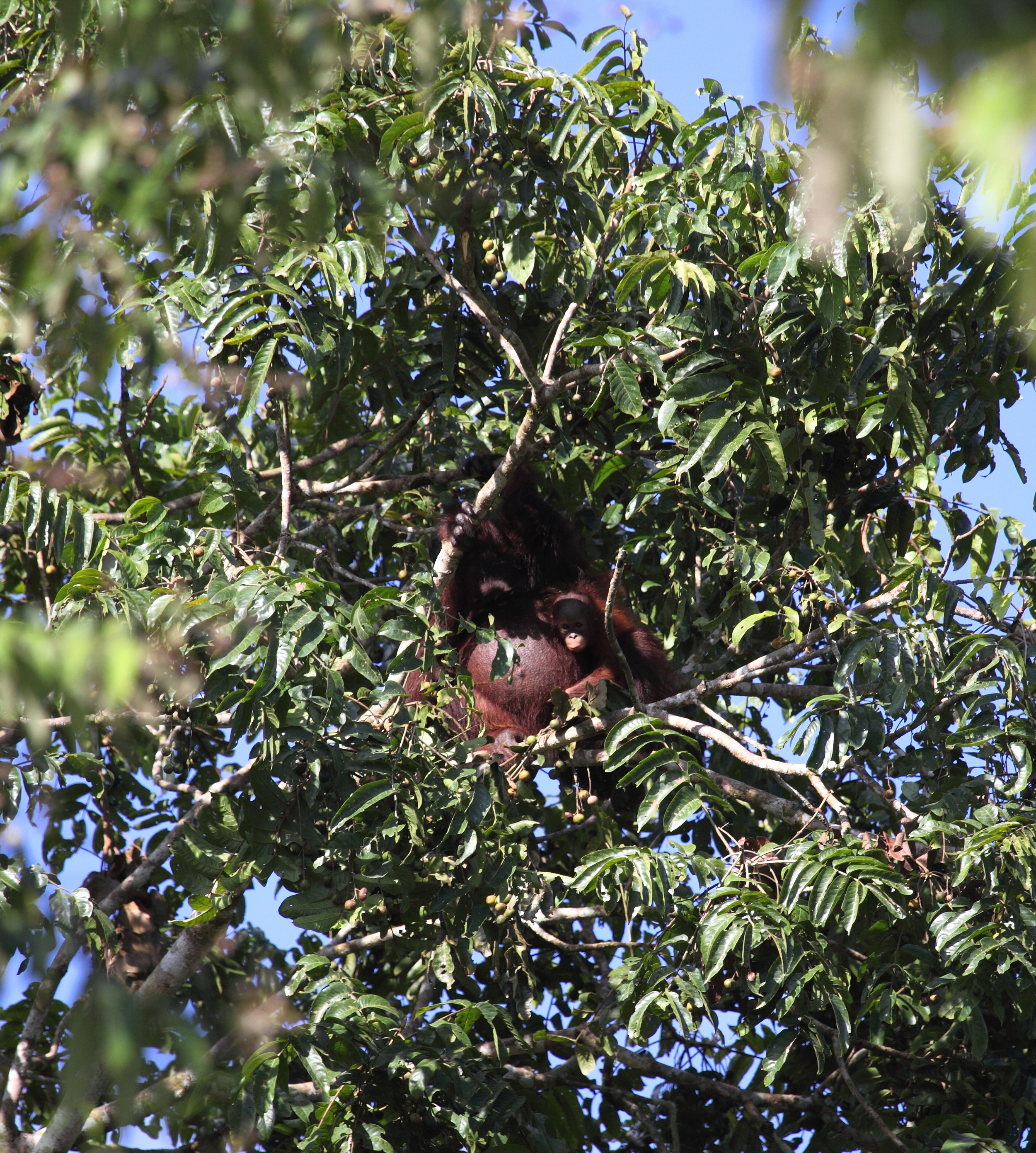
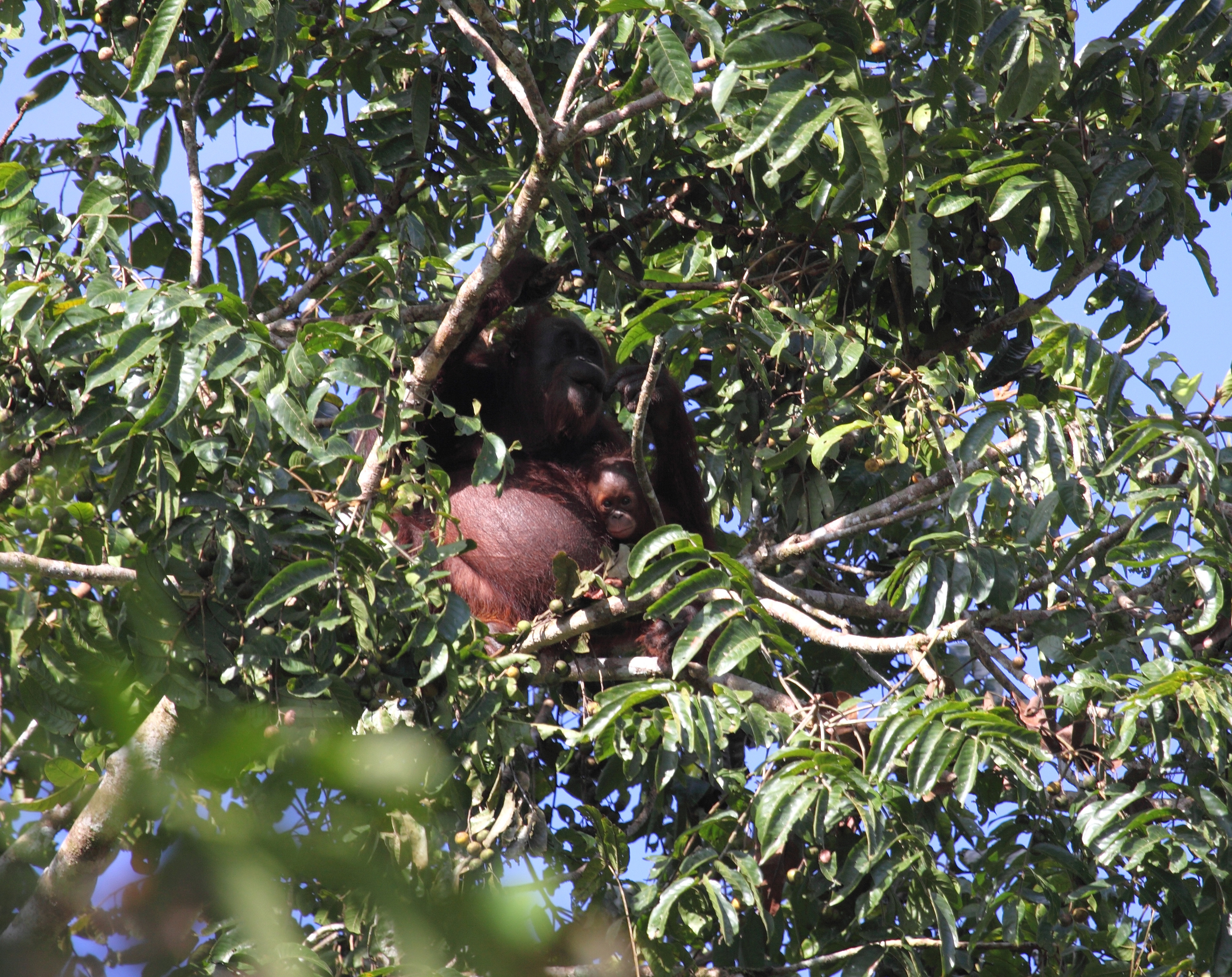
We had our afternoon all planned out ahead of us and we needed to head back to the lodge for lunch, but we made our way slowly, seeing new birds all the time. Once we were back on the Kinabatangan proper, the guide flicked a hand signal to the coxswain who immediately killed the engine and looked toward the far bank. The river was wide here – at least 250 metres across. But despite the distance, my guide had just demonstrated precisely how strongly the force flowed through him. (My guide for this section of the trip was the inimitable Mirwan – widely known as Obi-wan due to his Jedi-like ability to find wildlife. It was a fitting moniker for one so impressively attuned to his surrounds.) In the very top canopy of the trees on the far bank, a large adult Orangutan sat motionless. As we quietly motored across, it was apparent that it was a female trying her best to stay out of the sun. She sprawled, effortlessly suspended in the treetops like a huge hairy hammock for a young infant. Both the adult and infant looked directly at us. Time stopped for a bit while we just looked at each other. There was less than a 2% difference between the make-up of our genomes but this still marked an unbridgeable gulf between our differing experience of life on Earth.

The infant rested its head back on its mother’s belly and dozed off. Time resumed its usual relevance and we started back up the river to the lodge.

The rest of the afternoon would be spent in very different surroundings seeking serious raptors and cave-dwellers.

GOMANTONG CAVES

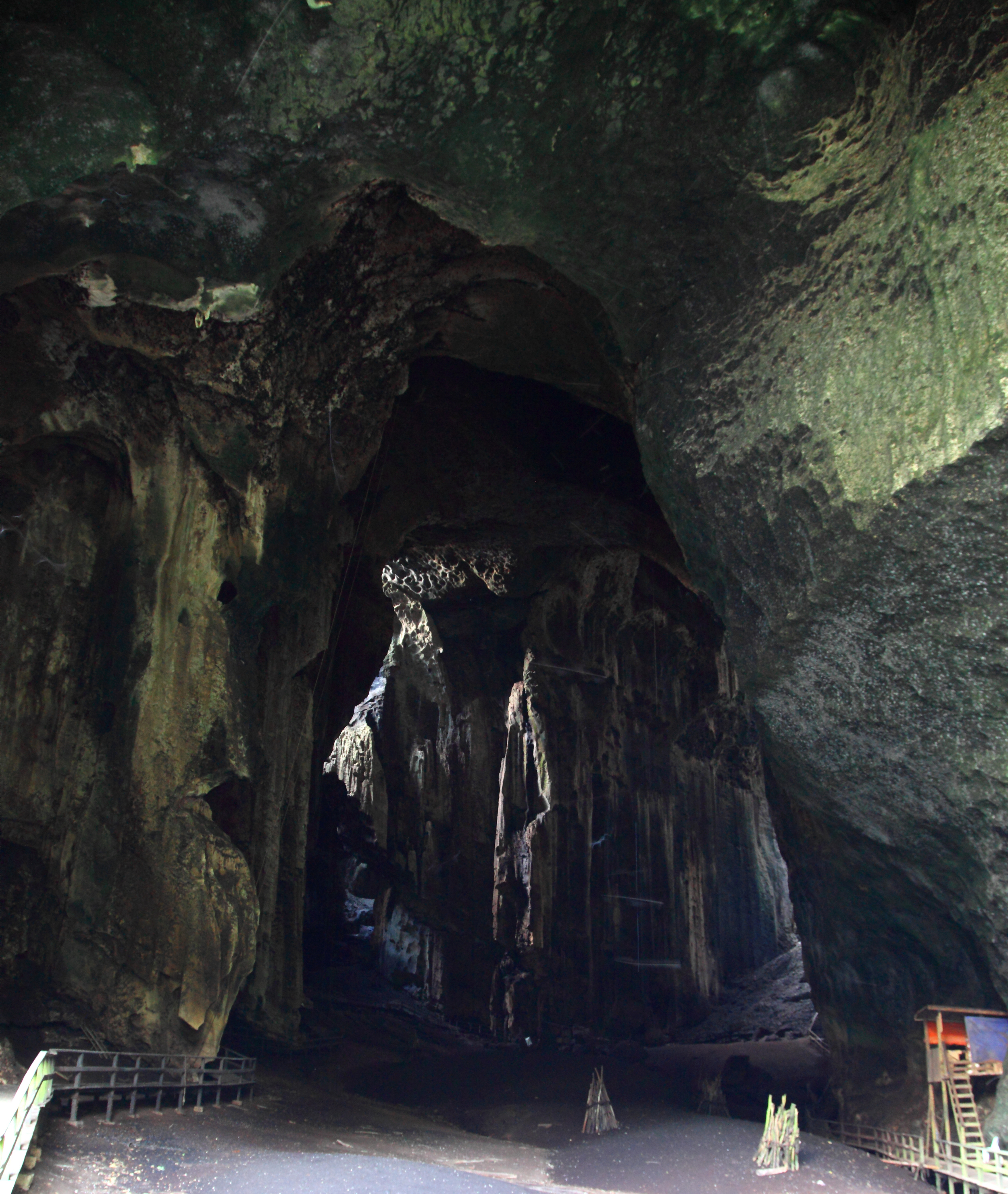
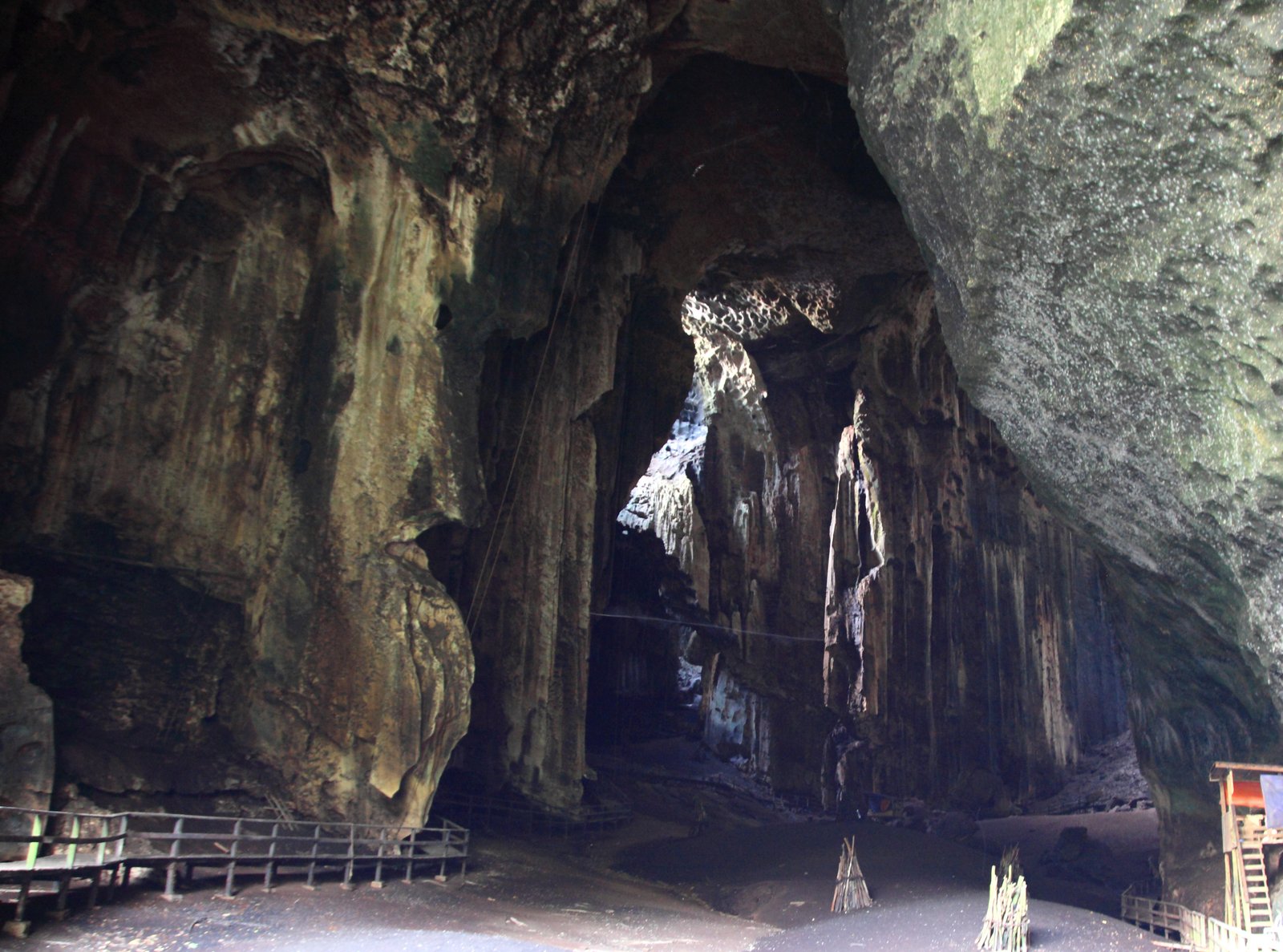
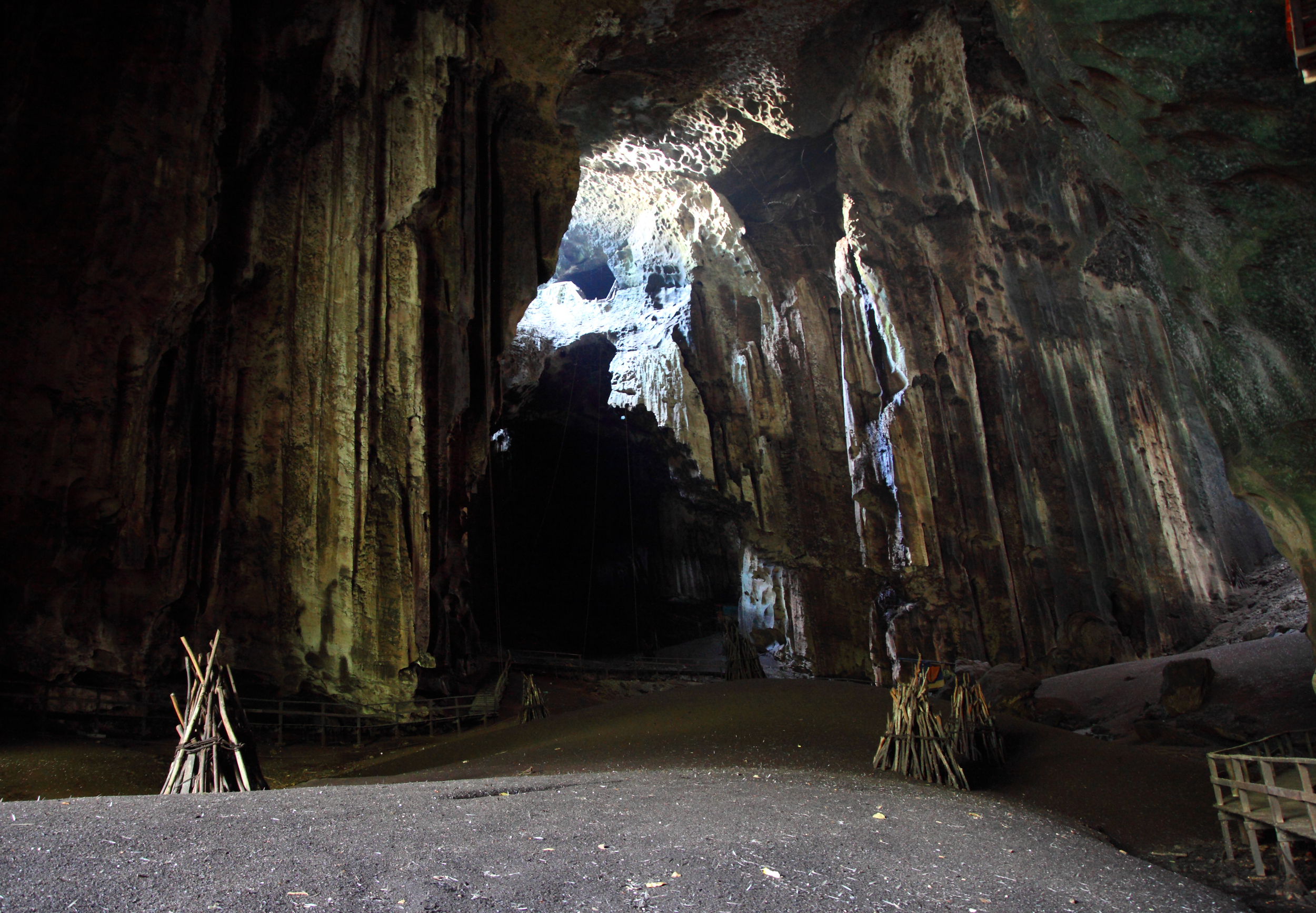
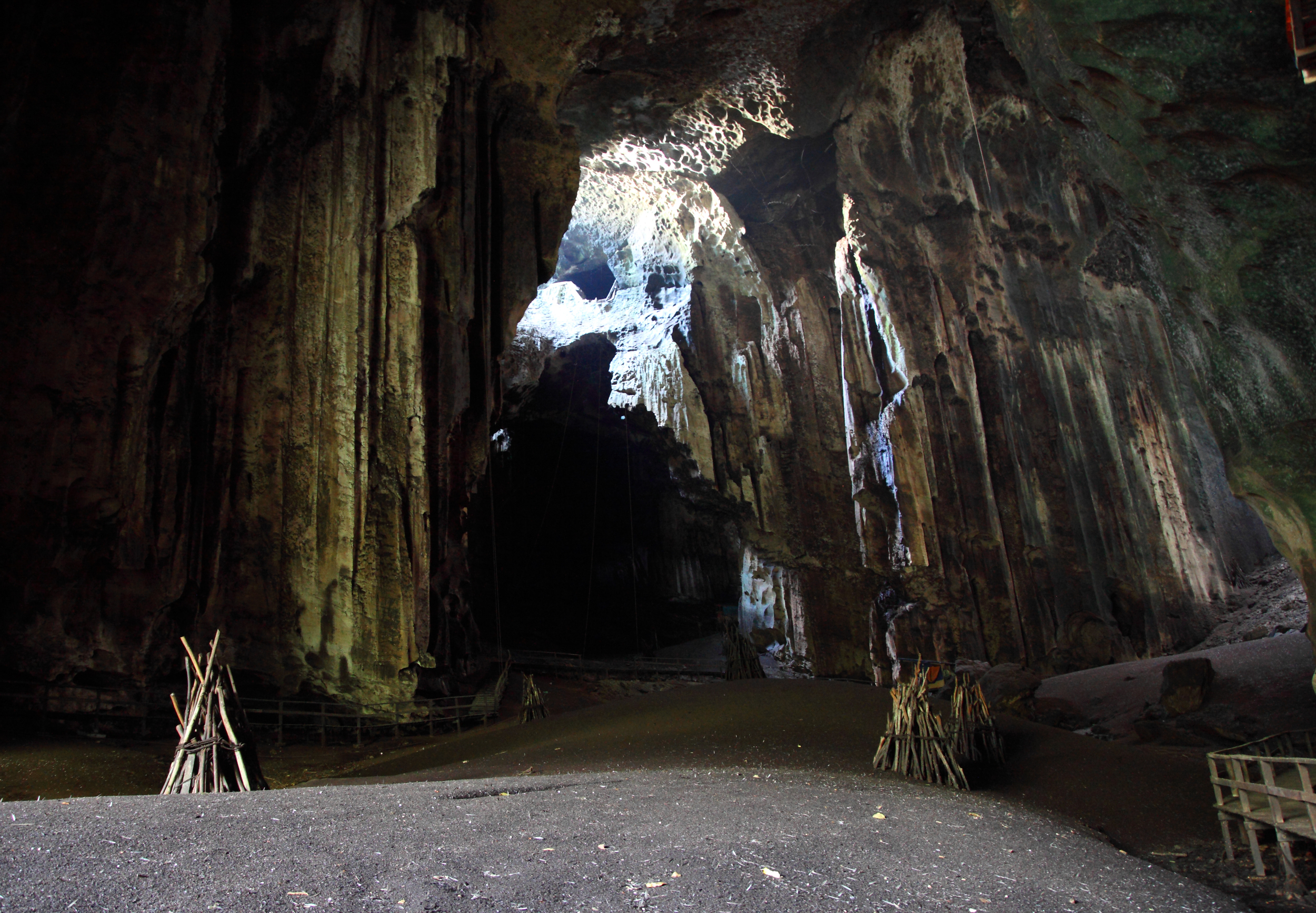
The limestone caves at Gomantong are famous, but they should be even more so. I’ll have to flag this experience, even among all the other extraordinary things I saw on Borneo, as the unchallenged highlight. Even Sir David Attenborough rates it as among his most memorable experiences. From a bloke whose list of world wildlife and travel must top everyone else's, that is surely the highest praise possible.

It was a short but very birdy drive from the banks of the Kinabatangan into the Gomantong NP where the caves are situated. On reaching the caves, we wasted no time and headed straight in.

There’s no other way to describe the experience of these caves but pure sensory overload. The heat and humidity was reaching its peak in mid-afternoon. There was the constant white-noise of millions of roosting and circling bats and swiftlets. The floor of the caves were metres deep in guano giving the air a suffocating stench of ammonia, and the floor and walls were all concealed behind a moving carpet of cockroaches and various other insect life.

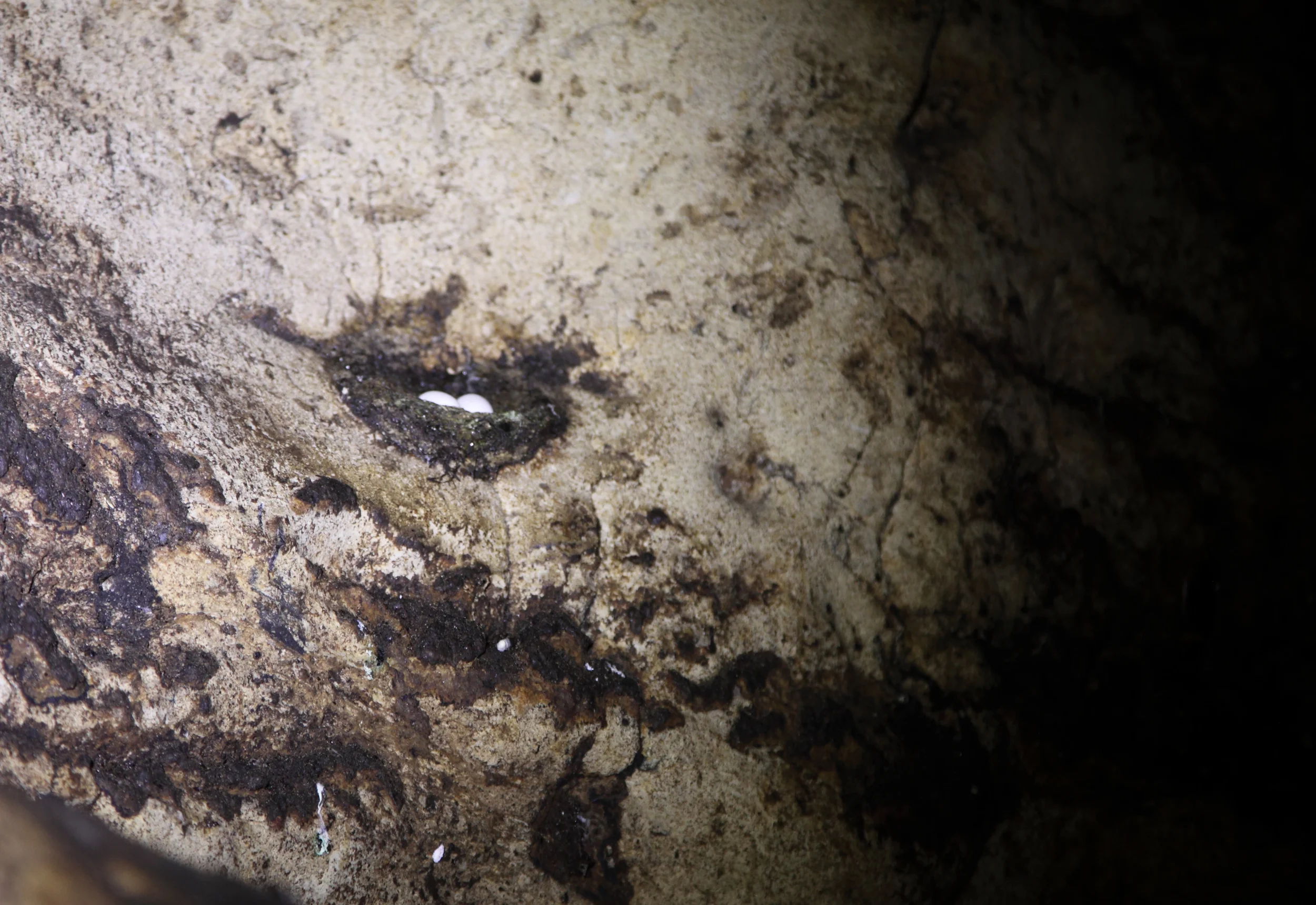
A boardwalk kept us mercifully clear of sinking up to my waist in the guano and took us on a walk around the internal perimeter of one of the larger caves. Here we could view all three species of swiftlets that call the caves home: White-Nest, Black-Nest and Mossy-Nest Swiftlet. The first two species are the famed ‘edible nest’ swiftlets. The saliva nest of the White-Nest Swiftlet is the more valuable, with a single 8 gram nest fetching up to $50 on the retail market for the production of bird’s nest soup. The nest of Black-Nest Swiftlet is less valuable as it is constructed not from pure saliva, but a mix of feathers and plant matter bonded with saliva. (As the name suggests, the nest of Mossy-Nest Swiftlet are made mostly of plant material and are of no commercial value.) Generations of local people have tenaciously guarded their right to harvest the nests of the swiftlets and, although this is done is a strictly regulated fashion, it seems that this practice is having a deleterious effect on swiftlet populations. Farming of edible-nest swiftlets has apparently been experimented with but none have been successful.

A mossy nest with eggs.

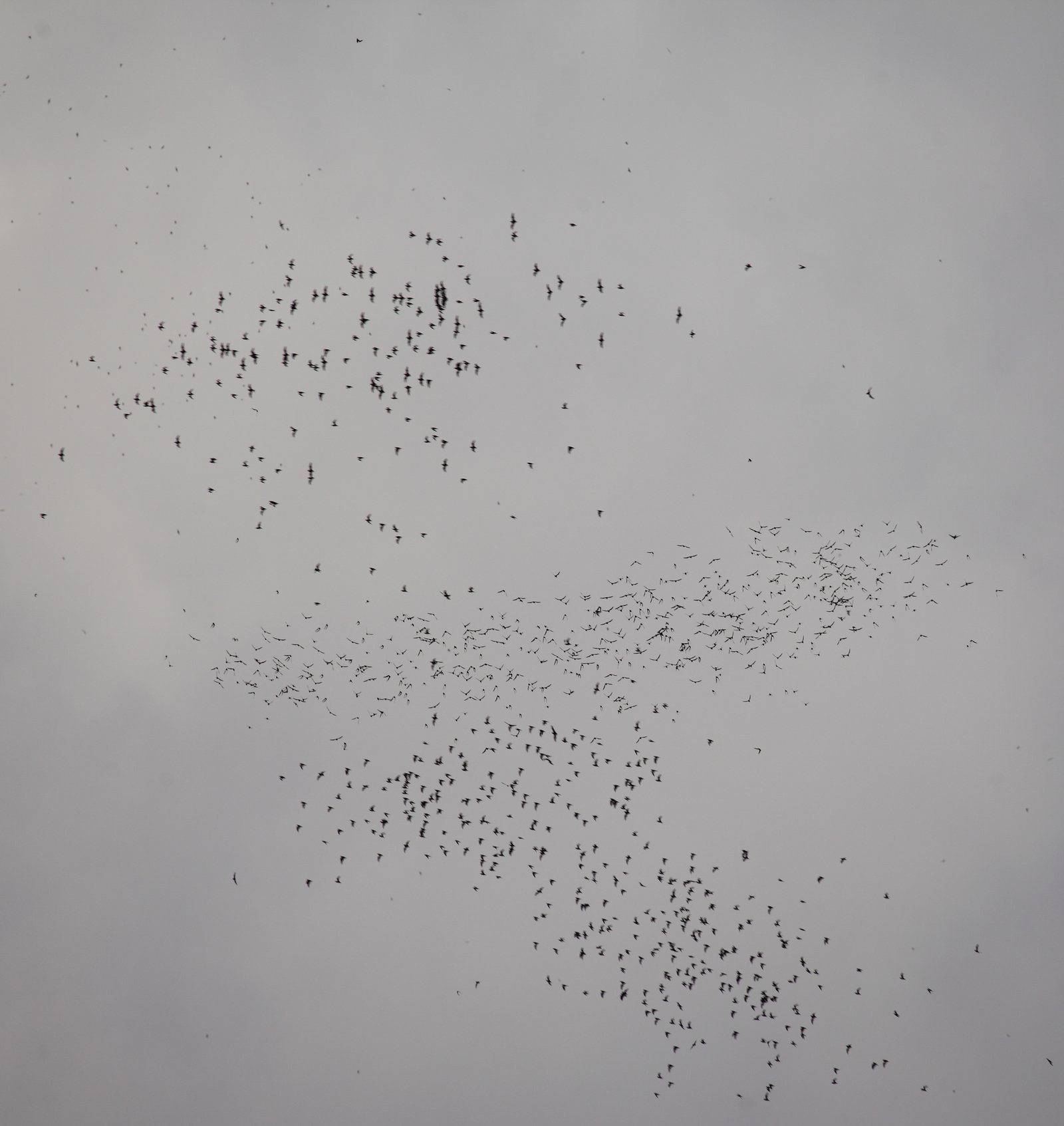
The three species are all capable of echolocation much like the bats that they ‘hot-bunk’ with. As dusk fell the swiftlets returned from day-shift, just as the bats roused from slumber and prepared to head out for their night of foraging.

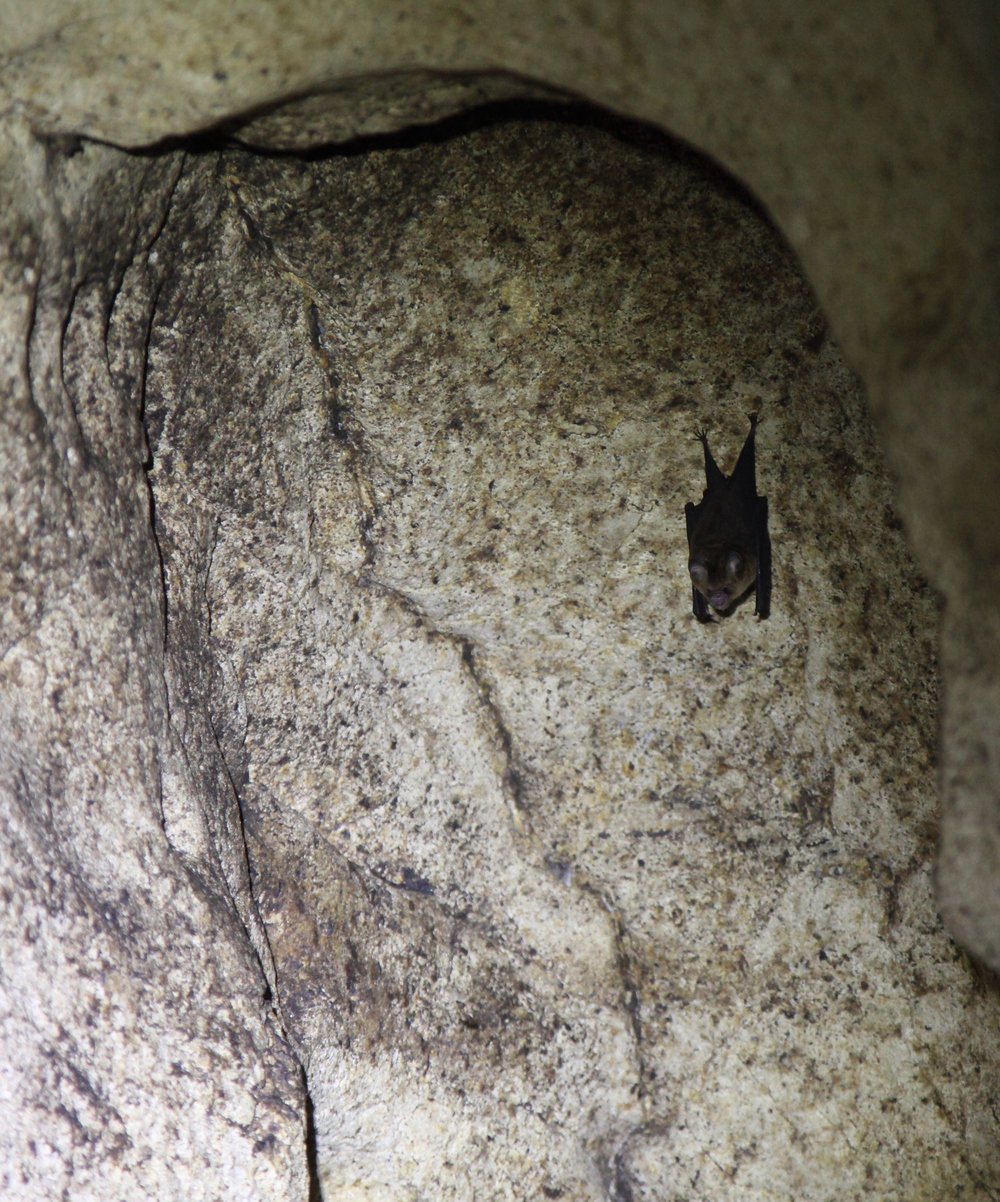
A lonely Large-eared Horseshoe Bat. Higher up in the cave they cluster in their hundreds of thousands.

There are three main species of bats that live in the Gomantong limestone caves: Large-eared Horseshoe Bat, Rhinolophus philippinensis, Wrinkle-lipped Free-tailed Bat, Chaerephon plicatus, and Fawn Leaf-nosed Bat, Hipposideros cervinus, a species also present in Australia. All up, there are over a million of them, and when they leave the cave at dusk, you’d better believe that an exodus on that scale is going to attract some attention from hungry predators.

The superstar of the Gomantong show was the Bat Hawk, Macheiramphus alcinus. This beautiful raptor occurs in sub-Saharan Africa and in southern Asia all the way to New Guinea. It was barely dusk and we could already see a few of them circling high up. A light shower of rain had delayed the bats’ egress from the cave but had provided us with the spectacle of a double rainbow over the caves with Bat Hawks, Wallace’s Hawk-Eagles and Peregrine Falcons soaring about them.

A more surprising appearance came in the form of a large bird that I had no idea would be an opportunistic predator of bats.

Hornbill number six.

A family of Rhinoceros Hornbill perched in a palm tree above us, noisily interrogating the fruit. Apparently when there are bats in the air it is not uncommon to see the hornbills sailing through with their bills ajar to catch the tiny insectivores.

We didn’t have to rely on watching hornbills’ clumsy attempts at catching bats though as the exodus soon began and the real raptors went straight to work. The Bat Hawk was easily picked out due to its overall dark colour with prominent white patch under the throat. In a move that any reader of this blog will almost certainly have seen a hundred times on Attenborough’s documentaries, the hawk would swoop down through a cluster of bats and throw its legs forward with the talons spread wide to snare its prey. The Peregrine used a more traditional technique of stooping from high above, while Wallace’s Hawk-Eagle seemed to favour the more labour-intensive approach of separating an individual bat from its flock and pursuing it single-mindedly.

As the skies darkened it became progressively harder to pick out the bats and their persecutors, so we packed up our scopes and headed back to the river for our evening cruise back to the lodge. We would have much more time on the river tomorrow and were heading farther downstream to where the Kinabatangan sprawls out across vast coastal wetlands and mangrove swamps.

KINABATANGAN WETLANDS

Setting off early again, we drifted down past most of the country we had been exploring the previous day. The river widened steadily and the banks took on a different character. More of the shoreline was lined with rattan and here and there were people in smaller boats harvesting this giant plant for crafting into cane products. The banks were lower with more extensive inundated areas. Navigating the river itself became more risky owing to huge numbers of large logs that were floating downstream, often with a just a small amount of their bulk showing above the surface.

We visited a couple more oxbow lakes, saw a circling kettle of Lesser Adjutant, a lot more kingfishers, a pair of Black Eagle and eventually made it down to the Kinabatangan Wetlands Resort. This is a new wildlife lodge located on the edge of the huge Lower Kinabatangan Segama Wetlands. This Ramsar listed area, covers almost 790km2 of the lower Kinabatangan and the nearby coast.

We’d only travelled a couple of hours downstream but it was surprising how much of a change it made to the species composition. Long-tailed Parakeets zipped overhead and we constantly scrutinised the many pigeons that flew overhead. As well as Pink-necked Green Pigeon, Little Green Pigeon and Green Imperial Pigeon, we hoped to get eyes on one of the more hard-to-find pigeons of coastal regions: Cinnamon-headed Green Pigeon. Kinabatangan Wetlands Resort (KWR) has already developed quite a reputation as a good spot to find these smallish fig-eaters.

None of the pigeons we checked seemed to be the Cinnamon-head, but our attention was attracted to a cackling noise coming from the trees beside the river. Obi-wan barely hesitated.

“Pied Hornbill.”

Oriental Pied Hornbill to be precise.

Hornbill number seven. Eyes down for a full house!

Rounding a bend in the river, we swept around the base of an immense dead tree. The tree seemed to have a number of sizeable hollows but, having no foliage at all, I didn’t give it a second thought. My folly was demonstrated only a few seconds later when Mirwan pointed out a bird I had really been hoping to see. Perched motionless on a high branch, with its grey colour blending well with the dead timber, sat the world’s largest woodpecker species.

Fully half a metre long, the Great Slaty Woodpecker flew down as we watched and tended a hollow where another bird stuck its head out to greet it. A breeding pair of Great Slaty Woodpecker.

As we alighted at the resort’s jetty, we immediately heard the call of Brown-capped Woodpecker and shortly afterwards we got eyes on one flitting between palm trunks. At the top of the same trees there were numerous pigeons, which held our guide’s attention for a bit longer than expected. After a short pause, the call came…

“Cinnamon-head!”

Sure enough as I scanned through the many pigeons clustered on top of the palm, three that sat together in the centre had a wonderfully rich cinnamon colour, not just over their heads but down the neck, breast and a lot of the back as well. A truly stunning bird and a cracking species to get on the list after a whole day of searching.

Cinnamon-headed Green Pigeon: right on cue.

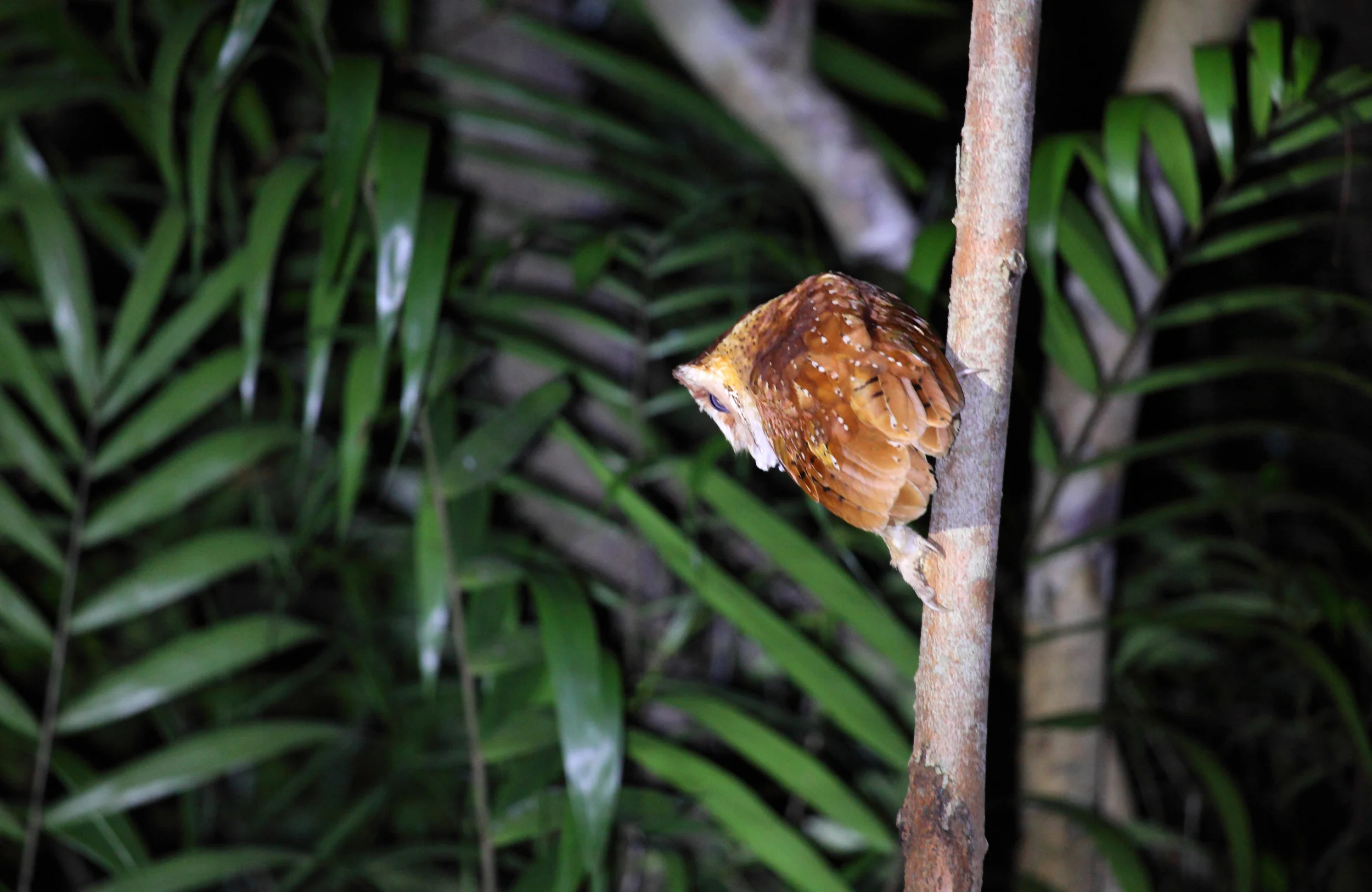
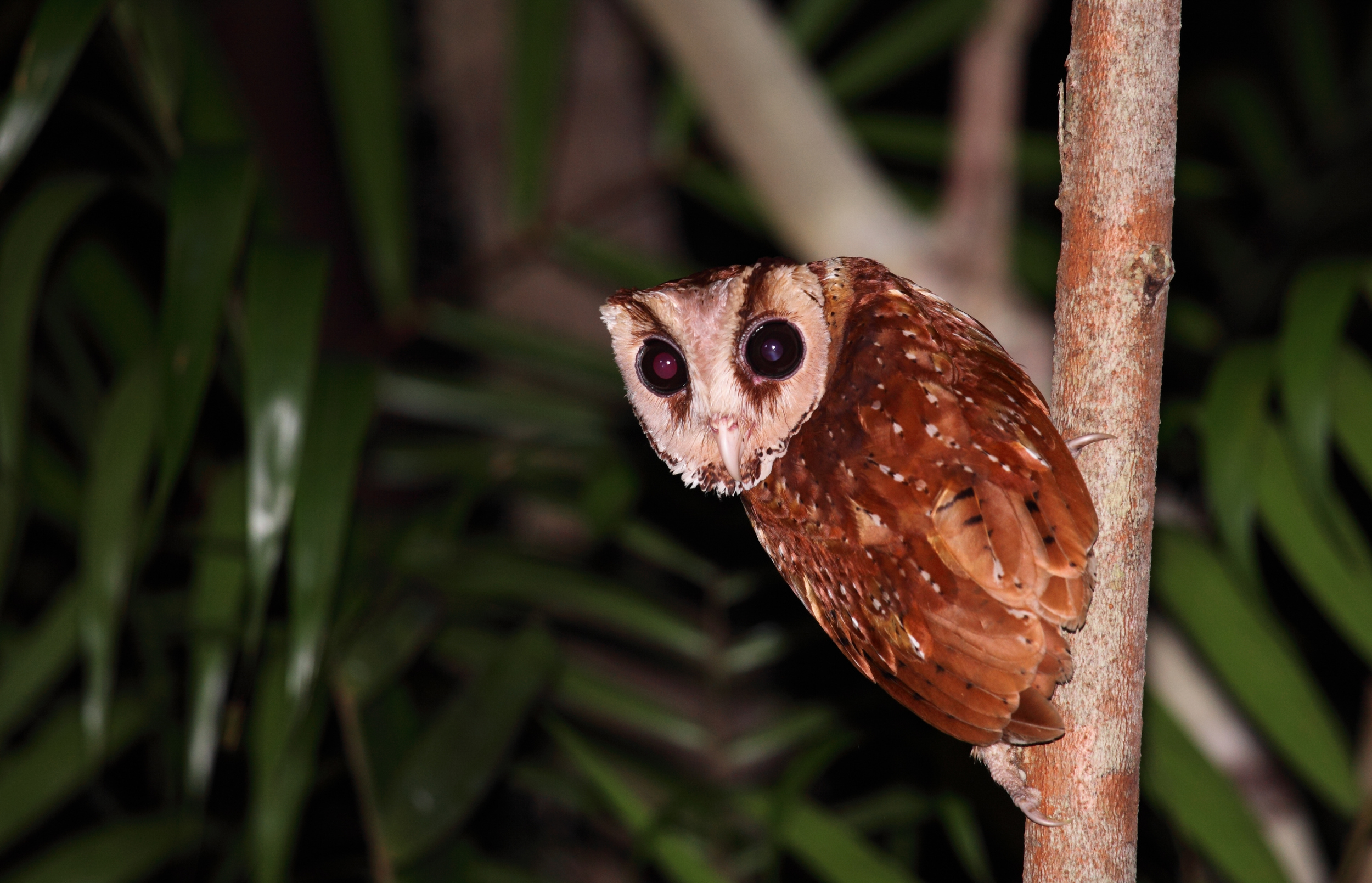
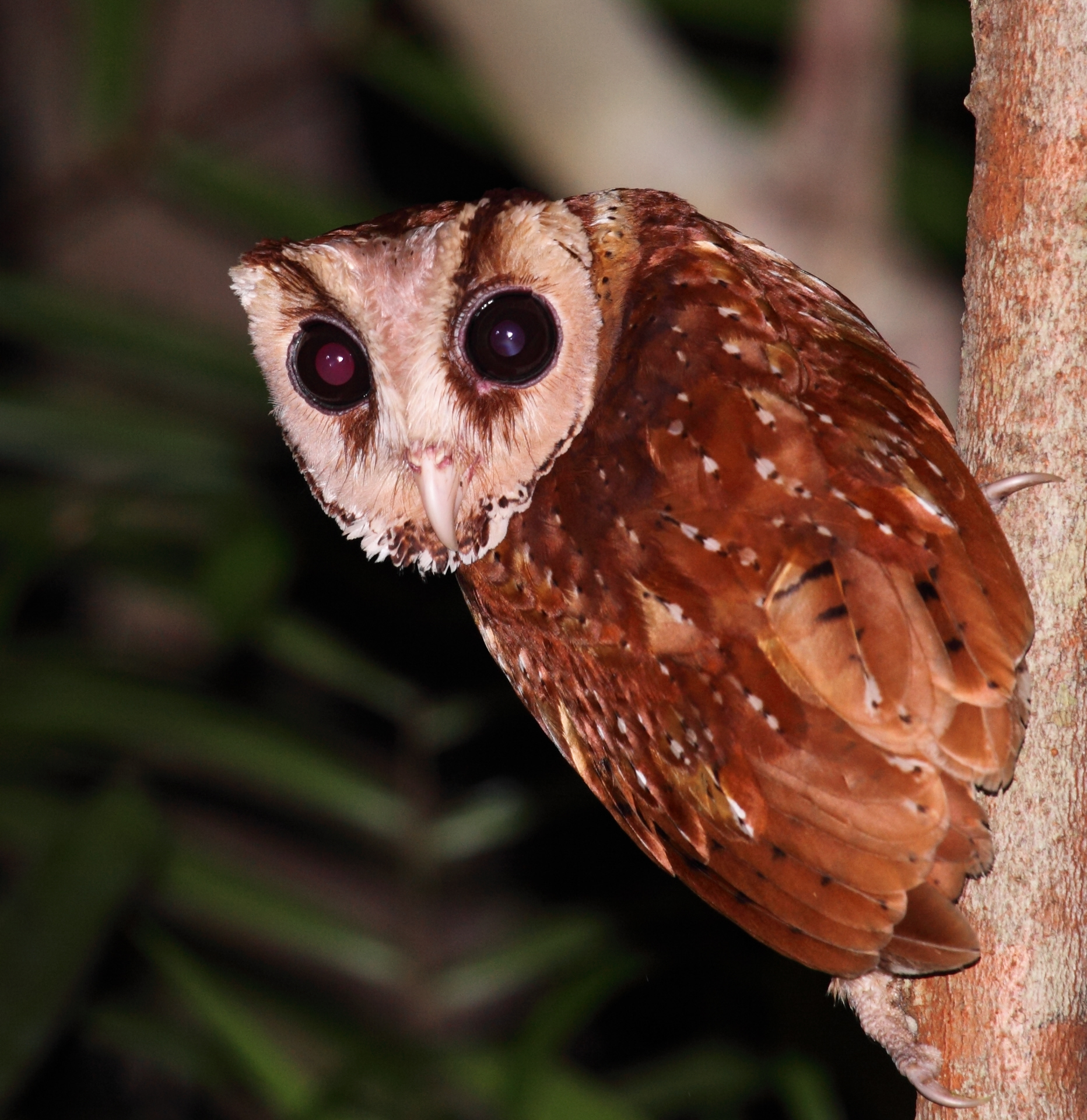
After another enjoyable afternoon on the river, I was most looking forward to getting out with the spotlight on the resort’s newly-finished boardwalk. This boardwalk is another trump card in KWR’s already strong hand and traverses several hundred metres of lowland mangrove forest. Slow Loris is regularly seen here along with Bearded Pig and Sambar. In particular, I was hoping to get a look at a special owl that this boardwalk is starting to become known as something of a hotspot for.

Setting out after dark we saw both Bearded Pig and Sambar only a short way from the main buildings of the resort. There was some motion in the trees above our heads and eventually our spotlights found a ribbon-thin snake which turned out to be a White-spotted Cat Snake Boiga drapiezii. This bizarre-looking snake looked more like a gigantic elongated tadpole than a snake. The bulbous head looked far too big for the slender body, and the body seemed so slight as to be incapable of housing all the organs that I knew it needed.

Our walk came to an end where the boardwalk finished at a cul-de-sac. It was a very still night and I strained my ears for a sound of anything moving but the only sounds were our shoes on the planks. We stayed a while just listening. There were plenty of frogs calling but none close enough to the boardwalk to identify. A while longer and it was time to head back along the way we had come. It was a disappointing end to a spotting session as we hadn’t seen a lot of wildlife and certainly no owls. Perhaps my expectations had been too high. As a tour guide, managing clients’ expectations is a big part of the job and in this instance it would seem I had failed to effectively manage my own.

But as I dawdled back along the boardwalk at the rear of the group it was consoling to have had such a blindingly good day with so many other lifers. A dud spotlighting session was hardly enough to dull the excitement from the many other wins of the day.

Then, literally as these thoughts were going through my head, there was a solid thud in the dark just a few metres to my left.

It took no skill at all, and barely any effort to train my spotlight to the left where something akin to divine providence had delivered an absolutely crippling owl sitting at eye level about 6 metres away. Nobody else had heard it, and it was shielded from view by foliage for most of the guides as I insisted they come back and stand with me. It was completely unperturbed by our presence and it allowed us to get a number of quite good photographs.

Indisputably now the bird of the trip, it was an Oriental Bay Owl – a bizarre beastie. Field guides would later tell me that this uncommon owl is usually encountered perched sideways on a vertical sapling close to the forest floor where it waits to ambush forest rats. As you can see from the photographs this is pretty much precisely how I encountered it. It slowly rotated its face toward me then ignored me completely for the next few minutes as it scoured the leaf litter for any movement that might indicate prey. We never got to see it hunting, as we retreated to give it peace, but the feeling of sharing the same pocket of time out in that dark mangrove swamp on the edge of Borneo will stay with me forever.

My time at KWR was magical but short, just an overnight stay, and much of the next day was taken up with travel. We rose early to get a couple more sunbirds around the resort grounds and then boarded the high-powered speed boat that whisked us down the last stretch of the Kinabatangan, out into the Sulu Sea and down the coast to Sandakan.

RAINFOREST DISCOVERY CENTRE

As the Kinabatangan opened out and merged with the Sulu Sea it was clear that it was a shallow and sheltered body of water. No seabirds were spotted other than a few Crested Terns. The trip around the coast to the city of Sandakan took us around 2 hours. Sandakan seemed like a thriving small city with numerous floating townships extending out over the water.

Following a short drive through the city we got to Sepilok just beyond the outskirts of Sandakan. Sepilok, perhaps most famous as the home of the Orangutan Rehabilitation Centre and the Bornean Sun Bear Conservation Centre, is rapidly building a reputation as one of the top birding destinations on the island of Borneo, largely due to the Rainforest Discovery Centre (RDC).

The RDC protects a chunk of primary rainforest on the edge of the Sepilok Forest Reserve. It has an extensive network of trails through the forest and a huge raised walkway giving views out across the top of the canopy. With viewing towers at intervals along the walkway, it has become one of the best places to find and view Bornean Bristlehead – the photographs of this stunning species by Sandakan Borneo Bird Club President, Cede Prudente, at RDC make this clear enough. Below the walkway, the dark forest floor holds Black-crowned Pitta and the creeks and ponds attract Oriental Dwarf Kingfisher. I just had time for an afternoon to dusk session here but after dark there are mammal-spotting walks taken and the centre has Slow Loris and a population of Western Tarsier.

KINABALU PARK

After an overnight stay in Sepilok we headed off early on the overland trip to Kinabalu Park on the lower slopes of Mount Kinabalu. I had come almost full circle from my start point in KK but there was still much birding to be done in my two nights at Kinabalu Park. This place held promise on a number of fronts. Aside from offering respite from the smothering humidity and high temperatures of the lowlands, many of Borneo’s endemic species live in the montane forests on this and neighbouring slopes.

Kinabalu National Park (KNP) is World Heritage listed and gets higher visitation than many of the other sites I had visited. It doesn’t attract the tourists looking for Orangutan or elephants so it’s more of a birdwatcher’s place really, but it gets a lot of muggles interested only in climbing the mountain for whatever reason. It is now a very well-worn path and described as quite an easy ascent considering the summit’s height and remoteness – they even run races up it.

But topographic conquests have never been my thing and we had too many lifers to chase to bother with walking up to the top. In particular KNP is known as a good spot to find “The Whitehead’s Trio”. These birds, each of which has graced a cover of one of the first three editions of the Phillipps’ field guide, are some of the trickiest birds to get eyes on. Named after the 19th century explorer of northern Borneo, John Whitehead, these are just three of the many animals that bear his name: Whitehead’s Spiderhunter, Whitehead’s Broadbill and Whitehead’s Trogon. None of these are easy to find but it was good to meet a number of researchers (mostly from British or US universities) who are studying the species, which at least suggests they are definitely present.

A steep and winding road makes its way up from the KNP headquarters to a spot called the Timpohon Gate. At 1866m above sea level this ornamental portal marks the beginning of the trail to the summit of Mt Kinabalu and as high as we went. For most of my first day there, it rained solidly making birding almost pointless but on subsequent visits to the Timpohon Gate and the adjacent viewing platforms, we were rewarded with great views of the forest canopy and views down through the valley all the way to distant KK on the coast.

Bornean Green Magpie - fairly frequently encountered on the mountain.

The large Mountain Imperial Pigeon was easy enough to get eyes on as they winged over the canopy in their search for fruiting trees. Also easily seen was the only hornbill species regularly seen at elevation, and the last species I needed for my full house…

“Wreathed Hornbill!” called Adrian as two of the birds zoomed in low over our heads.

The eighth and final hornbill on the island.

The curious Mountain Black-eye was another mountain forest endemic that was common enough in this area, along with Crested Yuhina, Temminck’s Sunbird, Golden-naped Barbet, Ashy Drongo, Pale-faced Bulbul, Chestnut-hooded Laughing-thrush and Bornean Treepie. With a little bit more work on surrounding trails we also managed to find Bornean Green Magpie, Mountain Wren-babbler and we stumbled into a group of Crimson-headed Partridge by absolute fluke.

On the second day, the rain eased. We started up at the Timpohon Gate and descended the slope using a few different trails through the forest. We followed a little stream in pursuit of the Bornean Forktail. In shape and behaviour, this is a bird not unlike Australia’s Willie Wagtail, but with much more bold patterns of black and white. It favours rocky mountain creeks and it didn’t take long for one of these beautiful little birds to flush from under a log across the river and forage on a gravelly sand bank in front of us.

He did not let us approach too close but it was sufficient to get a good look through the bins and a snap off couple of distant record shots. In stark contrast, shortly after our stand-offish meeting with the forktail, we had a very close encounter with a bird that you don’t often get close to at all.

The first I was aware of was some quiet bill-clapping noise. We were in fairly close vegetation beside running water, so there was enough white noise to drown out subtle sounds. The bill-clapping stopped me and I had to look surprisingly hard to see a bird that was very close – I mean arm’s reach close.

Sitting just at head height was a juvenile Brown Wood Owl. You could have knocked me over with a feather. The little bloke was just sitting there quietly staring back at us. Adrian, the guide, had walked straight past it but the gentle noises emanating from the fluff ball had been just enough to catch my attention. This was not a lifer as we had seen the pair of adult owls the other night at Danum Valley but this sort of close-up experience is a rare privilege with any sort of owl. It looked like this bloke was probably fairly recently out of the nest and perhaps in the early stages of fledging, so perhaps he’d been trying to emulate his parents’ night time peregrinations and been unable to make it back to a higher roost. I looked very carefully but I couldn’t find any adults nearby roosting watchfully. That doesn’t mean they weren’t watching us though, so I kept my distance, got a few pics of the youngster and we continued on down the path with a very large spring in our step.

A very young (and not very brown) Brown Wood Owl.

The mountain forest endemics had largely cooperated but unfortunately we didn’t manage to see any of the Whitehead’s birds. But it’s never a good thing to concentrate on the birds you miss. As we wrapped up and headed off on the drive down to KK it was good to know that there were still so much left for me to come back for.

TANJUNG ARU

Back in KK there are plenty of good birding sites but, having no transport and lots of work to do, I opted for just a bit of a morning session to look for a particular bird with a very limited range.

Blue-naped Parrot is a species that apparently used to be widespread and common in the Philippines but has now been extirpated from most areas. Tanjung Aru is a popular beach near the centre of KK that has a coastal park lined with some beautiful old casuarina trees. A population of up to 50 Blue-naped Parrots that nest in the hollows here has been the saving grace of many a birder seeking a last minute lifer before leaving Sabah – who was I to blow against the wind?

Just after dawn, the beach was abandoned with just a few remnants of litter hinting at the previous night’s revelry. More than just the parrot, I added a few more lifers here, with Pied Triller, White-breasted Waterhen and Red-headed Tailorbird all making it into my field of view for the first time.

The parrots were actually quite simple to get on to. They were fairly rowdy as is typical with many parrots and could be readily viewed in small groups as they moved from tree to tree. It was more than worth the walk though. As the sun rose somewhere behind Mount Kinabalu, I stood on the shore of the South China Sea looking at grey rollers tumbling onto the beach. The daily chaos of life in KK was just coming to life but the serenity of life as a visitor struck me for the first time.

The pace of my trip had been brisk. For most birders it was probably counter-productive to attempt cramming this much in. At the end of the day though, this was a work trip. Fun though it certainly had been, I’d been so focused on absorbing my surroundings, making contacts, taking notes and constantly scanning for wildlife that I’d really not stopped to absorb the pace of local life.

Borneo had loomed for so long in my imagination as a prime birding destination and a place inherently marked as remote and unknowable, that it was gratifying to finally have a few quiet moments to process the experiences of the last week or so and reflect on my new and very different image of Borneo.

Gone are the outdated military associations and hazy-vague projections of an impenetrable green jungle hell. Gone also is the impression of a place only seen on Attenborough documentaries: remote, inaccessible, difficult. The new Borneo is a place with a face. Many smiling, friendly faces and not all of them human.

THANKS

I’d like to extend my heartfelt thanks to Cassie Forsythe and her colleagues at the Sabah Tourism Board who invited me to come and share the truly extraordinary experiences that await wildlife tourists who decide to visit Sabah. Thanks also to the incomparable hospitality of Cede Prudente and his cronies at the Sandakan chapter of the Borneo Bird Club – may all visitors to your city feel so warmly welcomed and leave so thoroughly well-fed and watered. Hearty thanks to the staff at each of the exceptional lodges that I was privileged to stay at. I hope you all realise the importance of the work you are all doing. You are the backbone of the tourism infrastructure of your fabulous state and you have every reason to be proud of your tremendous work.
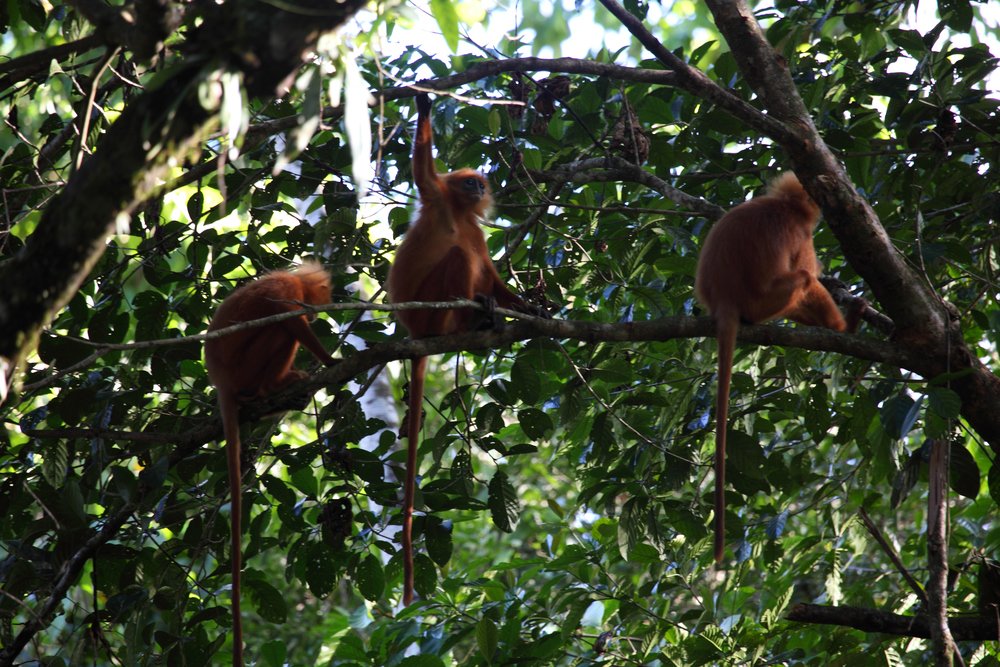
Finally, to my guides. Emraphel, Adsel, Mirwan, Adrian. However beautiful the lodge, however sumptuous the meals, you are the memory that your visitors take away with them. You are each, in your own very different ways, river gods, jungle jedis, rainforest raconteurs and monarchs of the mountains. You could always find the right name for the wildlife I challenged you to identify and you could always find a cup of coffee when I needed it most.

Thank you all a thousand times. If you ever want to visit Australia’s outback, just drop me a line.

Review: Understanding Bird Behaviour by Stephen Moss

ReviewChris Watson

“The Golden Eagle, which has universally been considered as a bird of most extraordinary powers of flight, is in my estimation little more than a sluggard, though its wings are long and ample.”

John James Audubon

The only times I've seen a Golden Eagle I've always gawped at its mastery of aviation. Clearly Audubon thought otherwise. But everybody looks for different things in the pursuit of birds. This is why there are so many different names for it: birding, twitching, ornithology, bird-watching. They are all subtly different, but there is a lot of overlap and most of us are practitioners of all of these at different times. This is why only a true birdo understands that you can be out for a day of birding and stop for a while to do some bird-watching; a statement that seems the height of nonsense to a muggle.

If birding can be loosely defined as noting all of the birds in a general area for the purpose of listing or census, bird-watching is a more immersive activity. Monitoring a sheltered pool of water and observing the birds interacting while bathing and drinking might be bird-watching. So might setting up in a patch of scrub to observe the behaviour of a mixed flock feeding in a bloodwood in heavy blossom. Bird-watching is what elevates a Willie Wagtail from merely another common bird on your day list, to a larger-than-life character, full of personality, staunch in defence of resources or territory, endlessly adaptive and innovative in its choice of nesting locations, tireless in its hawking of insects from its perch on a fence post and hilarious in its interrogation of its reflection in a car mirror.

Willie Wagtail Rhipidura leucophrys, a true bird-watcher's bird.

When everything on your patch has been ticked and listed, surely understanding what birds are doing when you’re watching them is the name of the game. More than this, interpreting the behaviour of the birds we seek also helps us find the birds more easily and ultimately become better birders overall.
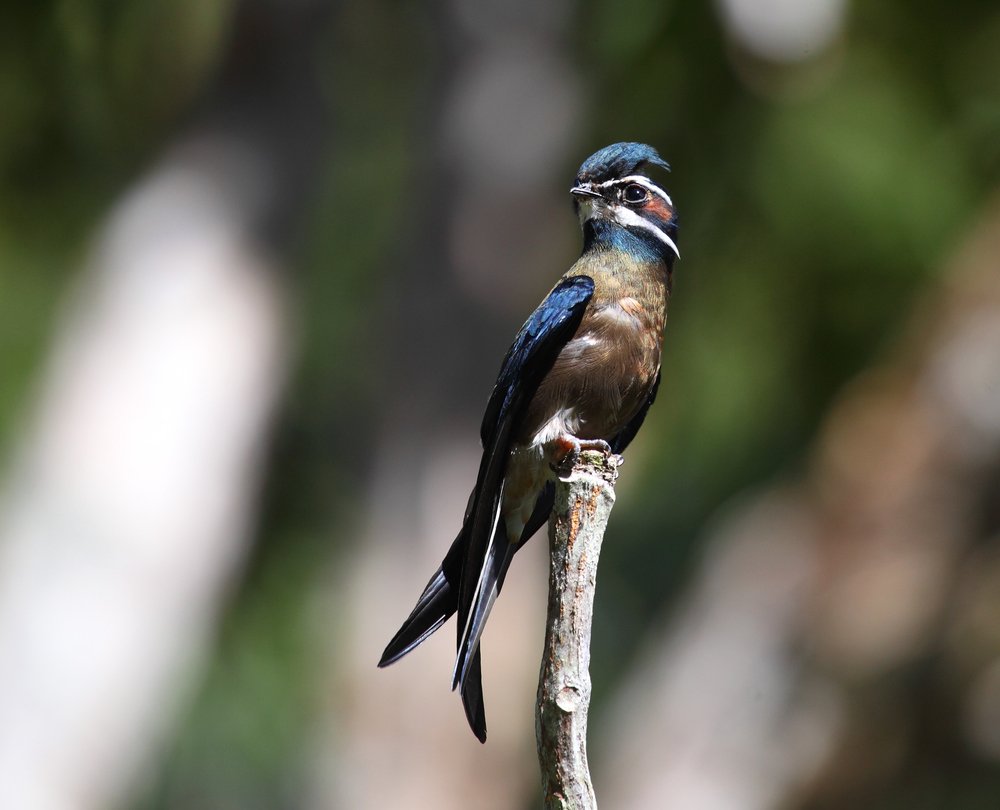
With the acquisitive activity of bird photography gaining ground on the more inquisitive pursuit of bird watching, it’s crucial that people seeking wildlife, for any purpose, recognise the difference between restful, natural bird behaviour and a bird that is agitated, threatened or stressed by the observer’s encroachment. 

We've all seen a bit too much of this I think. Surely the point of having a long lens is that you don't have to stalk so close to birds in such an exposed situation? When the tired little birds that have just flown halfway around the world are looking up from their frenetic (and critically urgent) feeding and fluttering nervously just 10 metres from the glass on your 500mm lens, it's probably time to stop looking at the birds and have a good hard look at yourself. 

If birding is primarily about allocating a bird its correct identity, bird-watching is about observing and understanding birds’ behaviour.

Understanding Bird Behaviour then, is very much a book for the bird watcher in all of us. Well-known British naturalist and author, Stephen Moss, has produced a valuable, timely and exciting book here. For anyone interested in taking their birding beyond mere identification and listing, this book will provide the perfect jumping off point.

It is laid out superbly with god-tier photographs throughout. The main body of text is split into two parts, with part one taking the reader through the basic range of bird behaviours broken into six chapters: movement, feeding, breeding, migration & navigation, distribution & range and life & death. Part two addresses the birds by family and sets out the behaviours they share and those that make some species stand out from their close relations.

It’s an educative read, but it is not quite the comprehensive treatment of the behaviour of all groups of birds that you might surmise from the title; a better one might have been Understanding British Bird Behaviour. The book limits its treatment, for the most part, to species occurring in the British Isles. Despite this, the text provides ample coverage of all the more common examples of bird behaviour that most of us can expect to come across.

Understanding Bird Behaviour makes no claims of being an exhaustive reference but as an introductory text on the subject it covers a lot of ground. The information is clearly presented and perfectly accessible for beginners while still holding plenty to recommend it to experienced birders as well. The limited geographic treatment results in missing many fascinating examples of bird behaviour (nothing on flightless birds, nectarivores, bowerbirds, megapodes, hornbills, birds-of-paradise) but the interested reader will track down full accounts of these groups in other books easily enough.

Moss points out a recent decline in the activity of twitching (ticking rarities) and raises the possibility of an imminent “renaissance” in bird-watching. I’m sure many of us would welcome such a movement but I’m not sure I’d noticed the decline in ‘twitchiness’ – certainly not from this antipodean viewpoint.

But regardless of where you reside on the twitching spectrum we can surely all agree with Moss that, whether you’re in Galway or The Galapagos, alongside the Thames or on the shores of the Yarra, it is the behaviour of birds that encapsulates their fascination for all of us. To that end, this book should become a foundation text for all new birders and will be a welcome refresher for those of us who need to slow down and take more notice.

CBW

Buy it from Andrew Isles