Chris Watson

Review

The Red Kangaroo in Central Australia: An Early Account by A. E. Newsome

Review, EcologyChris Watson

by Thomas Newsome and Alan Newsome

CSIRO Publishing, July 2016

Paperback AU$39.95

“Desert lands have an appealing starkness and simplicity. The very grain of the countryside is exposed to all. Ancient mountain ranges plunge and rear from the plains. Rocks and boulders lie tumbled at their feet. Dry watercourses break through mountain gorges to meander and die in the desert. Stunted trees stand mutely enduring the heat.

Biological survival in such a land is not simple.” - p.15-16

It is just such a land, however, which is home to the Red Kangaroo Osphranter rufus; the largest extant marsupial on Earth and Australia’s largest terrestrial mammal. The Red Kangaroo is an Australian icon that ranks with Uluru and the Sydney Opera House for international recognition. The Red Kangaroo in Central Australia presents the gathered thoughts and findings on the species, from the early work of one of the great minds of Australian ecology.

Alan Newsome’s work was already familiar to me when I gained employment as an environmental consultant in Alice Springs in 2011. As it happens, Alan’s son, Thomas Newsome, was working at the firm which took me on, and I’d learn that he is a gifted ecologist in his own right. I’d been living in Central Australia for several years at that time and, being interested in the ecology of Central Australian fauna, Alan Newsome’s name was a regular feature on my reading list. Though I only worked with Thomas for a short time, my excitement at the publication of The Red Kangaroo in Central Australia comes, not only from my own affinity for the country and animals that it describes, but from an appreciation of his standing, and his father’s, in the Australian ecological community.

Alan began studying the Red Kangaroo in 1957 and it’s important to appreciate how rudimentary our understanding of the animal’s ecology was at that time. Alan was the first to discover many of the behavioural and physiological adaptations that have allowed the species to live so successfully in a landscape with such famously extreme and irregular conditions. Working on the beautiful plains to the north of the MacDonnell Range, Alan methodically uncovered the mysteries of the Red Kangaroo’s life. His book takes us through the challenges the kangaroo must overcome to survive in this country in chapters dealing with the landforms, climate and vegetation; distribution and abundance; reproduction (some of Alan’s most astonishing discoveries relate to the reproductive biology of the Red Kangaroo and these breakthroughs, and the methods by which they were revealed, are presented in considerable detail); food and water; sociology and a final chapter titled Ecomythology.

In addition to the main body of text there is an enlightening foreword by famed marsupial biologist Hugh Tyndale-Biscoe and a preface by Thomas Newsome in his role as co-author and editor. [Alan Newsome passed away in 2007. This book is the edited result of a mostly complete manuscript which Thomas discovered among Alan’s effects in 2010.]

In the intervening decades since Alan Newsome’s field work, another generation of ecologists has built on his findings and we understand the Red Kangaroo’s biology well. But perhaps the great story presented by The Red Kangaroo in Central Australia, and a thread running through the entire book, is Alan’s determination to also come to grips with the Aranda* understanding of kangaroo ecology.

Like few other outback zoologists since Baldwin Spencer and F. J. Gillen, Newsome allows room for Indigenous Ecological Knowledge (IEK) to be interpreted scientifically and considered alongside his own findings. The culmination of the book is in the final chapter titled Ecomythology in which Alan sets out the close alignment of his own hard-won knowledge with the traditional knowledge of his Aranda colleagues. The world has turned now and it is routine for IEK to be incorporated into scientific research and reporting, but we see the foundations of this practice in Alan’s work at a time when such considerations were by no means commonplace.

In addition to the book’s value as an important work of science and history, it is a beautiful piece of writing. As the brief excerpt I’ve used reveals, Alan's was an engaging writing style, as stripped-back and plain as the desert landscapes he describes. As an avowed desert-lover myself, Alan’s deep affection for the country in which he spent so much of his career, is instantly relatable from the way he writes about it. He also had that all-too-rare talent for rendering scientific writing enjoyable for the reader, without sacrificing any of its rigour. The ease of his style is such that The Red Kangaroo in Central Australia reads more like a story than a scientific treatise at times. This is testament to his ability to render deep scholarship comprehensible to the lay-reader rather than any “dumbing down” or skimping on detail.

Ultimately, The Red Kangaroo in Central Australia will appeal to an audience far beyond the ranks of biologists. It includes almost as much history and anthropology as it does ecology. It’s difficult to avoid drawing comparisons with the writings of other prominent Centralian researchers like T.G.H. Strehlow, with whom Alan discussed his work at some length, and the correspondence of the aforementioned Spencer and Gillen.

As well as being a peerless account of animal ecology and scientific investigation in the desert, it is a postcard from Central Australia and the ecological adventures of a young scientist on a personal journey of discovery. There is no doubt that The Red Kangaroo in Central Australia will continue to inspire and inform future generations of Australian ecologists for a very long time to come.

CBW

*Also spelled Arrernte and Arunta, these are the Aboriginal Australians who are the traditional custodians of the lands surrounding Alice Springs and much of the MacDonnell Ranges in Central Australia. 
Buy it from Andrew Isles

Review: Birds of New Guinea (2nd Edition)

ReviewChris Watson

Birds of New Guinea 2nd Edition by Thane K. Pratt and Bruce M. Beehler.

“New Guinea is central to this story: the island is not so much a neighbour of Australia as a core part of it, biologically speaking. To include Tasmania but not New Guinea is to let nationalism distort ecological thinking. Whenever sea levels have fallen New Guinea has joined the mainland for longer than Tasmania has, because the water that separates it is shallower. The line between northern Australian savanna and rainforest is more limiting to birds than is the Torres Strait. New Guinea’s birds are part of the Australian bird fauna.” Tim Low in Where Song Began: Australia's birds and how they changed the world, Chapter 4 - New Guinea: Australia's Northern Province.

New Guinea is weird - so close but so distant.

A perfunctory scan through a list of its fauna reveals tree kangaroos and hare-wallabies, dasyurids and monotremes: all the sorts of animals that are most obviously associated with Australia. The little Rakali Hydromys chrysogaster, can be found from Tasmania right up through Australia's mainland and through all but the highest parts of New Guinea. Even New Guinea’s most iconic animals, the birds-of-paradise, are also represented in Australia by four species: three riflebirds and the Trumpet Manucode.

As birders, we’re used to drawing arbitrary lines on maps for the purposes of delineating our lists but, at least from a biological perspective, none of these lines is more arbitrary than the separation of New Guinea’s fauna from Australia’s. This is perhaps one of the major themes of Tim Low’s sweeping assessment of song bird evolution in Where Song Began.

Like many birders, New Guinea is high on my list of places I yearn to visit. Also, I suspect, like many Australian birders, I barely gave New Guinea a moment’s thought before reading Low’s book. Despite being so close to Australia – I’ve flown over it countless times on my way to near-antipodal destinations – New Guinea is, by most accounts, still a challenging place to visit.

Gradually though, this reputation is changing and books like this 2nd edition of Birds of New Guinea are an important part of the process. Papua New Guinea, and even parts of Indonesian-occupied West Papua, is now a fixture on the itineraries of most of the major wildlife touring outfits. There is a string of reputable wildlife lodges across some of the more important habitat areas. As well as infrastructure and services though, the availability of accurate field guides is an important step in making wildlife tourism more attractive. And, as we’ve seen in many other developing parts of the world, when tourism revenue is tied to biodiversity it can result in benefits for research, conservation, local economies and, ultimately, greatly improve our understanding of the birds of that region.

For an area with such a famously diverse avifauna, New Guinea has been served by a limited, though quite high-quality, range of books on the topic. Before the release of this 2nd edition, the 1st edition of Birds of New Guinea was thirty years old and Birds of New Guinea and the Bismarck Archipelago by Coates and Peckover, while an impressive achievement as a photograph record of such a diverse and often secretive bird fauna, was a long way short of comprehensive (it covers 444 species).

Birds of New Guinea 2nd edition covers all 780 bird species for the first time and includes full-colour plates for all (some plates in the 1st edition were black and white). For a book treating such a number of species the layout is smart. The plates fill the first 260 pages and are accompanied by brief species accounts and range maps on the facing page. Maps were critically lacking in the 1st edition. The remaining half of the book is taken up with more detailed family and species accounts including range, habitat and appearance notes as well as quite detailed commentary on the vocalisations including, for selected species, stylised spectrograms giving a visual aid to the cadence and pitch variation of the bird’s song.

The plates are a bit of a mixed bag. They range from superb to serviceable but are competently executed throughout. They’ve been supplied by four different artists so there is bound to be some variation and, unsurprisingly, the plates depicting the birds-of-paradise are probably the finest in the book.

Considering the close affinities between Australian and New Guinean birds, Birds of New Guinea 2nd edition is a useful reference for Australian birders to have available. For northern Australian birders ever-hopeful for vagrant birds visiting from our northern neighbour, it’ll be indispensable.  For the introductory sections alone, describing the natural history and geography of the island, it is worth the asking price; there is so much to learn here.

We can hope that it won’t be so long before another revision, but with this edition being so expertly finished, Birds of New Guinea 2nd edition looks capable of seeing us through another 30 years if necessary.

CBW

Buy it from Andrew Isles.

If you enjoy reading The Grip, click HERE or look for the button in the right sidebar to become a supporter.

Review: Australian Wildlife After Dark

ReviewChris Watson

By Martyn Robinson and Bruce Thomson

Who among us doesn’t have a soft spot for owls? If you’re interested in looking for night birds and most of Australia’s other fauna, you’re eventually going to have to head out after dark. In fact, compared to most other places, Australia has an extremely high proportion of nocturnal fauna.

This book will be a good starting point for those who might be unfamiliar with spotlighting techniques and the ecology of the fauna that you’re likely to encounter. It deals not only with the more highly sought and charismatic species, like the owls, but with virtually every kind of animal that you might find in Australian habitats after dark: mammals, frogs, reptiles of various kinds and all manner of invertebrate are all treated in the one book.

Most of the chapters are organised according to the senses by which different animals navigate their world. This is a perceptive innovation and one that I think may help many to hone their field-craft and more successfully find their target species.

Australian Wildlife After Dark will be most suitable for the relative newcomer to spotlighting but will certainly have something to teach even experienced practitioners.

This review was first published in Australian Birdlife magazine Vol. 5 No. 1, March 2016.

Buy it from Andrew Isles 

Birds in Dead Trees

Review, birdingChris Watson

Tattiness: an indicator of durability or preference?

A Survey of Australian Field Guides on Paper

Astonishing as it may seem, a birder living anywhere in Europe, Africa north of 30˚N and much of the Middle East, can get by perfectly well with a single book.

The second edition of the Collins Bird Guide by Svensson, Mullarney and Zetterström is subtitled The Most Complete Guide To The Birds Of Britain And Europe, and this is a well-supported claim. In fact this field guide is widely considered to be one of the, if not the, finest of the genre.

If the imminent field guide from CSIRO Publishing achieves even close to the acclaim that this book has received it'll be a huge success. No pressure.

The artwork is accurate, beautiful and consistently so, across all species. Most species are depicted in a variety of poses and plumage stages and are shown against a typical background wherever it might be a useful aid to identification. Distribution maps are clear and thoughtfully colour-coded to depict seasonal movements. The text for each species is sufficiently detailed to identify species, even to the extent of describing the extensive moult variations in the many gull species, while avoiding counter-productive prolixity. Despite describing 713 species in the main body of text with additional concise entries for 209 vagrants, accidentals, ferals and escaped species, it comes in at a highly portable 448 pages. It weighs a paltry 785g, just 42g heavier than Simpson & Day but in a more daypack-friendly duodecimo (large) format as opposed to the common, larger field guide format, octavo.

In a book comprehensively treating this number of species, it has a TARDIS-like quality; it seems to contain a lot more than seems possible from its exterior dimensions.

For those who enjoy wallowing in the artwork of such books it is also available in quarto format weighing 2073g which, unless you’re training for SAS selection, is definitely one for the coffee table, not the rucksack. As with almost all good field guides now, there is also a companion smartphone app available which marries all the best aspects of the book with multimedia content including recordings of the calls of all species, photographs and video content. This app continues the tradition of excellence set by its paper predecessor – it’s the best bird app I’ve used by a long shot. (But field guide apps will be a topic for another post altogether.)

If it has any weak points I’ve not yet demanded enough of the book to expose them. Try as I might I have not yet found any errors – factual or typographical. Although, even as I type this I’m sure someone will be emailing me with a list of them.

In the challenging endeavour of wildlife field guide production, the book simply known as The Collins, is the four-minute mile. It’s the benchmark; the yardstick by which we can gauge all other attempts.

Which brings us to Australian field guides. Despite birdwatching having far fewer adherents here than in the UK and the US, antipodeans are well-served for bird books. There are numerous regional and local guides and more than a few How to Find… or Where to Look…. type books of greater and lesser renown. But, ignoring the historically significant but antiquated What Bird Is That? by Neville Cayley, there are presently five fairly current contenders in the class of pure field guides that treat all of Australia’s birds: Simpson & Day, Pizzey & Knight, Morcombe, Slater and Campbell (the only photographic guide in the bunch).

While it’s fair to say that none quite stack up against The Collins, everyone has their favourite and the field guides available to those seeking Australian birds are of a consistently high standard. Some have obvious, even infamous, shortcomings, but these are usually balanced by other innovations or points-of-difference.

Below, I take a look in as balanced a fashion as possible at the five main field guides to Australian birds. Inevitably, it will be coloured by my own preferences but I’ve tried to be as empirical as possible.

It’s worth mentioning at this point, that the impetus for this review has come from the imminent release of a sixth Australian field guide that we’ve been hearing about for at least a couple of years now. This is being worked on by a number of prominent authors who will be familiar names to most in Australian ornithology, and is slated for release by CSIRO Publishing later in 2016. Rumour has it that this new field guide has been inspired, if not modelled upon, The Collins discussed above. If this is the case, our expectations can hardly be anything but stratospheric but until its arrival it’s worthwhile to have a look at what’s been achieved in Australian field guides to this point.

Simpson & Day

Field Guide to the Birds of Australia: the most comprehensive one-volume book of identification

Editor – Ken Simpson

Illustrator – Nicolas Day

Art Director – Peter Trusler

Weight – 743g

Currency – 8th edition published in 2010

Simpson & Day - it's not pretty, but it's what's on the inside that counts.

I said I’d try to be as empirical as possible but I should also disclose that this is my favourite field guide to Australian birds. This is by no means an uncommon preference either.

This book has a lot going for it. Probably the most distinctive identifying feature is its spray-proof plastic cover. It is sold with a conventional paper dust jacket but few well-travelled copies retain this beyond their first few outings. Another distinctive feature which immediately sets Simpson & Day apart are the seabird bill charts printed, to scale, on the end papers. These are only likely to be of regular use to those who get hands-on time with seabirds, but they might also be handy for keen beachcombers and those identifying pelagic species from photographs. In any case they’re a good reference.

By far the most popular aspect of this book is the artwork. Nicolas Day seems to have a true talent for capturing the jizz of each species. Other books have serviceable artwork, but none quite display the jizz of each bird as arrestingly as Day. Birds are posed characteristically and many are set in front of a typical habitat scene which is always a useful detail, especially for newer birders. Where relevant, there are pointers for field marks and where there are confusion species they are often depicted on the same page for comparison.

The text for most species is brief. Some may see this a shortcoming but I see it as a strength. The text is concise, conveys enough information to clinch all but the most difficult identification and doesn’t get bogged down in pointlessly subjective waffle and elaborate phonetic descriptions of vocalisations. The space it saves on these it uses wisely with breeding information for species at the back of the book, a reasonably comprehensive section of vagrant records, and a guide to Australian habitats – very useful for international visitors.

In Summary:

The upside is… Spray-proof cover. Durable binding. Excellent artwork. Habitat guide. Breeding information. Seabird bills inside covers. Lightest of the full size guides.

However… The maps are OK but reference points/towns aren’t labelled which may be tricky for international visitors. Species text is fairly basic. Subspecies information is sometimes imprecise.

Pizzey & Knight

The Field Guide to the Birds of Australia: The definitive work on bird identification

Author – Graham Pizzey

Illustrator – Frank Knight

Scientific Editor – Sarah Pizzey

Weight – 1220g

Currency – 9th edition published in 2012

This is the heaviest of the bunch and outweighs its nearest rival (Morcombe) by almost 200g. Despite its heft, it remains a firm favourite with many and probably vies with Simpson & Day for Australia’s favourite field guide overall.

Frank Knight’s illustrations are clean, clear and beautiful but the criticism levelled at them by most is that at times they may be too simplistic. They don’t capture the jizz and motion of the birds in the same way that Nicolas Day manages to so consistently and Knight’s birds are often posed like statues or museum specimens all in a row. Despite this, they are beautifully executed and more than serviceable for all but the most vexing identification problems.

What this book has become most famous for is Graham Pizzey’s wonderful descriptions. I remain completely apathetic toward written descriptions of bird vocalisations; I suspect they have as much ability to lead observers astray as provide the final clincher in an identification conundrum. In the days of widely available and portable recordings I don’t see the point in persisting with trying to describe bird calls in text. However, if you need a bird call described, Graham Pizzey is clearly your man. This is perhaps most obvious in descriptions of two species with overlapping ranges which are virtually inseparable in the field… except by voice. Thus the Chiming Wedgebill has, “4 or 5 quick, peculiar metallic, ringing notes (or 3, or 2) in descending chime, ‘but-did-you-get-drunk’ with cyclic pattern; metallic plonk on ‘drunk.'” While the virtually identical-looking Chirruping Wedgebill gives a duet, “one bird calls ‘sitzi-cheeri’, like Budgerigars’ rolling chirrup; female answers with upward-rolling ‘r-e-e-e-t CHEER!’; combined in endless rondo”. I still maintain that that gives not the slightest inkling of the captivating beauty of the former bird’s far-carrying call, but it clearly provides enough information, perhaps the only information, to separate the two species if you find yourself in their shared territory.

The maps are clear and useful but contain no sub-species information, the binding is durable and solid, and this book is one of two Australian field guides which has a companion smartphone app which is recommended. It is also available as a multimedia version which you can install on a PC. Some may find this of use; I have a copy, I installed it once, had a browse and have never been back to open it since.

The upside is… Good artwork. Good maps. Plenty of introductory information and a whole section featuring descriptions of the various bird families. Lots of text in the species descriptions. Smart device app and desktop versions available. Several regional editions available. 2nd most recent.

However… Vagrant accounts are very patchy. Heaviest of all the field guides. Subspecies information is very light on.

Slater

The Slater Field Guide to Australian Birds

Authors – Pat Slater, Raoul Slater

Illustrator – Peter Slater

Weight – 447g

Currency – 2nd edition published in 2009

NB: I only have the revised 1st edition (1995) but a fully revised 2nd edition was published in 2009. If there are any errors in my assessment based on differences between these editions, feel free to get in touch and let me know.

This well-liked family production is instantly recognisable as the only truly pocket-sized (215 x 115mm) field guide to Australian birds (other than the cut down edition of Morcombe). As such it is the lightest by a long margin – almost one third the weight of Pizzey & Knight.

Despite its smaller size it still manages to pack in all the information most birders are ever going to need. The species descriptions are more than adequate but the most commonly lamented shortcoming of this book is the maps. For widely distributed species they are acceptable, but for species with small ranges (ie: the ones for which an accurate map is most critical) they are all but useless. The maps are all in black and white with the coastline delineated with a bold black line. So bold in fact, that the inexperienced newcomer to Australian birds could be forgiven for surmising that all Australian species occur around Adelaide and Kangaroo Island, completely obscured as this region is by the solid black of the coastline. The best (worst?) example of this is perhaps the Scrub-birds and Bristlebirds. For these species the maps in their present form are next to pointless.

So THAT'S where they live...

I quite like the paintings in Slater. They’re truly very well executed throughout and all plates have the eggs of the species lined up along the bottom of the page – a nice touch. One perplexing aspect of the artwork arises in the plates depicting the petrels, storm-petrels and shearwaters. The main image of each species is depicted as if sitting on land – an image of absolutely no use to any pelagic birders other than the rare and lucky few who might occasionally visit these birds’ breeding colonies. Surely discarding these in favour of dorsal and ventral flight views and other angles where possible would be preferable? To be fair, there is a double plate of ‘petrels and shearwaters in flight’ but this has been inexplicably printed in a grainy monochrome; as if looking at an overly noisy black and white photograph. Absolutely baffling and surely of next-to-no use in the field.

Another curious aspect of Slater is some of the strange inclusions: Grenadier Weaver, White-winged Wydah, Great Reed Warbler to name just a few. The book has no separate section for vagrants and escaped or feral populations so these sometimes contested records are included in the main body of the guide.

The upside is… Very good artwork which includes depictions of eggs but plates are sometimes deficient in a few areas. Tiny size and weight is easily carried in a trouser or jacket pocket.

However… Terrible maps. Limited supplementary text. Probably not the best reference for pelagic birding.

Campbell, Woods & Leseberg

Birds of Australia: A photographic guide

Authors – Iain Campbell, Sam Woods, Nick Leseberg

Weight – 996g

Currency – 1st edition published in 2015

This most recent field guide to Australian birds, sits at the lighter end of the heavyweight division and is the only photographic entry. I posted a full review of this book here when it first came out in which I disclosed my troubled relationship with photographic guides in the past. This book however, went a long way toward addressing my misgivings about the form. This isn’t my first choice among Australian field guides but it is a long way from my last choice.

It’s a beautiful production, with good solid binding, heavy and glossy stock paper and very high quality photography throughout. It has some excellent introductory text on habitats and climate across Australia and depicts all resident species with the obvious exceptions of the problematic Night Parrot and Buff-breasted Button-Quail; the former only recently photographed and the latter which still eludes the lens.

The accompanying text is adequate for all species and the birds are depicted, for the most part, in poses that make field marks clear. The only thing missing from this guide that all the others have is any vagrant species. In an effort to save space and weight, even established breeding species like Spotted Whistling-Duck don’t get a look in.

The upside is… For a photographic guide it has a good variety of depictions. Extensive introduction on habitats and climate. Reasonably good maps. Most recent edition of any Australian guides.

However… No vagrants at all. On the heavier side.

Morcombe

Field Guide to Australian Birds

Author – Michael Morcombe

Weight – 1053g

Currency – 2nd edition published in 2004

My very old and well-used Morcombe - clearly a reference I visit often.

NB: I only have the revised 1st edition so there may be some differences in my assessment.

Regardless of what you think of the shortcomings of any of these guides, or any guides from elsewhere around the world, we should always keep in mind what a monumental amount of work they represent. It may seem simple on the surface to assemble an annotated list of birds, pop some maps in, illustrate it with paintings or photos and bind it all up into a nice book, but nothing could be farther from the reality. Putting together a work like any of the books reviewed here is a herculean feat of great scholarship and dedication.

With that in mind, Michael Morcombe can be singled out for particular awe, being the only sole author among these Australian field guide producers. His book is almost 200g shy of Pizzey & Knight but at over a kilogram, still very much a heavyweight. The book looks good, no doubt owing something to the tidy graphic design of the Steve Parish publishing house, and the cover is a robust plasticised card.

My well-thumbed copy of Morcombe is what I turn to most often when I’m in need of sub-species information. Morcombe’s coloured, graduated maps do a good job of the difficult task of describing our incomplete knowledge of bird distribution across Australia to sub-species level.

Part of the weightiness of this book is due to an extensive section near the rear which provides a complete guide to the nests and eggs of the birds – another inclusion which no other guide does to a similar extent. There is also a section treating the species of Australia’s island territories and vagrants but the latter is fairly rudimentary.

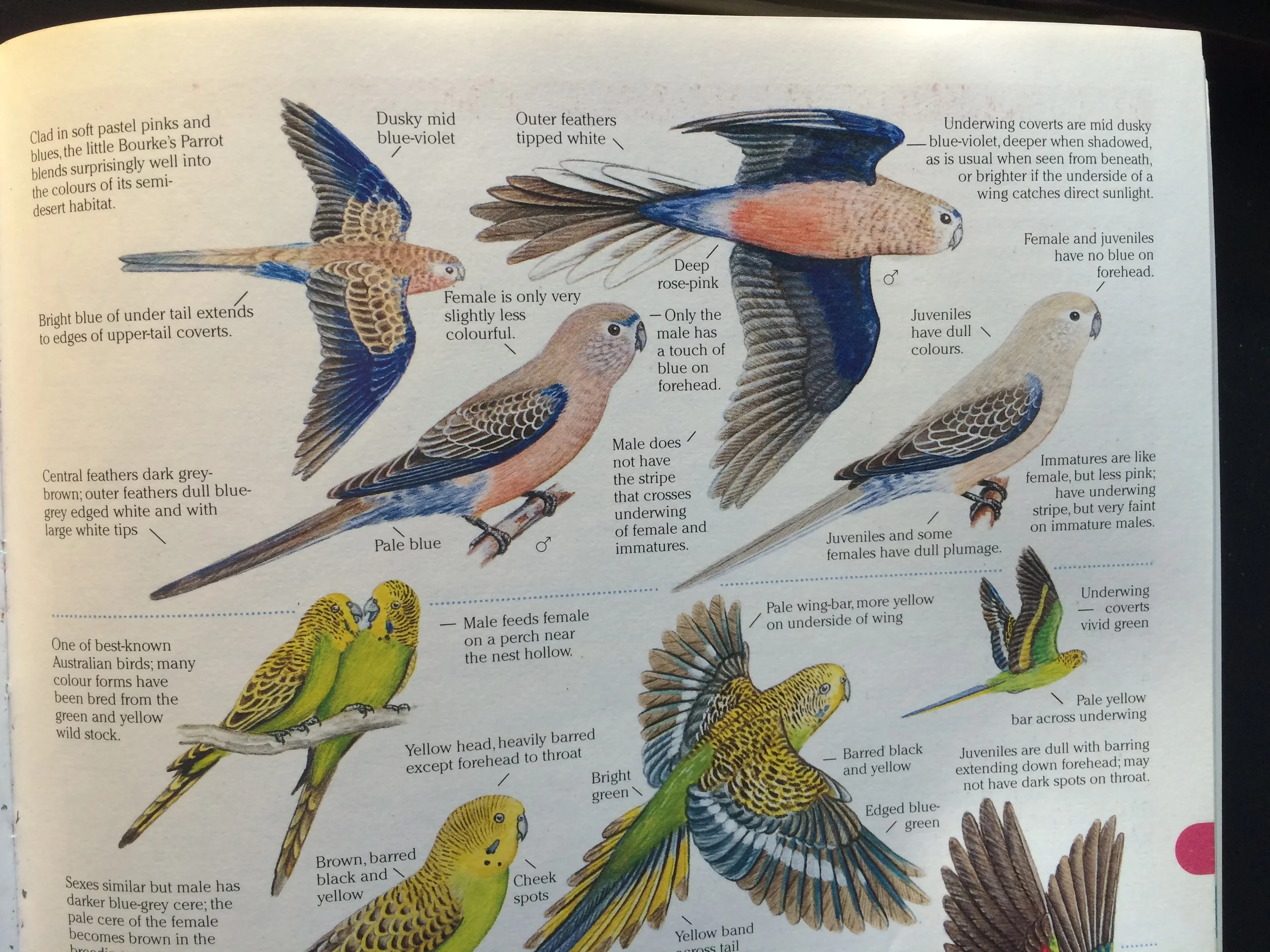
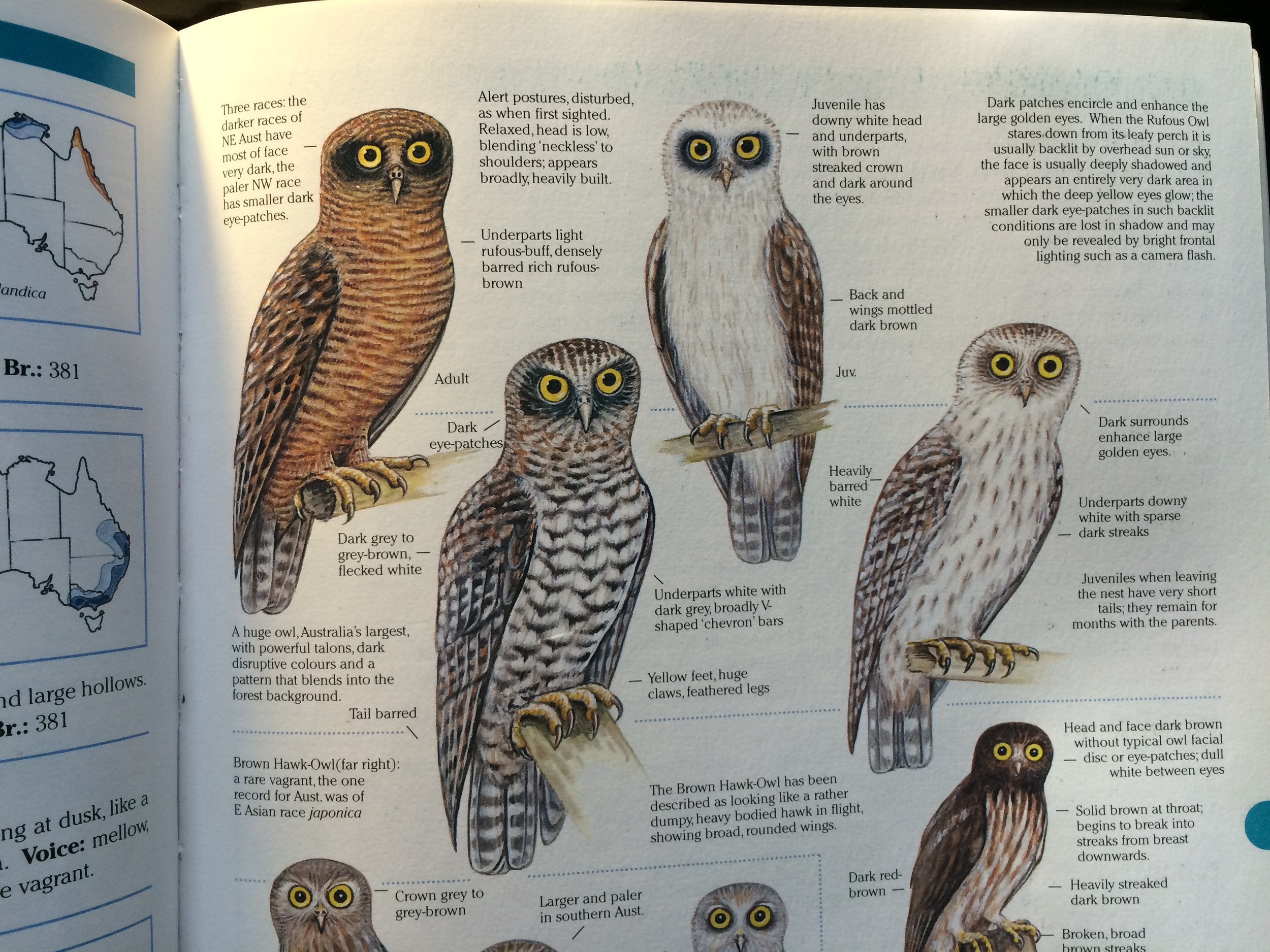
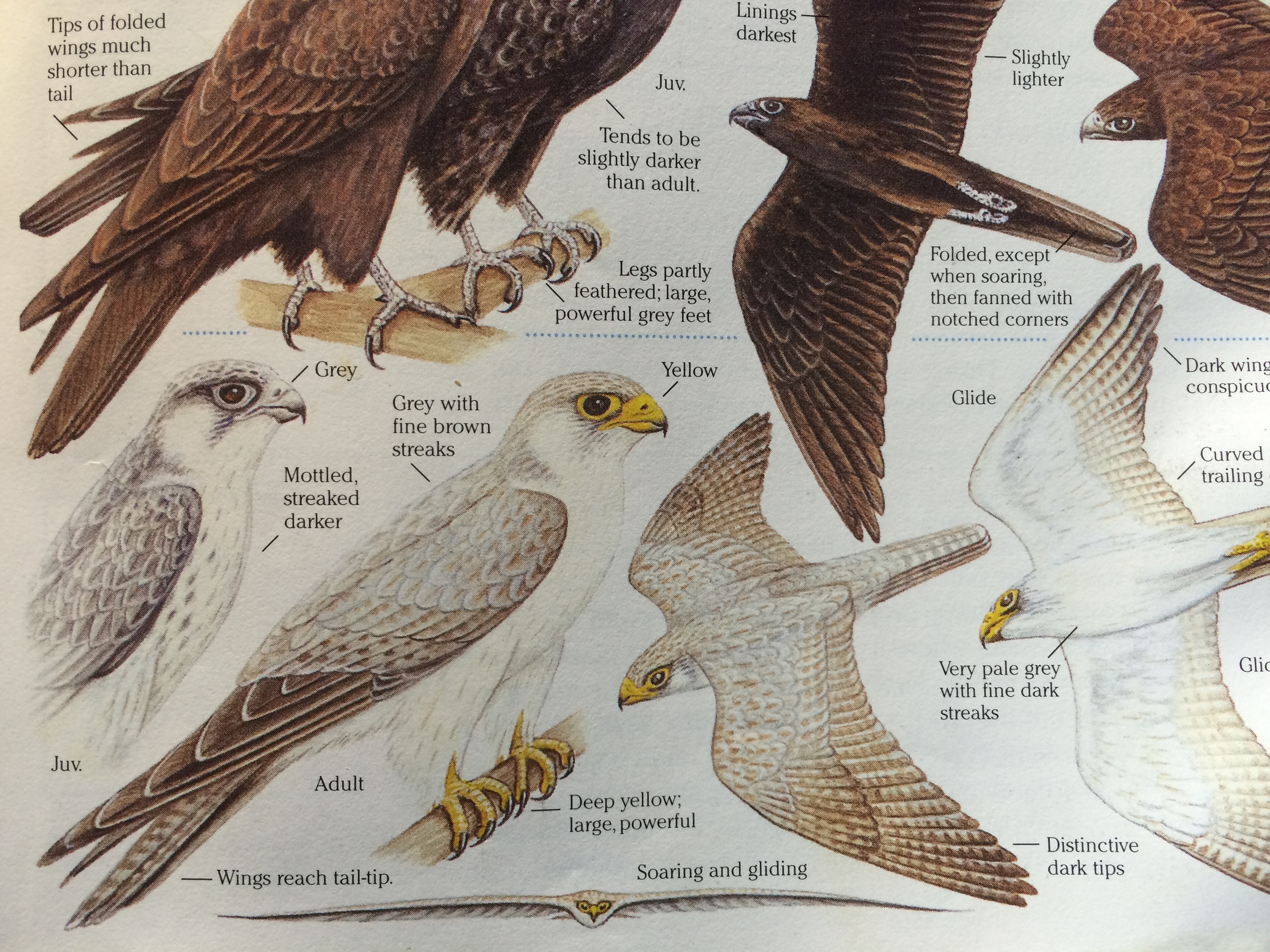
My main reservation with Morcombe is the artwork. He is clearly a talented artist and many of the birds are depicted adequately but occasionally it seems like he got to some species at the end of a long day at the drawing board. Some drawings definitely seem to have received less careful attention than others. Look at the Grey Falcon, Bourke’s Parrot and Powerful Owl (below) as just a few examples: body proportions are all squiffy or colours are just plain wrong. To be fair, none of these are so bad that they might cause any danger of misidentification, but they’re just a lot less accurate than other artwork available. Again, as the sole author and artist of such a comprehensive work I’m sure we can all forgive Morcombe a few dud daubs.

Morcombe was also the first Australian field guide to become available as a smart phone app and this is still the one that I use the most – the functionality of the call recordings alone make it worth the asking price. It also comes in a cut-down pocket-sized version which makes it similar in scale to the Slater field guide. This contains most of what the full-sized edition contains minus the nesting information and bit of other text. It can’t be that bad as my copy was pilfered by a light-fingered birdwatcher on a tour bus many years ago.

The upside is… The best maps and subspecies information of any of the guides. Good amount of text for each species account. Nests and eggs supplement. Smartphone app and cut-down pocket-sized edition available.

However… Probably the weakest artwork of all the guides. At the heavier end of the scale.

Buy any of these guides from Andrew Isles:

Collins Bird Guide

Simpson & Day

Pizzey & Knight

Slater

Campbell, Woods & Leseberg

Morcombe 

Review: The Complete Guide to Finding the Mammals of Australia by David Andrew

ReviewChris Watson

“Many of Australia’s unique and beautiful mammals are not easy to find in the wild. Most of them are nocturnal and extremely wary of humans.” – Barbara Triggs, in the introduction to her superb Tracks, Scats And Other Traces: A Field Guide to Australian Mammals.

We could add to Barbara Triggs’ introduction, that many of our mammals are also rare and range across massive areas of remote and challenging country. Throw in our disastrous record on mammal extinction and you might be forgiven for not ever starting a mammal list and sticking to watching the birds.

But then again, would anyone really bother looking for Grey Honeyeaters if they weren’t so bloody hard to find? The thrill of the treasure hunt and the pursuit of rarities is a big part of the allure of birding so there’s no reason to think that the difficulty of finding mammals would have any less appeal. Mammal watching has always lagged somewhere behind birding, at least in popularity but certainly not the ardour of its devotees. But lately it seems to have been gaining ground and this book comes along at an interesting time.

Literally just weeks before the release of Finding the Mammals of Australia we saw the creation of the first dedicated Facebook group for serious Australian mammal watchers. This group rapidly grew to over 200 members and we’ve had hints that the first semi-official Australian mammal big year attempts are already underway. Then, following on the heels of Finding the Mammals of Australia, we’ve had news of another forthcoming release from CSIRO publishing, Australian Wildlife After Dark, also with plenty of relevance to mammal watchers, due in April.

Common Ringtail Possum Pseudocheirus peregrinus, often the first tick on many suburbanites' mammal list.

To give you the executive summary: Finding the Mammals of Australia is an astonishing achievement. It’s thoroughly worth owning if you have any interest in our mammal fauna and if you don’t already have it, eventually, you almost certainly should. David Andrew has done a colossal amount of work here and deserves endless kudos for delivering a long-overdue book.

Moreover, it’s astonishing and reassuring that publishers like CSIRO are continuing to support such releases. Hats off all round. The easy assumption to make is that the technologically adept can these days access all the relevant knowledge they need with a visit to one or more online fora and the magical letters R-F-I. Request For Information.

These three dread initials, I was sure, would snuff the interest in, and relevance of, guide books like this in a matter of a few years. They have already ensured that professional wildlife guiding will never be much more than a boutique industry, in this country at least. Go to any birdwatching forum or Facebook group and it’s quickly apparent that a good portion of posts are preceded by the scurrilous three letter initialism. I’m off to FNQ – where to see this mammal or that bird? It’s my first time in Perth – where do all the critters hide out?

Prefix your subject line with RFI and there is no end to the lengths that any number of friendly and generous souls will be prepared to go to, in order to make available the collected knowledge that they have spent years accumulating through long hours scouring the bush (not to mention the literature) and hundreds of thousands of kilometres behind the wheel. If I come across as at all bitter on this matter, it's only because I know precisely how hard many professional guides work for their site knowledge only to have it broadcast on such public channels, or to have their professionalism usurped entirely and rendered cruelly redundant by well-meaning local amateurs or enterprises like Birding Pal.

But I needn’t be so pessimistic. The same generosity of spirit and genuine love for our fauna has ensured that there is an enduring market for books like this and that seems set to remain the case. My revised appraisal of species-seekers in Australia is that despite having access to endless free information online, most still see the value in having an expert like David Andrew assemble the sum of that web-based colloquy, adding a comprehensive survey of the scientific literature, analysing it all through their own research and expertise and binding it all in a single volume. That, in a convenient nutshell I guess, is the appeal of reference books for most of us.

And of course international visitors without time for thorough research, not to mention Australian mammal listers with particularly recalcitrant bogey-beasts, are still just as likely to desire the services of a wildlife professional. So I should dismount my high horse (still a tickable plastic if you know where to look) and return to Andrews’ achievement.

Finding the Mammals of Australia is set out in a very similar format to CSIRO’s 2011 updated edition of Richard and Sarah Thomas’ Finding the Birds of Australia with Alan McBride and David Andrew as co-authors. This book looks pretty similar to that book, is similarly comprehensive in its geographic treatment and at 419 pages is just a few pages smaller than its birdy sister publication. Navigating it will feel familiar to users of Finding the Birds of Australia; after the introductory sections it goes through sites state by state then follows this with a complete annotated list of the mammals, a glossary and an index. The introductory passages deal in some detail with the notorious difficulties of observing mammals in the wild and the differences in observation techniques between bird-watching and mammal-watching.

Fat-tailed Dunnart Sminthopsis crassicaudata - a tiny marsupial carnivore. A lot harder to get to than a back yard ringtail possum but, happily, still pretty common if you look in the right places.

 The coverage of species is complete enough, although it follows the older mammal taxonomy set out by John Woinarski et al in the 2012 Action Plan for Australian Mammals, rather than the more up to date 2015 taxonomy by Jackson and Groves. The latter splits a few more species here and there (the feathertail gliders and greater gliders come to mind) and is being used by most mammal listers, but this won’t be any sort of impediment to accuracy for the most part.

So if it was the advent of good, cheap binoculars and the fledgling conservation movement that finally transformed the old pursuit of bird shooting into the worldwide phenomenon of modern birding, then perhaps digital photography, LED torches and social media may be doing the same for mammal listing.

If that’s the case, a book like this for the Australian mammal fauna might very well herald the opening of the floodgates.


BUY IT FROM ANDREW ISLES