Chris Watson

Melbourne the first Australian city to join Global Urban Birding Challenge

Chris Watson

Here’s something for Melbourne birders to get their teeth into which might help see you through the impending cold winter. Melbourne has just become the first Australian city to enter the global Urban Birding Challenge (UBC).

The Melbourne skyline from the home straight at Moonee Valley racecourse - an urban jungle beckoning to the intrepid city-birder.

If you haven’t heard of this then you may not have been paying attention. There is a lot more information over on the UBC website, but it’s fairly self-explanatory. The UBC team are using map polygons to extract eBird lists and counts for various urbanised areas of the world. Then they’re turning this data into a friendly multi-media birding competition to see how the bird diversity and birding effort varies from city to city. The hope is that this might feed into conservation by stimulating birders to bird more frequently in the ‘burbs, and in the process discover more about bird populations using modified environments. At a less serious level, as the website says, “it’s a big year competition between cities”.

The project grew out of the US (it’s administered from NYC) and when I inquired as to why there was no listing for an Australian city, the response was that there had simply been no interest. So I emailed the blokes running the site and they very quickly set me on the course to getting Melbourne registered for inclusion in the challenge. The geographical data for Melbourne is all set and I have sent them a crude polygon for the urban limits of metropolitan Melbourne (and I mean crude – this can be refined later). A blog post for urban birding in and around Melbourne will go up shortly on the site and further blog contributions are welcome from any Melbourne birders.

Moonee Ponds Creek - a concrete-lined shadow of its former self, but still flowing its original course and yielding some valuable riparian habitat along its banks for urban birders to explore.

It’d also be helpful if birders in other Australian cities could pick this up and get involved. It doesn’t take a lot of time and could provide a very interesting little rivalry for patch-workers in our main cities. If your town has a population of more than 250,000 you’re eligible to enter so get cracking!

Start poking around your suburb and start looking for those hidden pockets of remnant habitat and little-known populations of urban cripplers.

Go have a read of the UBC site and let’s get the lists up!

A typically creepy Nankeen Night-heron at far right of picture. Just one of many stunning urban species adorning the lists of most Melburnian birders.

FIELD GUIDE REVIEW - Birds of Australia: a photographic guide

Chris Watson

Authors: Iain Campbell, Sam Woods, Nick Leseberg

With photographs by Geoff Jones

Summary: A big step-up in quality for photographic field guides. 

Price: Varies massively. Ive seen this advertised for as little as $25 and as much as $50.

Species Count: 714

Support A Local - purchase at Andrew Isles Natural History Books 


A new photographic field guide? I can hear the groans from here. Just relax a minute and think about why so many of us have no time for photographic field guides.

Who among us isnt excited by the release of a new field guide? Our island continent is particularly blessed in this regard. Australia might just as well be termed the Land of Field Guides as the Land of Parrots; were that spoilt for books describing our birds. This one, however, generated quite a bit of chatter in the lead up to its launch. There have been a few photographic field guides produced for Australian birds over the years but we had yet to see one that did as good a job as any of our non-photographic guides. With rumours continuing to circulate about the imminent release of a new field guide by Menkhorst & Davies, two of our top natural history authors/illustrators, Iain Campbells book comes along at an interesting time.

Iain Campbell is an ex-pat Aussie living in Ecuador (he set up the famous Tandayapa Bird Lodge in the cloud-forest below Quito) and the proprietor of global wildlife touring outfit Tropical Birding. He has teamed up with a couple of his guiding colleagues for this effort: veteran Australian birding guide Nick Leseberg, probably known to many east coast birders; and Sam Woods, a gun English guide, also living as an ex-pat in Ecuador (what is it with that place?) who also co-authored a guide to Australian wildlife with Iain. Nick is also the co-author of a forthcoming guide: Birds & Animals of Australia's Top End: Darwin, Kakadu, Katherine and Kununurra.

From the outset its important to note that photographic field guides have had a chequered history at least here in Australia they have. My most recent encounter with the format has been Jim Fleggs 2004 effort, which made a good enough fist of it, but still had too many dark, non-representative, or otherwise substandard pictures, and tended to show only the male of many species standard grumbles with most photographic field guides. Donald and Molly Trounsons 2005 book is the most recent photographic guide Im familiar with and the less said about that books shambolic re-ordering of the species the better. Innovations one thing, but that guide was borderline unusable.

In photographic field guides, all else being equal, the plates have usually left something to be desired when compared to the hand-illustrated guides. Thats fair enough considering the immense task of photographing every single bird on the continent. Its worth keeping in mind the challenges of low light, difficult (for humans) habitats, and cryptic habits meant that good quality pictures were extremely hard to achieve for many species in the days of film photography. The DSLR age has rapidly been making up ground but even so we still only saw pictures of a live Night Parrot for the first time in 2013 courtesy of John Young, and we are yet to see photographs of anything other than a museum skin of a Buff-breasted Button-quail. So the question remains: if a perfect and complete set of photographs is so difficult, costly, and unlikely to come by, why persist in attempts to produce field guides this way? The question is even more pertinent if you consider that we have some of the best avian illustrators in the world on our doorstep and some of the best non-photographic field guides as a result.

Clearly things have changed. The images in this book have raised the bar for photographic field guides.

Its not controversial to suggest that digital photography has brought about something of a revolution in birding in recent years. It's not just the quality of digital cameras, but the increasingly affordable price and resulting ubiquity. One aspect of this is the standard of evidence we have come to expect from reports. The bar has unquestionably been raised from the honour system that has served us so well. These days, any report of a range expansion or a vagrant or rare bird not accompanied by photographs, will be subject to much greater scrutiny (even scepticism) than it might have done only ten years ago. A decent digital camera capable of capturing acceptable record shots is now considerably cheaper than the optics carried by most birders. Indeed, most smart phones have cameras comparable with even quite high-end point-and-shoots. So with these tools now carried by most birders in the field we might be excused for increased scepticism in the face of extraordinary reports with no photographic evidence. Even the most ham-fisted of us have probably managed to hastily digi-bin or digi-scope the occasional surprising find with a phone clumsily smooshed up against an eye-cup. The results of these urgent captures are never going to win ANZANG but theyre usually good enough to get the nod of approval from the online Brains Trust.

So what excuse does the birder returning from the field with grand claims and no pictures have left? Sure, more diligent birders still keep notebooks, but why not snap off a shot or two before the bird shoots through? The better, more affordable, and more ubiquitous photographic technology becomes, the harder it gets to believe claims of outstanding birds without pictures. But on the other hand, weve all been in those situations when a bird flies through or only perches momentarily preventing the chance for a photograph of any kind, regardless of the skill or equipment of the photographer. I digress.

The all-but-complete collection of photographs assembled in Birds of Australia: a photographic guide is partly the result of this recent ascendancy of digital photography. More than this though, it is the result of the efforts of a few talented individuals, and one prolific individual in particular. As professional guides, the authors have each had ample time and opportunity in the field to seek their subjects and build an enviable archive of high quality images. The largest contribution to the photographic record in this book, is from Australian snapper Geoff Jones. Geoff gets a mention in the acknowledgements of the book, and was paid by Princeton Press for access to his archive, and it is hard to imagine a book like this being possible if it were otherwise. Geoffs images are routinely breathtaking in quality, arresting in composition, and he must have very few rivals in the completeness of his archive. If youre not aware of Geoffs work, he kindly makes many of his images viewable free-of-charge on his website here. BEWARE: you can easily lose hours of your day perusing his images of birds and other wildlife from around the world.

Geoffs images are crucial to the success of this guide, but the pictures are only part of the story and this book has much else to offer. Chief among these is the extensive introductory sections on climate and habitat. As even the most novice birder will understand, (other than knowing a birds calls) knowing a birds preferred habitat, and being able to identify a healthy example of that habitat when in the field, is the most effective way of finding the birds youre after. In this regard, this guide has few peers. There are detailed descriptions of the habitats accompanied by clear photographs of examples from around the country. Non-Australian birders are sure to appreciate the explanations of uniquely Australian terms like gibber, mulga, and spinifex.

In most regards this is a successful field guide to our birds. I like the optimism of including Paradise Parrot even though there would be very few, if any, birders left who consider its continued existence anything more than the most remote possibility. I think a bigger deal could have been made of Night Parrot, but Im always going to make that point. Its good that both Night Parrot and Buff-breasted Button-quail were included despite the unavoidable lack of photographs.  

Its been tricky to pin down any major shortfalls in this guide, but nothings perfect. The information included in the species accounts is not as detailed as some other guides, but still adequate. The very occasional typo and factual error have snuck though. Red-tailed Black Cockatoo certainly occur in Central Australia despite what the distribution map indicates. But these sorts of errors in field guides are part of their character. They become birding lore. Every guide has its famous mis-labelled bird or omission. It would be more notable if it had no such errors. As it happens, this book has very few.

No, I think the only major criticism I have of this book is the absence of vagrants. I understand that this is a concession to size and cost, but Im not sure it is the best place to find these savings. One of the secondary things all birders look for in a field guide (after the actual quality of the images and information) is completeness. We want a comprehensive guide to all birds recorded in the treated region. A feature on vagrants is likely to be of much greater use to locals than international readers, but I think the authors have missed an opportunity. At roughly the same size of Pizzey & Knight, this book is already a glovebox edition rather than a true stick-it-in-your-daypack field guide. So if bulk is not an issue, why not include the extra 20-25 pages, at marginally higher cost, and have the most comprehensive and up to date field guide ever produced? Most existing field guides already have a vagrant section, but these are out of date as soon as theyre printed and many are illogically selective. The records of vagrant birds, and the number of their occurrences, to Australia are available online and would be useful to have in a field guide. For experienced Australian birders it might even be the section they would consult more than any other. Perhaps this will be a feature best saved for the smart phone app edition, when it can be updated regularly and be less of a burden on paper supplies as it grows. (But will we see a smart phone app edition?)

The lack of vagrants wont, and shouldnt, discourage anyone from buying this book. In reviewing something that I have been provided a copy of, it wouldnt feel right if this assessment was too glowing, and as far as looking for shortcomings, Im scraping the bottom of the barrel. The truth is, this will be a fantastic addition to the library of any Australian birder, and I happily recommend it to international birders visiting the continent.

Who am I kidding?

Most Aussie birders own all of the available field guides to our beloved birds anyway. Theyll be adding this one to the pile too. The only question will be: how close to the top of the pile will it be? For me, Im predicting itll be right there beside Pizzey & Knight as one of my most-used.


Disclosure: I was provided with a complimentary copy of the book for reviewing purposes.
Night Parrot – a possible sight record from the Northern Territory

Twitching, ResearchChris Watson

Sunset over the Wakaya Desert, Northern Territory in the vicinity of the report. A varied landscape.

The phone went off early the other morning (12 Feb) with the new email tone. Only the subject line of the email was visible on the screen but it was enough to take me from bleary-eyed and recently woken, to bolt upright and running, screaming downstairs to the office.

Probable Sighting of Night Parrot Pezoporus Occidentalis [sic] Qld-NT border.

The mainframe of the Moonee Ponds Laboratory of Ornithology slowly came to life and the email continued (excluding salutations and other niceties):

Driving West on the Barkly Highway near Kiama Creek, at approximately 07.00 hrs N.T. time with sun rising behind me, I saw, what at first I identified as a Ground Parrot scuttle out of thick 30cm high growth on the edge of the bitumen, stopping 40 cm onto bitumen. I was able to swerve onto centre of road avoiding the parrot.

It is only now as I log my sighting that I realise that there is every chance that I saw a Night Parrot Pezoporus Occidentalis [sic]. Sighting was perfectly clear, brightly lit by full morning light.

I processed the information and its possible import. Then I sought permission to post it straight to Birdlines and Facebook groups to get the report as widely known as possible. (My next thought was to contact Taxonomy Hulk to smash the mortal who doesnt always use lowercase for species name, but I let it go.)

The report went out on the various social media and Birdlines and some busy threads of discussion rapidly got going. These mostly fell into one of two categories that will be entirely predictable for anyone familiar with birding groups on Facebook: a) over-the-top congratulations, or b) forensic analysis. Theres often not much grey area in these instances. There is a third category which may be described as c) oh-yes-I-used-to-see-those-all-the-time-and-have-an-extensive-video-collection-of-them-at-my-bird-bath-here-would-you-like-to-see-them-oh-it-seems-that-I-cant-find-them-just-now-but-I-will-look-them-out-and-get-back-to-you. Its not quite a grip-off; I like to call it the crank-off.

The Night Parrot is a bird that is held up to exceptionally, and uniquely, high evidentiary standards. Beyond a certain level of diligence this can be counterproductive. Sight records of Buff-breasted Button-quail are regularly accepted despite not a single photograph of this species existing. But if you see a Night Parrot, youd better be ready for a grilling; just ask John Young and he had photos.

The Wakaya Desert is a landscape of extensive native grasslands with immense fire scars, ephemeral swamps, chenopod, and gibber. 

The observer in this case, Steve McKenna, is unknown to me. The email he sent came via the organisational account for BirdLife Central Australia rather than directly to my personal email. Steve would later join the Australian Twitchers Facebook group and contribute several further comments to the discussion. It seems safe to assume from the tone of many comments, that no-one involved in the thread knew the observer either.

To the original details in the email report above, the observer added the following details during the Facebook conversation:

Further to my possible sighting of Night Parrot. The terrain was flat and poor soil with dense herb growth of samphire and or saltbush growing to about 40cm high. Herbs grew to very edge of bitumen. The road was a straight stretch on a heading of 255 degrees. I suspect the bird was chasing a grasshopper when it can only be described as scurried out from under cover. With its plump body and head low to the ground, stopping as if it was surprised to have a run into the clear. Even giving a comic had turn in my direction. Fortunately it did not attempt to fly. The N. Day illustration is very accurate with my specimen having more distinct mottling on the cheek clear in the bright morning light. Definitely a Pezoporus. If not night parrot must be ground parrot. Pale dusty green with distinct mottling, no other colouration. Size about 1.5 times the size of a budgy. provided here exactly as written including errors.

So there you have it; a fairly confident claim.

As usual, the Facebook audience offered everything from outright dismissal to high pronouncements of congratulations and everything in between. The communitys response also offers an instructive example of how, I think, our responses to reports of this species have gone wrong in the past and how they might improve.

The Wakaya is exceptionally flat with local relief changing only a few meters over hundreds of kilometres. Periodic rains can flood extensive areas for weeks at a time.

We know next-to-nothing about the observer. In another post, Steve felt the need to explain that he is a trained investigator, but without any other details to suggest what sort of training he has had. Its unclear whether Steve has birded this part of the outback before, or even if he is a regular birder. One thing that we have some basis to assume about the observer is that he is probably not a keen twitcher. He doesnt appear among the rankings on Tony Pallisers birders totals page, nor does he seem, prior to this report, to have been active on any of the national or state-based Facebook groups devoted to birding or twitching despite being active on Facebook for some time. Perhaps most importantly, he saw what he describes as definitely a Pezoporus on the Barkly Highway and didnt think it worthwhile stopping for a closer look. Any bird from the genus Pezoporus in this part of the country is almost equally extraordinary, albeit for very different reasons.

Despite all birders understanding that vagrancy is a very real phenomenon, we all know that it has its limits as well. A Forest Wagtail in Alice Springs, while extraordinary, is conceivable in the sense that it is a migratory species that routinely covers long distances. If such a bird encounters extraordinary weather its plausible that it might end up somewhere unusual, and by a further, ridiculous stroke of luck, it might be found and identified by a birder. But for an Eastern or Western Ground Parrot to appear at Kiama Creek NT, a minimum of 2100km from the nearest known population requires a complete re-assessment of the species habits, habitat requirements, movements, and distribution. Considering that there are known populations of Night Parrot only a few hundred kilometres from Kiama Creek, this seems the more likely possibility, if it was indeed a Pezoporus species.

Which brings us to confusion species. There are a number of contenders, but knowing very little of the observers experience and skill level renders this activity entirely speculative and not very helpful. We can spend all day tossing up whether the observer had the skill to discern the difference in size between a Budgerigar and a Night Parrot, but it doesnt really contribute much to the assessment of the sighting.

The little we do know about the Night Parrot, suggests a readjustment of the standards of evidence for reports of the species. John Youngs search for the bird shows that even a highly-skilled naturalist can be foxed for many years before successful detection. Johns story also demonstrates that even once the presence of the bird is confirmed at a particular site, it is still highly unlikely that you will be able to observe it in the open. The possibility of obtaining photographic evidence of a sighting, especially a chance sighting while driving, is so remote that it neednt even be considered.

The outback remains one of the world's largest and most pristine wilderness areas. Helicopter and even camel are sometimes an ecologist's only hope of getting to surveys sites. 

The outback maintains its sense of mystery and remoteness. But despite this, it is now comparatively well-travelled and regularly birded by tourists, very few of whom dont carry camera equipment. Indeed Steve McKenna had a dash-mounted camera recording his journey through the windscreen for posterity but it stopped recording (it is not clear whether he turned it off or it ran out of batteries) before he saw this bird; a salutary lesson for all those driving outback routes with dashcams and GoPros. If Night Parrots were regularly out and about we would have more photos of them.

Now that we have proof that Night Parrot persist in at least a few pockets of the outback, it is time to start mapping its contemporary distribution. This will only be possible if we lower the bar slightly and encourage people to come forward with their reports. This doesnt mean opening the floodgates to every crank report and throwing aside all diligence, but it might mean recognizing that this is no longer a yowie were chasing. We need to be cautious of treating people like bunyip-hunters or Nessie researchers when they might have seen one. Its a real bird, its really out there and, thanks to John Young, we may soon have the survey methodologies to detect their presence much more effectively. We know the bird exists, we know something about the habitat it prefers, and we know that its habits make it very hard to observe. Sight reports in recent years have come from as widely scattered localities as western Queensland, north-western Victoria, the Pilbara in WA and now the NT.

If we only accept, and follow up on, reports by expert observers accompanied by photographs then I suspect we will be waiting a very long time before someone finds another population.

 CBW

NB: If youre interested in hearing about the Night Parrot from the man who knows it best (and seeing the only photographs and moving footage of a live bird ever produced), John Young will shortly be visiting Melbourne to deliver a talk about his historic 2013 re-discovery of the Night Parrot. This event is at 6:45pm on Sunday the 1st of March at the Deakin Edge auditorium at Federation Square. Tickets are $40 and are available at the shop page of this website or you can simply click this link.

John Young presents: Rediscovering the Night Parrot. Get your tickets while they last.


Nhulunbuy (NT) Black-headed Gull Makes Headlines

Chris Watson

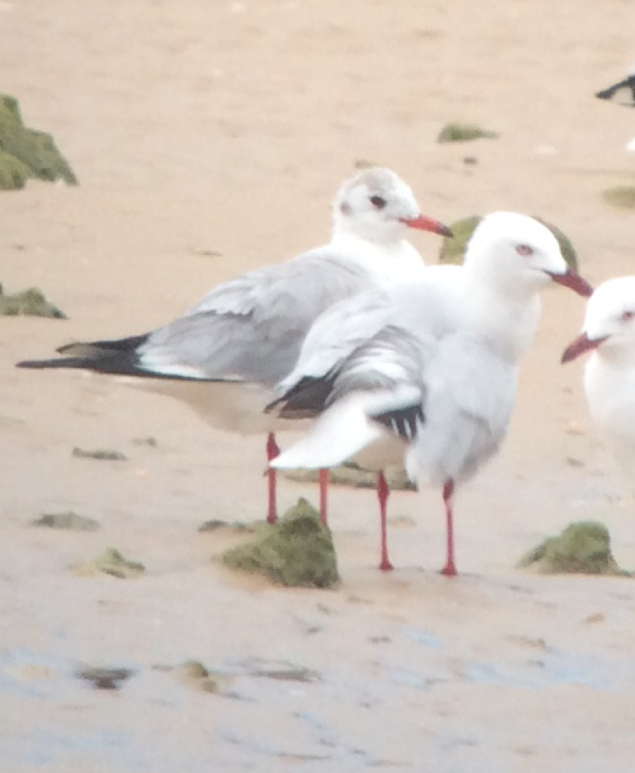
Black-headed Gull (back) with Silver Gull on the shore at Nhulunbuy (NT). Image with kind permission of Karen Rose.

Australia’s ninth Black-headed Gull Chroicocephalus ridibundus, has been re-found near the remote East Arnhem Land town of Nhulunbuy.

First reported by Chris Wiley on the 2nd of February around the old alumina refinery’s export conveyor, this got everyone’s attention. This is a bird still absent from some of our top twitchers’ lists. Sadly Chris didn’t manage any photographs of the bird and failed to re-find it the following day. At a remote locality like this a report with no pictures just doesn’t cut the mustard to get most twitchers booking flights.

So it was all the more exciting on the 11th of February when Karen Rose poked her head above the virtual parapet to post a distant phone-through-scope photo of the bird. Distant and grainy though the shot was, it was sufficient to establish a good identification of the bird which (STBA*) will be our ninth record of the species. Both Birdline reports can be viewed here.

Black-headed Gull preening. Image with kind permission from Karen Rose.

Even better news was that Karen had first noticed the bird on the 9th of February, so it seems to be at least briefly site-faithful most days, apparently at low tide. This is a fairly out-of-the-way spot so the question that remains now is… who’s going to twitch it?

PS: ABC weren’t slow to pick up the story and you can read James Purtill's article here. Before anyone jumps in, Sean Dooley (@twitchathon) was quick to correct himself on Twitter; it was a Javan Pond Heron, not a Chinese.

*Subject To BARC Approval – a phrase this writer employs so often it warrants the abbreviation. 

The Cat Is Out Of The Bag

Chris Watson

The old man rang me early yesterday morning and quickly told me to turn on the radio… and it was a jolly good thing that he did.

Ian (Macca) McNamara was doing his usual Sunday morning ‘Australia All Over’ program on ABC 774, and Dad informed me that his guest was a bloke called Tom Biggs, and they were about to talk about the Night Parrot. I flicked on the wireless just in time to hear Macca announce that they were going to the news, but would be back shortly to talk with Tom about the ground parrot. This was surely a slip of the tongue as I knew, as will my reader, Tom Biggs as the associate of John Young – famous re-discoverer of the Night Parrot (still congeneric with the Eastern and Western Ground Parrots but for how much longer?)

Tom had evidently been an interesting guest, but no-one will be surprised to read that the only bit I was interested in was the parrot. Tom went through a quick summary of Night Parrot news since John Young’s 2013 announcement of its re-discovery. Tom then literally (figuratively) let the cat out of the bag with the revelation that John had discovered evidence at the site to indicate that a female Night Parrot had been taken by a feral cat.

 Kaye Kessing's brilliant portrayal of the ongoing battle between invasive species and outback Australia's native wildlife is the stuff of legend. Kaye was kind enough to grant permission for use of this image. If you'd like to see more, head over to Kaye's website - http://www.kayekessing.com/posters - and buy her posters; they're perfect for the class room wall, the nursery wall, and a great addition to any office space. Also keep an eye on this blog for details on the Bilby's Ring Trilogy of novels which I'm told also features the Night Parrot.) 

Kaye Kessing's brilliant portrayal of the ongoing battle between invasive species and outback Australia's native wildlife is the stuff of legend. Kaye was kind enough to grant permission for use of this image. If you'd like to see more, head over to Kaye's website - http://www.kayekessing.com/posters - and buy her posters; they're perfect for the class room wall, the nursery wall, and a great addition to any office space. Also keep an eye on this blog for details on the Bilby's Ring Trilogy of novels which I'm told also features the Night Parrot.) 

This is bad news any way you slice it, but immediately I posted this news (I was sticking brief snippets on Facebook as I heard them for those unable to listen in), the thread sprang to life with some positive offerings along the lines of what this might teach us. Mark Carter, a frequent contributor to the scientific discourse on social media, responded in characteristically robust fashion:

“…this will be a chance to discover something more about their breeding ecology- will the male stay at the site, attract a new mate? How is that done? How long does it take him? Or does he leave and the site be occupied by new birds? Or the site just be abandoned (indicating that habitat availability isn’t what is holding these birds back)”

For all we know Night Parrots are getting taken by feral cats every week; here’s hoping, for this at least would mean that there is a population that has so far been big enough to endure this level of predation. In any case it means that the story of the conservation of the Night Parrot, like all of our other wildlife, is a story that will be inextricably linked with the control of invasive species. It’s only quite recently that the clear consensus emerging from the work of Australian ecologists has been that the very worst among the invasive animals (at least in terms of overall detrimental impact on native biodiversity) is the feral cat.

In October last year the birding community of Alice Springs was excited to have John Young at the Red Centre Bird Festival to deliver his talk about re-discovering the Night Parrot. Anyone who attended will testify that it was a riveting presentation, and historic in the sense that it was the first time John had told his story to an audience in the arid heartland of the bird’s former territory. I was lucky to attend on that night and will readily testify that John’s story had lost none of its immediacy in the telling, despite being almost 18 months old. John had no doubt recounted his journey hundreds of times over those months but the 104 people in the Alice Springs Desert Park theatre that evening felt as though they were the very first to hear it. They genuinely were the first to hear the announcement during that talk that John had been successful at locating two further populations of Night Parrots some 40kms from John’s initial site.

 John Young holding court at Alice Springs Desert Park in October 2014.

John Young holding court at Alice Springs Desert Park in October 2014.

It’s exciting to announce then, that for the first time John will be travelling down to present his story to a Melbourne audience. On the evening of Sunday the 1st of March, the Deakin Edge at Federation Square will be hosting perhaps the greatest story of discovery in Australian natural history for over a century. Organisers are still finalising the finer details of this event, but we are hoping to have tickets available for purchase by the end of this week. As soon as further details are confirmed, they will be publicised here, and through all other channels that Melbourne birdos are likely to be checking.

If you’d like to listen to Macca’s full interview with Tom Biggs, or even just fast forward to the bits about the Night Parrot you can stream the entire show at this link.

With thanks to Steve Davidson for his beautiful painting of the Night Parrot for the thumbnail accompanying this post.