In 2005 the Cornell Laboratory of Ornithology published its report of the rediscovery of the iconic Ivory-billed Woodpecker Campephilus principalis, rightful claimant to the title of Grail Bird in US ornithology, and presumed extinct since the 1940s. Exhaustive searches of the Cache and White River systems ultimately produced no further evidence and the "rediscovery" is now widely discredited. The similarly elusive Pink-headed Duck Rhodonessa caryophyllacea, may have been sighted in 1988 on the banks of the Brahmaputra (north-eastern India), by Rory Nugent and Shankar Barua - but we can't be sure. The only known photographs of this species alive are from 1925, and the last specimen was shot in India, in 1935. That much of its habitat lies in remote and poorly surveyed parts of Myanmar is a cause for some optimism and its official classification is Critically Endangered, rather than Extinct. But despite a few reports in the last decade, no evidence of its continued existence has ever been produced. In Australia there still remains one living species that, despite being seen and identified by a few determined birders in its difficult north Queensland home in most years, no photographs of a live specimen have ever been produced* - the Buff-breasted Button-quail Turnix olivii.
The world of birds offers many tantalising mysteries to the intrepid adventurer, but pre-eminent among these has always been the Night Parrot Pezoporus occidentalis - a bird tailor-made for controversy and a species which eluded some of the best field ornithologists in the land for a century. A fair dinkum enigma.
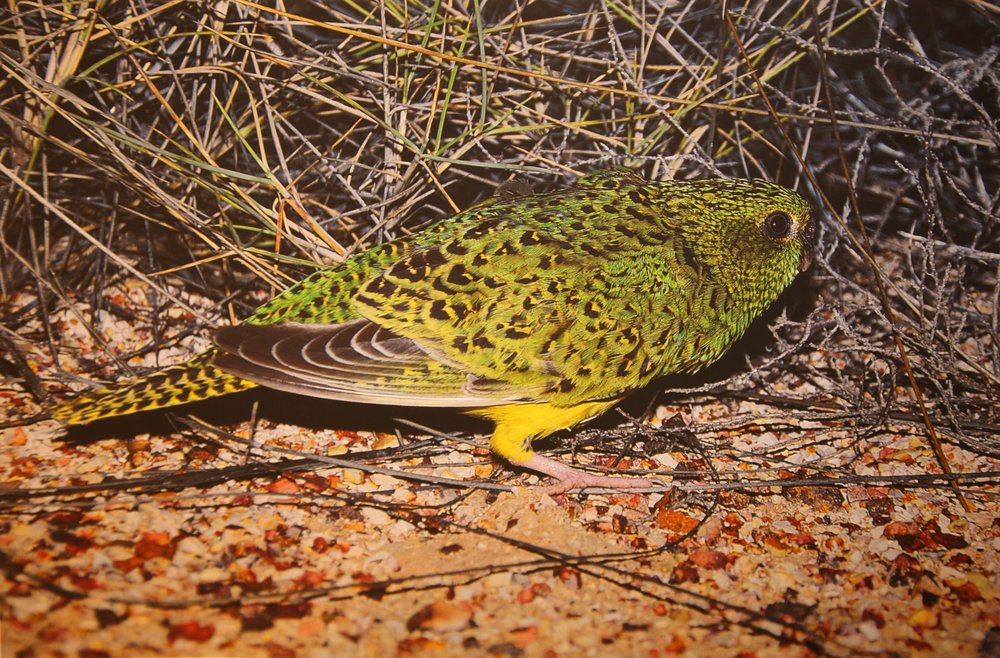
The Night Parrot has laboured under many unfortunate monikers; The Loch Ness Monster of birds, The Tasmanian Tiger of birds, The Holy Grail of Birding, The Fat Budgie, or simply, The Ex-Parrot. If you have been following this story however, you will understand that none of these epithets is fitting, if indeed they ever were. While it will almost certainly remain the Holy Grail for some birdos, some of the mystery surrounding the species was banished forever on Big Wednesday. On the 3rd of July 2013, Australian naturalist John Young revealed at an exclusive, invitation only, private function at the Queensland Museum, irrefutable evidence of the species' continued existence at an undisclosed site in the southwest of the state. Marking the culmination of many years of fieldwork and study including 17000 hours at the one site, John Young, with his mate John Stewart holding the torch, managed to capture high quality digital photographs and 17 seconds of video footage of the species, very much alive, in its native habitat of thick spinifex. Only a few photographs were displayed at the strict no-cameras and no-recorders event, and only 6 seconds of the video footage, but the images have been studied around the world and there is no doubt that they're the real deal. John’s stunning images graced the cover of our national bird magazine, Australian Birdlife, and one of them now graces my wall.
A more demure and heavily-watermarked image appeared on the front page of The Weekend Australian accompanying an article by Tony Koch on June 29th 2013. The online edition of that story can be found here.
Since this first appearance in the media, John’s story has done the rounds and an online search will take you to any number of articles that have summarised the find with wildly varying degrees of accuracy. Among the coverage that has been less burdened by truth, rectitude, and research, I got a particular chuckle out of the following that claims the species can be "commonly found" while still being one of the "world's most mysterious birds" in the same sentence. It also credits the discovery to a "Mr John King", (there's been a second discovery?) and accompanies the news with a stolen picture of a Ground Parrot Pezoporus wallicus, here.
Suffice to say that the coverage in the media has been patchy at best, and is a nice reflection of a conversation that is gaining momentum across the country about the loss of good science journalists. Other reports unnecessarily perpetuated some old myths and even started up a few new ones. Chief among these is the fallacy that the species was presumed extinct. Very few, if any, people with any interest in the subject thought that the species had already gone extinct. This would be a difficult assumption to maintain in the face of much evidence to the contrary. Although the last specimen was actively acquired in 1912, two dead specimens were found more recently within 200 kilometres of each other in western Queensland; one in 1990 and the second in 2006. Dead birds have to come from living populations.
Other news reports claimed this to be the first time the bird was seen alive in over 100 years. This is another clear exaggeration - the excitement in the ornithological community was over the first photographs of a live specimen, ever. It would be unusual for more than a few years to pass without one or two reports emanating from the outback of observations of the species. While many of these reports have common and questionable characteristics (they occur in poor light, observers had fleeting glimpses, observers were not bird experts or even practised bird-watchers) and are rightly treated with some skepticism, not all of them are likely to be apocryphal or mistaken. Some observations have been by highly respected, experienced field ornithologists, and some have been well-documented and ratified by peer review as recently as 2005 in Western Australia. Add to this the fact that anyone seeking or claiming to have seen the Night Parrot has often been treated to raised eyebrows and some level of derision with labels like "Yowie Hunter" sometimes thrown around. In such an atmosphere it's easy to understand that there are probably other sightings that have gone unreported due to the fear of ridicule or the loss of professional credibility. Furthermore, if we look at other examples of species whose former range covered much of the continent inside the 280 millimetre isohyet, Greater Bilby Macrotis lagotis, say, it's possible that there remain remnant populations at widely separated locations - it's unlikely that John discovered the last of the Night Parrots. He just happened to be the only one with the talent and the grit, and let’s be fair perhaps a bit of good luck, to find them. At the time of writing he remains the only living person to have found a population of Night Parrots.
John’s photographs are spectacular, and provide satisfying evidence of the bird's continuing existence, but they don't really provide any advantage to other people looking for the species; we already know what the bird looks like and we have 24 museum specimens to study at close quarters.
Make no mistake - it is a recording of the Night Parrot's call that professional ecologists have been really excited about. This will provide an immeasurable advantage in any attempts to locate populations of this bird elsewhere. As, by John's own accounts, the bird is so difficult to observe, knowing what it sounds like will be the crucial tool for professional scientists hoping to identify remnant populations in other locations, and prevent the destruction or disturbance of their habitat. For professional ecologists working on the site of a development, the key to halting or modifying the extent of habitat disturbance or destruction comes down to proving the presence of listed species. So seen through the eyes of an ecologist conducting pre-clearance surveys in remote areas with undisturbed tracts of potential Night Parrot habitat about to be flattened, the importance of this recording is difficult to overstate. As it stands, field ecologists have Buckley's chance of actually observing a bird, and even less chance of being able to authenticate the sighting unless they also manage to photograph the bird. However, if they know what to listen for, or better yet, have an automated recording device allowing them to screen both audibly and visually for the bird's vocalisation after several weeks or months of constant recording, the chance of verifying the species' presence, and stopping land clearing, heads into the realms of practicality.
Withholding such a crucial tool for establishing the species’ presence hampers attempts to locate the birds in other locations. John kept his recordings of the bird’s call to himself in the weeks and months following his announcement and I was too hasty to be critical of him for this at the time. I’ve since got to know John quite well and have come to understand the immense pressure that he must have been under at the time. He had a lot of different interests competing for his attention and his response, and in hindsight perhaps the best thing he could have done, was to keep the welfare of the bird in the front of his mind and keep the recordings under wraps. Once the dust had settled he had the unenviable task of trying to work out what to do next and the rest, to coin a phrase, is history.
I know nothing of the supposed acrimony surrounding John’s parting of company with the current research team at Pullen Pullen Reserve so there is no point engaging in baseless speculation. But the availability of acoustic data remains a pertinent and pressing question three years on. Why can’t it be released? Bush Heritage, or people operating on their property, are in possession of an unprecedented library of calls. Just a few call recordings is all it would take for ecologists operating in potential Night Parrot habitat elsewhere to positively confirm the species’ presence. The species range once took in most of inland Australia so they might not necessarily occur in habitat identical to that at Pullen Pullen Reserve; we should be looking and listening far and wide. Just a few individuals and organisations have been in possession of this critical piece of knowledge for some years now, while potential Night Parrot habitat has been going under the dozer blade for developments of all types across the outback. Bush Heritage and the team they have researching the Night Parrot at Pullen Pullen deserve full credit for the work that they are doing. It will be a landmark publication when the findings of their study finally see the light of day but we have no way of knowing how far off that publication will be. Their lack of engagement has some in the conservation community pessimistic that the call will ever be released.