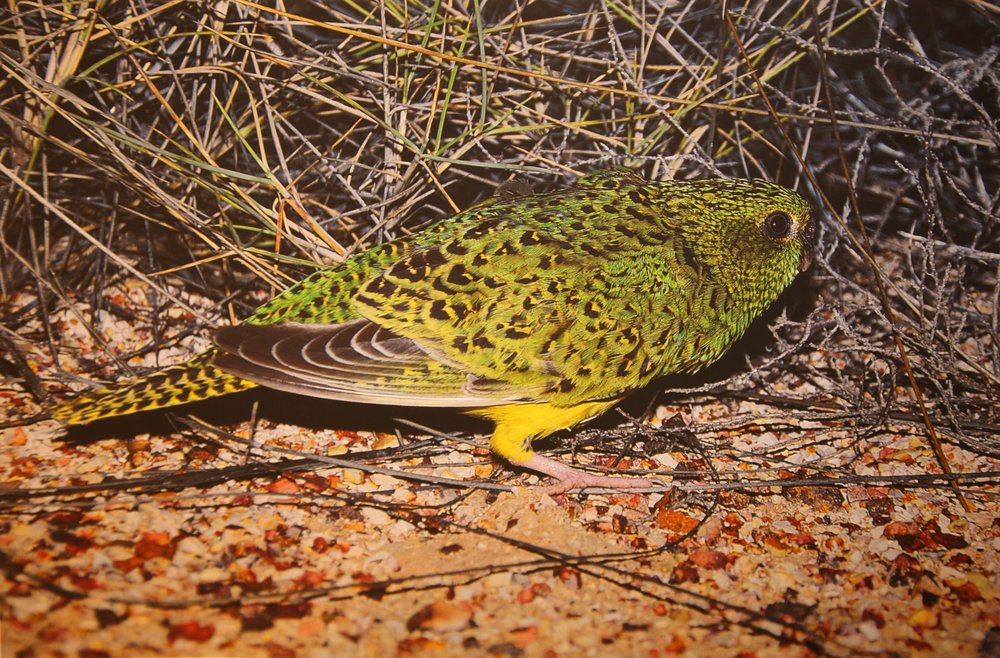
The Orange-bellied Parrot is vanishing before our eyes on the doorstep of one of our largest cities. A large portion of our remaining small and medium-sized mammals are on a similar trajectory. There are swathes of Australia’s remote interior that remain poorly-sampled and numerous species that are virtually unknown. The Great Barrier Reef is knackered. Our forests are riddled with dieback. The last of our south-eastern tall, wet forests are still under threat from an antiquated and unprofitable logging industry. Dangerous and barren legacy mines dot The Outback, uninhabitable and toxic. The scars left behind by unsuccessful mineral exploration criss-cross even the remotest regions of the continent's interior. They are rehabilitated in the most perfunctory manner permitted by law and left to testify to our rampant disregard for the natural heritage to which we are all heirs. Most of our frogs aren’t having a good time. The oceans are increasingly full of plastic and empty of fish. The entire continent is awash with feral cats, foxes, camels, horses, donkeys, fish, goats, pigs, deer, rabbits, ants, toads... and then there are the weeds. Changed fire regimes often shadow the spread of weeds laying waste to further remnant habitat and wildlife refugia. We’ve already cleared a fair whack of the native vegetation anywhere that might be good for a farm and there are many out there who don’t seem to grasp the folly of proceeding to clear the rest. Both of Victoria’s faunal emblems (Leadbeater’s Possum and Helmeted Honeyeater) are classified as Critically Endangered. There’s only one classification worse than that. And on top of all this we’re entering an increasingly unstable and erratic climatic future characterised by changes in temperature and rainfall that are already proving too rapid for some species to successfully adapt to.
Faced with all of this, as Dale’s article concludes, it is difficult not to question exactly how urgently we need to spend $50 billion on submarines when expenditure of just a few hundred million dollars could mitigate or eliminate many of the problems listed above. Do we really need to cut $54 billion from public health spending in order to provide tax cuts (coincidentally totalling a very similar figure) to the wealthiest individuals and overseas business owners?
When did Australian democracy jump the shark?
Our leaders wring their hands and furrow their brows with earnest sincerity while explaining, apparently without an ounce of irony, that the savings must come from the smallest funding pools: human services, health, science, education, the environment. The burden of funding cuts must be shouldered by the most vulnerable and least represented in our society. Never mind that just a handful of our wealthiest individuals, chipping in just a fraction of their combined wealth, could fund everything we could ever need and not notice the slightest difference in their standard of living. This while the Australian Taxation Office seems to be legally incapable of ensuring that the businesses and individuals who accrue the most wealth from Australian resources pay proportional taxes on that wealth, while simultaneously falling over themselves to hound lower income earners and hold them to account for their pittance.
It’s not even the stuff of conspiracy theory to suggest that our government is now led by a corporate class which serves any interest but the national interest. This much is observable. At best, we now live in a thinly veiled oligarchy; the cynic in me might suggest outright kleptocracy.
This is only occasionally contested, half-heartedly, by those in Parliament House and nobody with the capacity to think for themselves would believe them. It isn’t happenstance that some individuals at the top of Australian politics rank among the wealthier in Australia, and have friends and associates among the wealthiest. Neither should it be a surprise that they might collude and go out of their way to preserve the status quo.
The same people who helplessly hold up their hands when exposed for exploiting loopholes that allow them to needlessly consolidate their already obscene economic advantage, are the same people who are uniquely placed to close those loopholes and render the system more equitable.
On top of saving billions on unnecessary submarines and corporate giveaways, we might not have to look too far to find funds that could return to government coffers if they simply decided to make it so.
Stop imprisoning innocent people. Tax the church. Legalise marijuana. Tax wealth.
These ideas are simply expressed here but I acknowledge they would not necessarily be simple to put into effect. These are concepts that have been spoken about and debated at length for decades and their time has well and truly come. Are they really that revolutionary? Is it objectionable to demand a government that takes clear action toward building an equitable society that looks after the weak rather than endlessly reinforcing privilege among a tiny few? Is it pie-in-the-sky to expect our leaders to engage honestly and intelligently with experts and harness their learning to develop the best practices to benefit society? Is that unreasonable? Is anyone really so dull that they’re content to entertain the prospect of living in a barren post-mining landscape, drained of its mineral wealth, ravaged by climate change and depauperate of its unique fauna?
Anyone with rudimentary arithmetic skills (or the faintest shred of human decency) can tell you that our current refugee and immigration system is a millstone around the nation’s neck that serves entirely political, rather than practical or humanitarian, ends. Aside from being completely ineffective, it is costly; and cruel. Why are we so intent on displaying this barbarous side of our nature to the world? If we simply stop imprisoning and brutalising the most vulnerable people on Earth, we’ll save a truckload of cash and we can all feel better; win/win.
Next, tax the church. I’m not religious myself but I don’t mind if other people are. We shouldn’t care what people believe – we should care about what they do. Religious institutions rank among some of the wealthiest businesses on the planet, they offer a “service” which is faulty at best and plainly fraudulent at worst and religious observance has been dropping steadily for decades. Their continuing tax-exempt status is a farce which demeans and burdens us all. The first counterclaim to this proposition is usually to point out the variety of charitable and social services that various religious organisations provide which would otherwise need to be picked up by the government. But this is easily dismissed by a simple calculation of the amount of extra tax revenue we’d have to lavish on those services if religious tax exemption were revoked. The religious are always happy to point out the moral and charitable aspects of the organisations they support while sweeping their large catalogue of misdeeds under the carpet. If they’re genuinely keen on helping their fellow humans, they should be stepping forward to welcome taxable status with open arms and ululations of divine joy. They should be happy to do their bit and we should afford them the opportunity to do so.
To these measures you could add: rational defence spending based on realistic strategic assessments rather than hyper-politicised scare campaigns; a rebuilt corporate tax system to stop large businesses heading offshore with billions of dollars owed to Australian tax-payers; social welfare payments that equal a living wage; an end to the negative gearing nonsense; an increased minimum wage and a rebuilt personal income tax system which taxes wealth rather than income.
Implementing even a couple of those measures would have the nation so flush with cash that finding the paltry $10 million per year estimated to be sufficient to prevent the extinction of ALL Australian bird species, would be a matter for petty cash.
Our leaders have all benefitted from our (previously) free education system. They have grown up among the riches of our (seriously imperilled) natural heritage. Many of them have parents who were (welcomed as) refugees and some of them are immigrants themselves. They should be ensuring the same freedoms are available for generations to come, not dismantling each of them systematically.
I don’t even know what any of this has to do with parrots anymore. I guess I’ve had a creeping feeling for a long time that throughout the span of my life the government has been steadily extricating itself from responsibility for the environment. The Earth is just one giant ecosystem and one upon whose function we, and our economy, rely upon for our continued existence. Increasingly, conservation, and the broad base of scientific endeavour that underpins it, is left to not-for-profit NGOs: Birdlife Australia, Landcare, Australian Wildlife Conservancy, Zoos Victoria, Bush Heritage Australia, Greening Australia and countless others. Our national parks have had their funding and staffing progressively slashed to the extent that some reserves are virtually un-managed and many others run on a skeleton crew of rangers who function more as groundskeepers and maintenance crews than natural resource managers or wildlife ecologists.
There’s an election coming and I just hope that the shark which Australian democracy jumped some time ago can be returned to the open sea without fear of culling and we can forget the entire ghastly episode.