Chris Watson

The heart of the Never Never

TourismChris Watson

This piece was first published in Great Walks' Annual Bumper Edition in January 2016.

Mick Jerram from Gecko Canoeing &Trekking led us clear across the Top End's two famous national parks.

Great Walks spent a week hiking in Arnhem Land and came back the wiser.

Halfway up a precipitous scramble in the Northern Territory’s Kakadu National Park, a foot slips somewhere above me.

“All good Mick?!” I call up the cliff face. A pebble bounces past and into the dark pool at the base of Motorcar Falls, 30 metres below. The reply comes quickly, “YEP! No worries. Come on!” Mick has found a way. Mick Jerram is the nuggety former Royal Australian Air Force PT instructor leading us on a walk that will take us across some of the most spectacular and rarely seen parts of the Arnhem Land Plateau.

We eventually strain and scramble our way to the top of Motorcar Falls to be rewarded with views across the entire region known to Jawoyn traditional owners as Yurmikmik – named in onomatopoeic homage for the call of the White-throated Grasswren which calls this area home.

From Motorcar Falls we trek along Yurmikmik ridge, stopping just once to evade an aborted charge by four Water Buffalo. We retreat to the safety of a nearby rock pile and the buffalo vanish into the scrub as quickly as they had appeared. Further on, a hiker’s boot disturbs a rock. From underneath, a harmless Children’s Python makes off to avoid the disturbance. Bird song surrounds us, and the trees are alive with movement. We count the number of different birds we can identify as we go along and the list tops fifty species before we arrive at our first camp on Kurrundie Creek.

Heading upstream

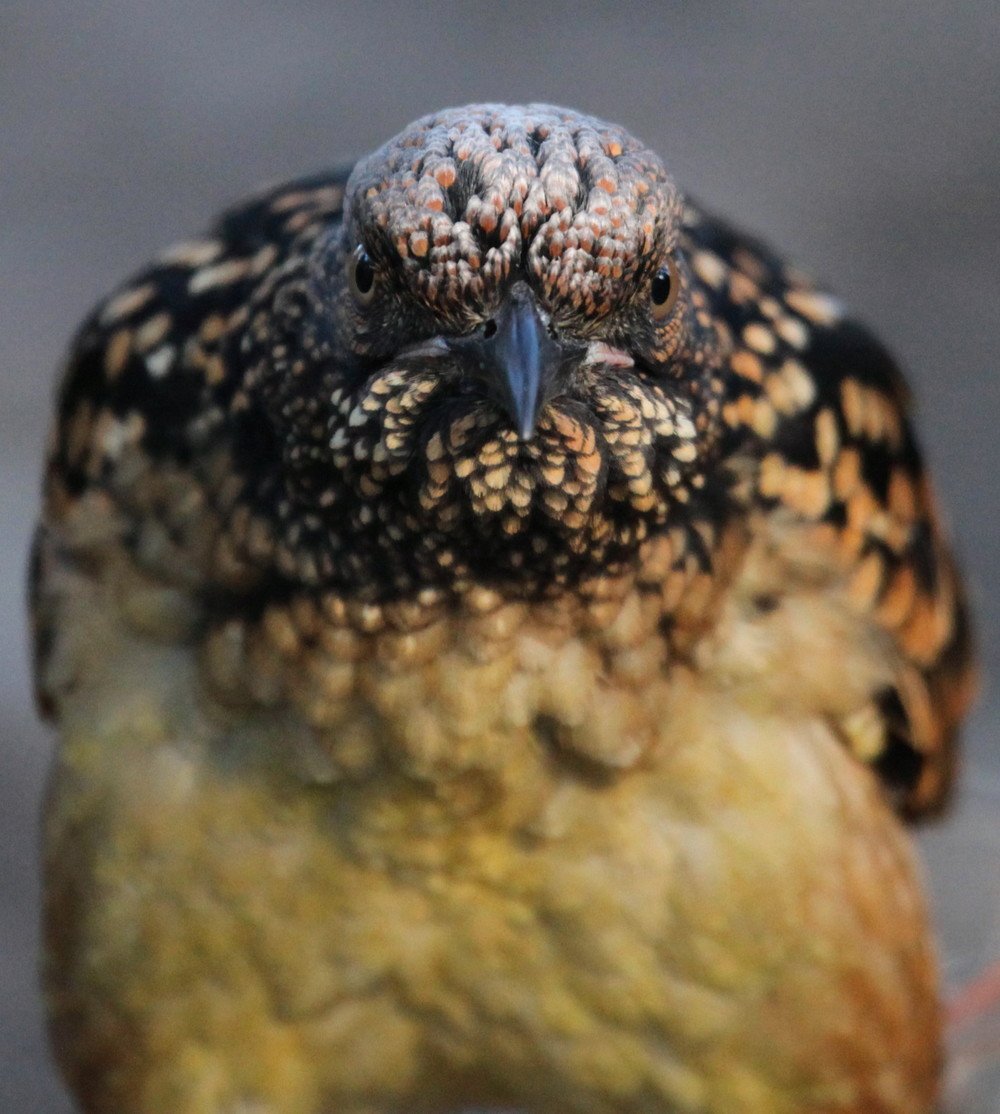
We can swim in the pools surrounding the falls here; we are above the level at which Saltwater Crocodiles may occur following the wet season.  Walking upstream takes us onto the terraced sandstone plateau. We pass bemused denizens of the sandstone like the prehistoric-looking Chestnut-quilled Rock Pigeon. Small groups of these plump, pin-headed birds scatter from the terraces as we approach.

We pause to scrutinise rock art galleries. Mick proves here to also be adept at interpreting the ancient daubs of Jawoyn ancestors. He identifies animals and ancestral beings for us, while leaving silence enough for our imaginations to travel. It’s impossible not to make comparisons between our journey, and the journeys of those people who have walked this country in eons past. The temptation to label such places as wilderness, denies the clear reality that, as wild as it is, this is a cultural landscape; a human place.

Continuing deeper into the sandstone country, the terraces erode to minarets and the fissured rock becomes a labyrinth capable of absorbing and disorienting the unwary navigator. We cross the watershed and camp by the flowing waters of Dinner Creek.

The landscape transforms here. Water cascades down sandstone falls every hundred metres or so. The sound of moving water is the constant soundtrack to life. This is remote country, and it feels it. By starlight we search the riverbanks for wildlife. Euros (bulky hill kangaroos) bound along the rocks. In a crevice, again adorned with ancient artwork, we encounter another endemic inhabitant of this region, a Northern Giant Cave Gecko.

Northern Giant Cave Gecko

Timeless landscape

Setting off in the morning it seems logical to assume it’ll be an easy walk from here on; a simple matter of following the watercourse down to its confluence with the South Alligator River. But walking in this landscape is rarely so straightforward. We skirt around ever larger falls until we’re stopped by the main falls on Dinner Creek; a 20 metre cascade with sheer rock on either side. We’re momentarily stupefied by the prospect of a lengthy walk to get around this barrier when Mick yet again finds a way. He spies a navigable scramble down a re-entrant to one side of the falls, and after a wary descent, we’re on the floor of a gorge straight out of Jurassic Park.

We pick our way along the river bed, and it feels as though few other people have had the privilege of visiting this magical hidden gem of a place. Ferns cover the water’s edge. Huge Black-banded Fruit Doves zip across the gorge overhead searching for ripe figs.

A regional endemic - Black-banded Fruit Dove

In due course we have to start taking care to avoid the dark waters that are now almost certainly home to salties. Having seen only 4 other hikers during our six day walk, it feels like we have emerged from a very special part, of one of the Northern Territory’s truly special wild places.

Just one of the extensive network of Top End routes that await discovery by keen hikers, Yurmikmik is only possible with permits and a talented, experienced and accredited guide. It connects the numerous trails within Kakadu NP with some of the lesser-known routes through Nitmiluk NP on its southern border. The walks here (the Jatbula Trail and many routes making their way up to the headwaters of the Katherine River) are rapidly earning a reputation for being among the best marked and “off-trail” walks in the country.

The permits required to complete these walks, far from being a troublesome barrier, should be seen for what they are: a welcome measure to protect an area of world-famous cultural and ecological significance and sensitivity. In every sense of the word, walking in such parts of the NT’s Top End is a privilege, and an experience never to be forgotten.

JATBULA TRAIL

The Jatbula Trail features magnificent waterfalls tumbling from the high sandstone escarpment. These feed into creeks surrounded by shady monsoon forests and the rock outcrops of the escarpment providing great opportunities to view ancient rock art, and cool off with great swimming spots. It’s a medium to hard walk and you’ll need to be able to carry a full pack over rough ground. The majority of people walk the trail independently however more people are starting to use guides. There are emergency call devices (ECD) and checkpoint book registers along the way. More info www.parksandwildlife.nt.gov.au

NEED TO KNOW

Kakadu National Park

Located 240km east of Darwin in Australia’s tropical north, Kakadu NP is Australia’s largest terrestrial national park. Kakadu covers almost 20,000 sq km and is a place of enormous ecological and biological diversity. It extends from the coast and estuaries in the north through floodplains, billabongs and lowlands to rocky ridges and stone country in the south. These landscapes are home to a range of rare and endemic plants and animals, including more than one third of Australia’s bird species and one quarter of its freshwater and estuarine fish species.

Nitmiluk National Park

This 292,800 ha national park is owned by the Jawoyn Aboriginal people and jointly managed with NT’s Parks and Wildlife Commission. Some of the park’s features include spectacular dissected sandstone country, broad valleys and numerous, significant cultural sites. The deep gorge carved through ancient sandstone by the Katherine River is the central attraction of the park. The park’s main entrance is 30km northeast of Katherine via a sealed road. Katherine is located 310km south of Darwin along the Stuart Highway. Leliyn (Edith Falls) on the western side of the park is reached by turning off the Stuart Highway 42km north of Katherine then following a sealed road for a further 19km.

Need to know

The walk was conducted by Mick Jerram from Gecko Canoeing & Trekking, Ph: 1800 634 319, gecko@nttours.com

Review: Understanding Bird Behaviour by Stephen Moss

ReviewChris Watson

“The Golden Eagle, which has universally been considered as a bird of most extraordinary powers of flight, is in my estimation little more than a sluggard, though its wings are long and ample.”

John James Audubon

The only times I've seen a Golden Eagle I've always gawped at its mastery of aviation. Clearly Audubon thought otherwise. But everybody looks for different things in the pursuit of birds. This is why there are so many different names for it: birding, twitching, ornithology, bird-watching. They are all subtly different, but there is a lot of overlap and most of us are practitioners of all of these at different times. This is why only a true birdo understands that you can be out for a day of birding and stop for a while to do some bird-watching; a statement that seems the height of nonsense to a muggle.

If birding can be loosely defined as noting all of the birds in a general area for the purpose of listing or census, bird-watching is a more immersive activity. Monitoring a sheltered pool of water and observing the birds interacting while bathing and drinking might be bird-watching. So might setting up in a patch of scrub to observe the behaviour of a mixed flock feeding in a bloodwood in heavy blossom. Bird-watching is what elevates a Willie Wagtail from merely another common bird on your day list, to a larger-than-life character, full of personality, staunch in defence of resources or territory, endlessly adaptive and innovative in its choice of nesting locations, tireless in its hawking of insects from its perch on a fence post and hilarious in its interrogation of its reflection in a car mirror.

Willie Wagtail Rhipidura leucophrys, a true bird-watcher's bird.

When everything on your patch has been ticked and listed, surely understanding what birds are doing when you’re watching them is the name of the game. More than this, interpreting the behaviour of the birds we seek also helps us find the birds more easily and ultimately become better birders overall.

With the acquisitive activity of bird photography gaining ground on the more inquisitive pursuit of bird watching, it’s crucial that people seeking wildlife, for any purpose, recognise the difference between restful, natural bird behaviour and a bird that is agitated, threatened or stressed by the observer’s encroachment. 

We've all seen a bit too much of this I think. Surely the point of having a long lens is that you don't have to stalk so close to birds in such an exposed situation? When the tired little birds that have just flown halfway around the world are looking up from their frenetic (and critically urgent) feeding and fluttering nervously just 10 metres from the glass on your 500mm lens, it's probably time to stop looking at the birds and have a good hard look at yourself. 

If birding is primarily about allocating a bird its correct identity, bird-watching is about observing and understanding birds’ behaviour.

Understanding Bird Behaviour then, is very much a book for the bird watcher in all of us. Well-known British naturalist and author, Stephen Moss, has produced a valuable, timely and exciting book here. For anyone interested in taking their birding beyond mere identification and listing, this book will provide the perfect jumping off point.

It is laid out superbly with god-tier photographs throughout. The main body of text is split into two parts, with part one taking the reader through the basic range of bird behaviours broken into six chapters: movement, feeding, breeding, migration & navigation, distribution & range and life & death. Part two addresses the birds by family and sets out the behaviours they share and those that make some species stand out from their close relations.

It’s an educative read, but it is not quite the comprehensive treatment of the behaviour of all groups of birds that you might surmise from the title; a better one might have been Understanding British Bird Behaviour. The book limits its treatment, for the most part, to species occurring in the British Isles. Despite this, the text provides ample coverage of all the more common examples of bird behaviour that most of us can expect to come across.

Understanding Bird Behaviour makes no claims of being an exhaustive reference but as an introductory text on the subject it covers a lot of ground. The information is clearly presented and perfectly accessible for beginners while still holding plenty to recommend it to experienced birders as well. The limited geographic treatment results in missing many fascinating examples of bird behaviour (nothing on flightless birds, nectarivores, bowerbirds, megapodes, hornbills, birds-of-paradise) but the interested reader will track down full accounts of these groups in other books easily enough.

Moss points out a recent decline in the activity of twitching (ticking rarities) and raises the possibility of an imminent “renaissance” in bird-watching. I’m sure many of us would welcome such a movement but I’m not sure I’d noticed the decline in ‘twitchiness’ – certainly not from this antipodean viewpoint.

But regardless of where you reside on the twitching spectrum we can surely all agree with Moss that, whether you’re in Galway or The Galapagos, alongside the Thames or on the shores of the Yarra, it is the behaviour of birds that encapsulates their fascination for all of us. To that end, this book should become a foundation text for all new birders and will be a welcome refresher for those of us who need to slow down and take more notice.

CBW

Buy it from Andrew Isles

Please allow me to introduce myself...

Chris Watson

Meet the Spotted Whistling-Duck, Australia’s newest resident breeding species.

This piece first appeared in the December edition of Australian Birdlife magazine.

The Spotted Whistling Duck Dendrocygna guttata. Pic by Dick Daniels from Wikicommons. 

It may seem unimaginable today, but seeing a Cattle Egret on your patch would once have been an immense thrill to an Australian birdwatcher. Initially unknown in Australia, from the 1870s onwards the Cattle Egret began a rapid expansion from its original range across south-western Europe, tropical and sub-tropical Africa, and southern Asia. The species crossed the Atlantic into South and Central America, reaching as far north as Canada, where it first bred in 1962. In Africa it expanded southward, arriving in South Africa by 1908. The species had spread as far as Australia by the 1940s and New Zealand by the 1960s.

Today, Cattle Egrets are well established through the better-watered regions of Australia’s north and east and even occur, less frequently, across the driest parts of the continent. The 1940s-era birdwatcher would have been there during the first wave of this self-introduction and been able to chart its progress across the Australian continent. Until now, the only other species of bird to have self-introduced into Australia in historic times is the Kelp Gull which arrived, presumably, from New Zealand in the 1940s and first bred here in 1958. Is it possible, however, that we are currently witnessing a self-introduction of another species, albeit on a less spectacular scale?

It came as quite a surprise to Australian birders when Spotted Whistling-Ducks were first sighted on the Australian mainland, at Weipa on the western coast of Cape York, in March 1995. It’s worth noting that this record followed closely in the wake of Tropical Cyclone Warren. Even more remarkable was that this turned out to be no one-off vagrant record – in the years that followed, the species would continue to be reported at Weipa in flocks up to 14 birds. Later it would be recorded at Chilli Beach and Lockhart River, with records as far south as Mission Beach in 2014.

The first confirmation of the species breeding in Australia came in 2000 on Cape York Peninsula, where it has now established a small but widespread breeding population. It was eventually recorded across the Gulf of Carpentaria in the Northern Territory in late December, 2011, when a lone bird was seen at Leanyer Sewage Ponds near Darwin. The similarities with the initial Weipa record went beyond its appearance at a sewage works to include its timing – immediately after a cyclone (this time, Tropical Cyclone Grant) had passed through. Spotted Whistling-Ducks may since have established a small breeding population on Melville Island, north of Darwin, with flocks of up to 130 birds recently reported by fishing charter vessels in the vicinity of Goose Creek.

The global spread of Cattle Egrets can be explained by its commensal relationship with large herbivores, cattle in particular, and the expansion of pastoralism in many parts of the world throughout the twentieth century. But what, if anything, is behind this self-introduction of Spotted Whistling-Duck to Australia’s north?

The Spotted Whistling-Ducks traditional range extends across the southern Philippines and through the Moluccas and Lesser Sundas to New Guinea (where it is the most common duck) and the Bismarck Archipelago. Throughout this range its status is listed as Least Concern, but it is rarely found in concentrations larger than 100 birds. The population is yet to be comprehensively surveyed as much of its home range is in remote areas, but estimates have placed the world population at between 10,000 and 25,000 individuals. It’s a decidedly lowlands resident over most of New Guinea, rarely venturing above 200 metres, and inhabiting freshwater swamps, marshes, pools, and occasionally mangroves and watercourses where there are grasslands with scattered tree cover.

When dealing with a species so little-known even in its heartland, any answer to such a question of self-introduction will involve a lot of conjecture, but it is an interesting exercise all the same. Adding further intrigue, other species, like the Collared Imperial-Pigeon and Red-capped Flowerpecker, are regularly recorded on the Torres Strait Islands between the tip of Cape York and Papua New Guinea. Neither of these species has yet to make the short flight south to be recorded on the mainland of Australia.

Considering the proximity of the first record to Tropical Cyclone Warren, the role of severe weather systems can’t be ruled out. Many northern areas of Australia share similarities of habitat type, climate and even faunal assemblages with the lowland areas of New Guinea. Perhaps ducks are being picked up by these storm systems and pushed the short distance over to comparable Australian habitats. Being a mostly sedentary species, once relocated over Torres Strait into suitable habitat, birds may make no attempt to return north. Most Australian records occur in November, December and January (the early wet season), which may support the idea of birds being caught up in tropical storms during the build-up.

Another suggested cause of southward movement is the destruction or degradation of habitat in New Guinea. The changes that have been wrought in New Guinea’s ecosystems by decades of mining are difficult to overstate. Mining operations in highland areas have drastically changed all aspects of the drainage systems below them. Some river supply routes once plied by all manner of vessels are now all but unnavigable due to changes in sedimentation which has resulted in ever-shallower rivers. How these changes to river levels and water quality might affect the habitability of connected wetlands and waterways along their length may have something to do with the displacement of waterfowl and other animals that rely on them.

In the last two years there has also been a worsening drought across the highlands of New Guinea related to the burgeoning El Niño. Drought in the highlands of New Guinea almost certainly has a different meaning in relation to rainfall than it has across most of Australia, but it’s a relative term, and the resulting drop in rainfall has had disastrous effects on crops in many areas. As a lowland species this drought may not be enough to directly affect the movements of Spotted Whistling-Duck but it is certainly connected to lower river levels across the region, which could be one of the many variables relevant to our question.

Finally, we are now undoubtedly seeing the impact of global climate change on a number of habitats and the animal communities that live within them. Many cuckoo species, for instance, are arriving earlier and travelling further south than ever before. It would be extremely difficult to definitively tie this to the comparatively recent southern excursion by Spotted Whistling-Ducks but it is certainly going to be part of a complex set of factors involved.

One of the most difficult variables to eliminate in researching this sort of phenomenon is ‘reporting bias’. Reporting bias is the effect that might lead you to draw erroneous conclusions based on the absence of records when the reason for the absence of records is not be the absence of birds, but the absence of observers. We see this every time we look at a bird distribution map of Australia. Point records form recognisable clusters around remote population centres and highways, with large blank areas in the deserts which aren’t traversed by accessible roads or tracks. Anyone who has visited these areas can attest that they certainly aren’t bird-less; the birds are there but the paucity and sporadic nature of reports from observers in these areas makes species occurrence appear negligible in comparison to more well-travelled and well-watched areas.

So we may say that 1995 saw the first record of Spotted Whistling-Duck in Australia, but we must acknowledge the limitations of that phrase. Perhaps they have previously existed in small numbers across northern Australia, before records (or notice) was taken, making their self-introduction more of a re-colonisation. Perhaps they did occur before 1995 but in areas so remote that they were never noticed before this date. It is doubtful that the birds could have been mistaken for one of Australia’s other whistling-ducks, as the Spotted Whistling-Duck is distinctly different in appearance to both of those species, being dark brown along the flanks and undertail with bold white spotting. It could be possible to an immature bird for Wandering Whistling-Duck, with the flanks presenting as streaked rather than spotted as in the adult, but this is an error unlikely to have been repeated on a regular basis by the many experienced birders who visited the Cape York region in the decades preceding the initial sighting.

To fully understand the nature of bird movements and the driving forces behind them, it is necessary to have comprehensive, long-term data. For many species this simply doesn’t exist - and Spotted Whistling-Duck is one of them. Happily, this is one area where we all play a role in setting the record straight and filling in the blanks. Projects like the Atlas of Australian Birds and, more recently, online databases such as Eremaea Birds and eBird, are showing bird watchers to be right at the coal face of citizen science.

While we may just be guessing at the motivations of Spotted Whistling Ducks in their progressive southern peregrinations at present, when we do finally come to understand the movements of this mercurial species, it’s likely to be the observations of bird watchers like you and me that we rely on.

To those about to bird hard - we salute you

birdingChris Watson

Twitchathon

It's a word to light a fire under any serious birder. This is an event in which strict temporal and geographic limits are placed on a birding attempt. Theoretically, this levels the playing field and makes the game a more genuine comparison of local birding nous. If you want to do a Big Year that’s fine but you’ll need some pretty solid funding if you plan to be competitive, not to mention a certain freedom from work commitments.

By narrowing the window down to 24 hours and confining the attempt to the borders of one of our smaller states, everyone is in with a chance. What counts more in a Twitchathon is how you plan your route and that ephemeral factor of luck. If you’ve been paying attention to the birding grapevine over the last year and have enough cash for a couple of tanks of fuel then you’re in the running.

'Thonning? Here, this may help.

In the US it’s called doing a “Big Day”, here we call it Twitchathon or just ‘Thon to the initiated. We race around in small teams for a day, trying to see and identify as many different species of birds as possible. The current Victorian record-holders are the Robin Rednecks (Matt Weeks, Mick Ramsay and Simon Starr) who tallied a blistering 225 species in 2011. For perspective, there are only 11 people on Earth who have seen 800 species in Australia in their entire life. So these three blokes went out and birded so hard that they saw more than a quarter of the all-time Australian list in 24 hours – without leaving Victoria and without setting foot on a boat. It’s impressive any way you slice it.

So it’s upon us again. Teams will be manning their spotting scopes from 4pm on Saturday the 7th of November and barely taking a break from the eyepiece to cram down a tepid roadhouse sausage roll until 4pm on the Sunday. In between, many will notch up over 1000 kilometres across the state, even with the compulsory 3 hour rest break. As I write this, the routes are being fine-tuned across the state. Nervous eyes are poring over weather forecasts and rainfall radars.  Caffeine-laced cheese scones are being baked.

Twitchathon regulations are yet to catch up with performance-enhancing scones.

As usual, this is a charity event as well. There is no prize money for winners but this year all teams are raising funds to support Birdlife Australia’s research in the Mallee IBA. The future of many species in this habitat hangs in the balance. One or two serious fires could spell imminent extinction for at least a couple of species and many of us barely realise how close they have already come.

All money is good... but the folding kind is best.

You can donate to The Manky Shearwater’s fund-raising effort at this link. Please consider tipping in a few dollars, but even if you can’t afford to contribute some cash you can help by sharing this link through your networks; telling your friends; writing a story for your local paper… just get the word out any way you can.

The Manky Shearwaters

Australian birding guide par excellence Steve Davidson AKA The Melbourne Birder, editor of Australian Birdlife, author, and previous Australian Big Year World Record holder Sean Dooley and journalist, author and 700+ Australian lister Andrew Stafford are joining with me to form The Manky Shearwaters.

Manky to the bone

Andrew is flying down from his home in Brisbane for the event and by his own admission Sean’s twitching activities these days are mostly limited to vicarious flights of fancy while putting together the magazine rather than tearing across the outback in a 4WD. But both these blokes have form. Sean and Steve are former winners (multiple winners actually) of the Vic ‘Thon back in the day and Andrew is one of the country's more experienced long-time birders. Steve is also a professional guide who spends the bulk of his time surveying bird populations across the state, so his credentials are unquestioned. Mine however are non-existent. I’ve been living in the Northern Territory for the last ten years. Perhaps my role in this can best be summarised as anchorman (or deadweight maybe?)

My old NT 'Thon team were The Gibberbirders... we never saw much.

Nonetheless we have the best of gen and a meticulously planned route, so with a bit of luck I’d say very tentatively, that we’re in with a chance.

Perhaps the biggest win is already locked in with Andrew set to cover the Victorian Twitchathon for The Saturday Paper. This is precisely the sort of front-and-centre media coverage that events like this are aiming to achieve. Keep your eye out for Andrew’s story in the coming week.

Thank you to everyone who has already contributed to our fund-raising, best of luck to all the teams, drive safely and if we see you on the paddock…. DON’T ASK! – we haven’t seen a thing all day.

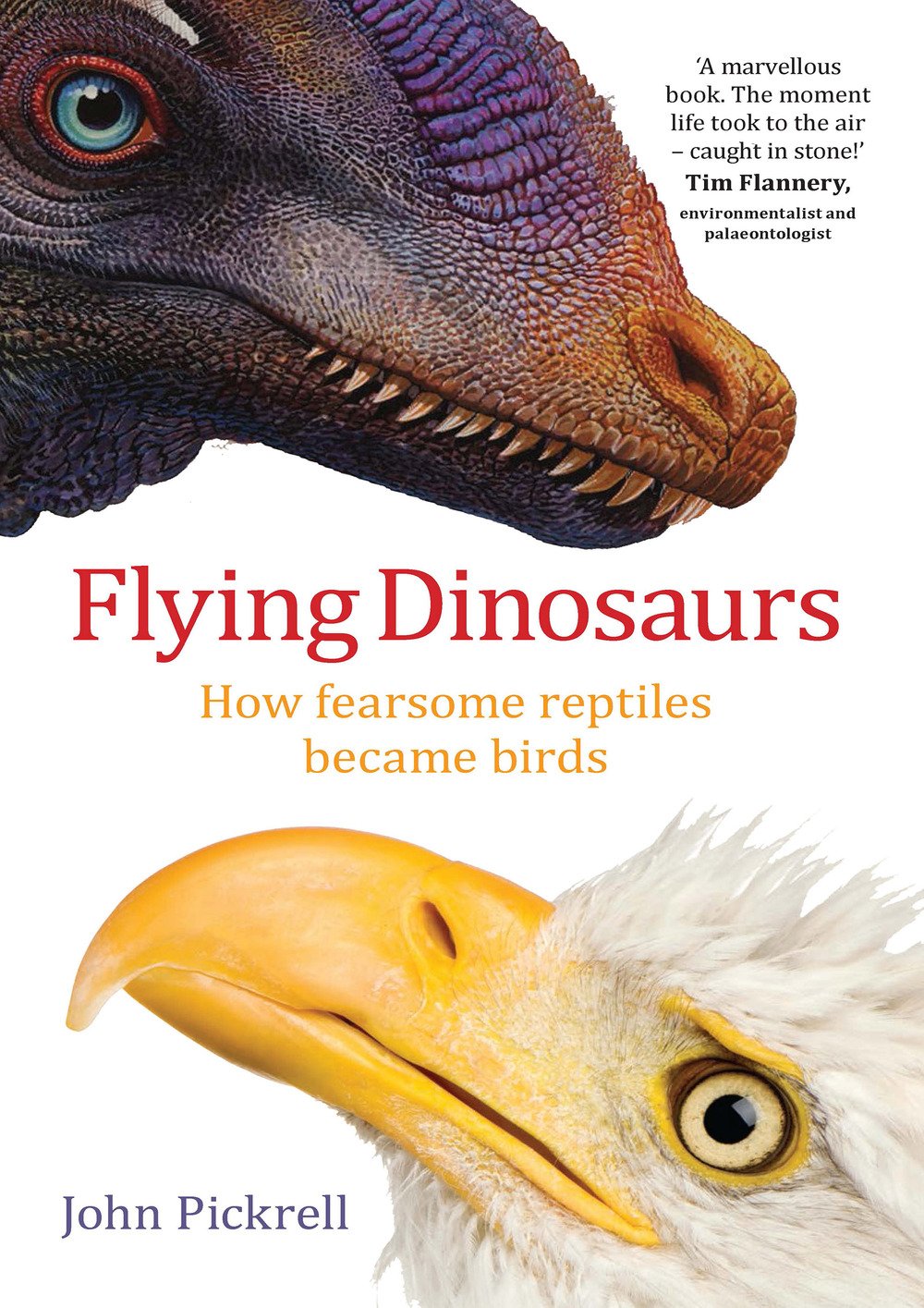
Flying Dinosaurs: how fearsome reptiles became birds by John Pickrell

ReviewChris Watson

NB: There is an analogue of Godwin’s Law that operates in vertebrate palaeontology. It is enacted whenever someone begins to speak or write about feathered dinosaurs. It states that that person will eventually use a form of the phrase ‘ruffled feathers’. In writing a review of a book that deals, primarily, with our not-entirely-recent knowledge of feathered dinosaurs, it seems particularly pertinent to get this out of the way in case I ruffle some feathers myself. Ruffled feathers. There.

*****

When Jurassic World director Colin Trevorrow decided to go to his Twitter account to say something about the pending fourth instalment of the Jurassic Park franchise, he may not have appreciated how many feathers he would ruffle. More likely though, it was a crudely-veiled marketing ploy and ruffling feathers was precisely his aim.

In a tweet that will live in infamy, on the 21st of March 2013, @colintrevorrow stated simply, “No feathers. #JP4”.  I needn’t go into the myriad reasons this decision was a load of old bollocks, as zoologist, writer and Tetrapod Zoology blog/podcast/conference impresario, Darren Naish covered the “No feathers” tweet nonsense more adeptly in his article for CNN Online, than I could here. But it’s a fitting reminder that the things you see in the media and even in some books, don’t necessarily have anything to do with scientific consensus. Anthropogenic climate change, the theory of evolution, and the living appearance of dinosaurs are just some of the topics that most scientists have reached an agreement on some time ago, but which are apparently still fair game to be drawn before the court of the masses and debated by the uninformed for the consumption of the unaware (to the chagrin of whoever’s left).

Jurassic World's dinosaurs lack authenticity - and feathers - John Pickrell in the SMH

But, unlike climate change and evolution (which I’d go as far as saying are common knowledge), you could be forgiven for not being bang up-to-date with your reading of vertebrate palaeontology over the last 45 years. Unless you foster a particular interest in birds or dinosaurs or both (not unusual), the advances in our understanding of the fossil record and origins of these groups of animals may have slipped past unnoticed. And if you missed this, then the 'Dinosaur Renaissance', in our understanding of how they appeared in life, may have passed you by also. It certainly passed me by. My childhood obsession with dinosaurs in the 1980s was fed by books full of (even then) erroneous depictions of dinosaurs as lumbering, ‘shrink-wrapped’, pachydermic beasts whose extinction, perhaps even without the benefit of hindsight, seemed inevitable.

Artistic Depictions of Dinosaurs Have Undergone Two Revolutions - Darren Naish on his Tetrapod Zoology blog at Scientific American

How handy then, to have a single source, John Pickrell’s Flying Dinosaurs, which offers us the ultimate catch up on modern perceptions of dinosaurs. Released in June 2014, this book takes the reader through the many discoveries of fossilised feathered-things to date. From the first find of Archaeopteryx lithographica in 1861 to the numerous feathered fossils that have been uncovered in China since 1996, we get the story behind each discovery and illumination of their significance to the bigger story… and what a story.

The big news, and the story that Flying Dinosaurs really seeks to tell, is that… [SPOILER ALERT] … dinosaurs never truly went extinct at all and are still among the most commonly encountered animals living among us.

Yes, there was a mass-extinction around 66 million years ago, associated with the massive impact at Chicxulub on the Yucatán Peninsula (and I was warmed to see that Australia's impact crater at Tnorala [Gosse Bluff] near Alice Springs even gets a mention on p. 169). But among the animals that survived the cataclysmic Cretaceous-Palaeogene boundary were the theropod dinosaurs that are the direct ancestors of modern birds; ergo, birds are dinosaurs.

Tnorala - the 142.5 million years old comet impact crater west of Alice Springs, Northern Territory

In fact, this is not particularly new knowledge. The close relationship between birds and dinosaurs was postulated by Thomas Huxley shortly after the first Archaeopteryx discovery in 1861, and it has been the generally accepted consensus that birds descended from some kind of dinosaur since the 1970s. The exact nature of the evolution of flight in birds is still being tossed back and forth between a few schools of thought, but the science of the theropod dinosaur ancestry of modern birds is as settled as it can be.

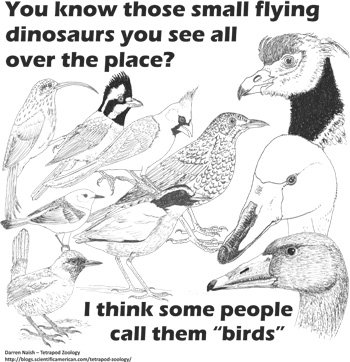
UK-based zoologist and author Darren Naish does a good line in t-shirt designs spreading the word. All the coolest birders buy them online at the Tet Zoo Red Bubble store - image by Darren Naish

Pickrell writes engagingly about sometimes technical scientific subjects. This won’t surprise anyone who has read his work as editor of Australian Geographic or in numerous other journals and magazines before that. It’s one thing to write well about a topic you understand yourself, but it’s another talent altogether to bring the layperson to a level of understanding that might allow them to enjoy the elegance of hard-won scientific knowledge. Flying Dinosaurs navigates the specialised terminology and mind-bending complexity of phylogenetic systematics (cladistics), without lapsing into unintelligible jargon or languishing too long on esoteric concepts. This is an achievement in itself. In the popular science genre there is a fine line trod between patronising the reader and skimping on crucial facts. While I wouldn’t class myself as a layperson in this field necessarily, I found my own knowledge being constantly revised, updated and deepened.

Flying Dinosaurs does for avian evolution what Carl Sagan’s Cosmos did for cosmology. It takes a large and complex subject and streamlines decades of technical work by specialists in a variety of disciplines into a well-crafted story, more easily comprehended by the rest of us. It loses none of the authority of a peer-reviewed paper as every claim and proposition is referenced. In many ways this is the finished product of science; the field work has been reported on, the technical work completed, the laboratory tests and models confirmed, the knowledge verified and the key conclusions are finally rendered plain for the rest of us to appreciate. Surely there can be no higher aim for science writing, popular or otherwise, than to bring all of us to a higher level of understanding of the nature of our universe and the world we live in.

Flying Dinosaurs certainly delivers on this aim. This is science communication at its best, and deserves to be widely enjoyed.

Flying Dinosaurs is published by Newsouth Publishing

You can follow the author on Twitter @john_pickrell

Buy it from Andrew Isles

Related Links

http://phenomena.nationalgeographic.com/2013/03/20/a-velociraptor-without-feathers-isnt-a-velociraptor/

http://edition.cnn.com/2015/06/11/opinions/naish-jurassic-world-missed-opportunity/

http://blogs.scientificamerican.com/tetrapod-zoology/aristic-depictions-of-dinosaurs-have-undergone-two-revolutions/

http://m.nzherald.co.nz/entertainment/news/article.cfm?c_id=1501119&objectid=10876135